Rangoli is the Indian art of drawing auspicious patterns on floors and thresholds — made fresh in rice flour or colour, and known by many names. The word comes from the Sanskrit rangavalli — ranga, colour, and āvali, a row or creeper: a row of colours. Across India the same morning gesture carries different names and materials — kolam in Tamil homes, muggulu in Telugu ones, alpana, mandana, pookalam and more — one family of arts, drawn at the door.
This guide explains what rangoli is, why it is drawn, what it is called across the country, and how the dot-grid method behind most South Indian designs works — from the team behind more than 3,000 step-by-step video tutorials.
Why rangoli is drawn
Tradition gives the morning drawing several kinds of meaning at once. The threshold is marked as clean, cared-for and auspicious — a welcome to guests and, at festival time, to the goddess Lakshmi, whom the decorated doorstep is traditionally held to invite. Drawn in rice flour, the pattern is also an act of quiet hospitality: the flour feeds ants and small birds, so the household’s day is traditionally said to begin with a gift.
And the drawing is deliberately temporary. Feet cross it, wind takes it, and the next morning it is made again. That impermanence is not a flaw but the point — a daily renewal, practised for as long as anyone’s grandmother can remember.
A history told honestly
Many pages will tell you rangoli is exactly five thousand years old, or name the ancient text it first appears in. We won’t — because no one honestly can. Floor-drawing is a household art, passed from mother to daughter by hand and swept away each day; it left no monuments to excavate and no dated first edition. What is documented, everywhere and continuously, is the practice itself: the unbroken habit of beginning the day by making something beautiful at the door. Its origins are older than any record of them — and that, told plainly, is the truest history available.
One art, many names
Rangoli is the umbrella word most of India uses. Region by region, the art carries its own name — and in some places, its own materials and method entirely:
| Name | Where | Note |
|---|---|---|
| Kolam | Tamil Nadu | Rice-flour dot-grid designs, drawn daily at dawn; the pulli kolam is the dot-grid form |
| Muggu / Muggulu | Andhra Pradesh, Telangana | The Telugu tradition; dot-grid designs are chukkala muggulu, at their peak in the Sankranthi month |
| Rangavalli / Chukki rangoli | Karnataka, Maharashtra | The word behind “rangoli” itself; chukki and thipke are the Kannada and Marathi words for the dots |
| Alpana | Bengal, Assam | Freehand rice-paste painting — a sibling art, drawn without a dot grid |
| Aipan | Uttarakhand | White rice paste on red ochre — a sibling art of ritual patterns |
| Jhoti / Muruja | Odisha | Rice-paste and powder floor art — sibling traditions |
| Aripana | Bihar (Mithila) | Ritual rice-paste diagrams — a sibling art |
| Mandana | Rajasthan, Madhya Pradesh | Lime on red ochre, on floors and walls — a sibling art |
| Chowk purana | Uttar Pradesh belt | Ritual squares drawn for ceremonies — a sibling practice |
| Pookalam | Kerala | Circular flower-petal carpets for Onam — a sibling art in a different material |
This site’s collections belong to the dot-grid family — kolam, muggulu and their cousins. The sibling arts above are part of the same story, told here so the map is complete.
The dot-grid method
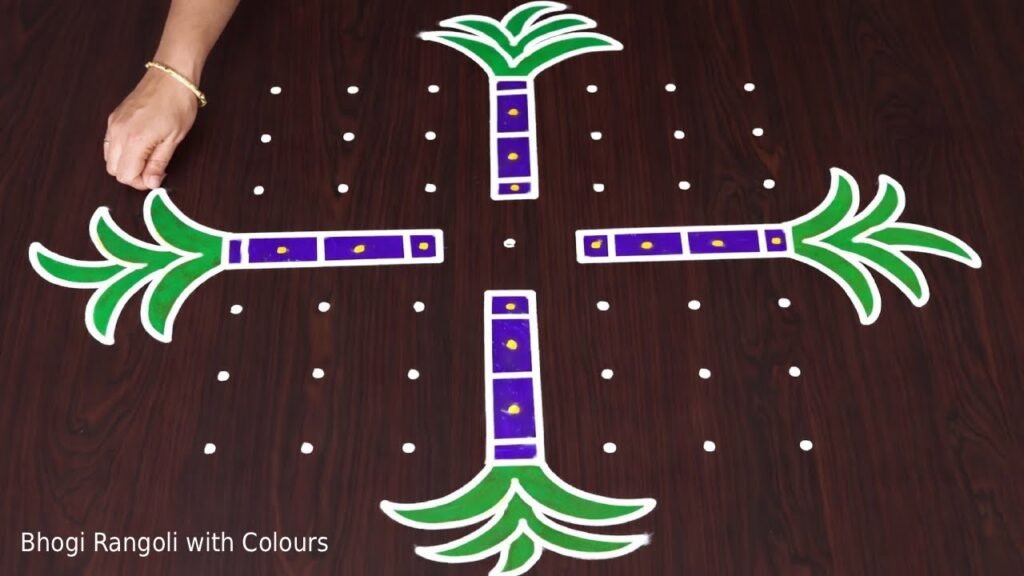
Most South Indian designs begin the same way: a grid of dots is set down first — pulli in Tamil, chukkalu in Telugu, chukki in Kannada, all meaning dot — and the design is then drawn around or through them. The grid does the geometry: place 25 dots in a five-by-five square and symmetry comes almost by itself.
Grids are named by their dots. A “5 to 5 dots” design is a square of five rows with five dots each; our 5 to 5 dots guide and 6 to 6 dots guide explain the square grids step by step, and descending grids (like 7-to-1) shrink row by row into a diamond. In Tamil practice, aligned rows are ner pulli and staggered rows idukku pulli — two ways of laying the same dots.
The festival seasons
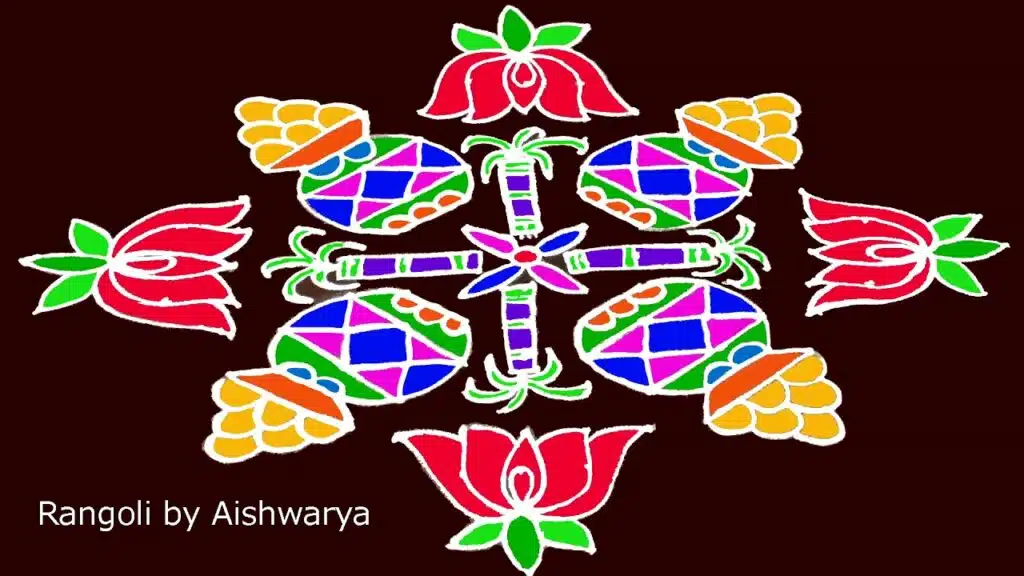
Rangoli has a calendar. Its greatest month is the mid-December to mid-January stretch — Margazhi in Tamil, Dhanurmasam in Telugu — when designs grow larger every dawn and culminate in the harvest festivals: Bhogi, the shared opening day; Pongal in Tamil homes; Sankranthi in Telugu ones — one harvest moment, two traditions, a pot at the heart of each. Diwali brings rangoli to thresholds across all of India, in colour and lamplight; and through the rest of the year the art simply continues, one modest morning drawing at a time.
How to begin
Start small and square. A 25-dot grid — five rows of five — is the traditional first canvas: quick to set, forgiving to learn on, and the basis of hundreds of real designs. Watch one drawn from start to finish, then draw along; that is how the art has always been taught, hand watching hand. The 5 to 5 dots collection is the place to begin, and if you’d like a nudge before each festival season, there’s one email per season — nothing more.
Quick answers
What is rangoli? The Indian art of drawing auspicious patterns on floors and thresholds, traditionally in rice flour or coloured powders — from Sanskrit rangavalli, “a row of colours.”
Are rangoli, kolam and muggulu the same thing? They are one family. Rangoli is the umbrella word; kolam is the Tamil tradition and muggulu the Telugu one, both built on the dot-grid method.
Why is rangoli drawn? Tradition holds it marks the threshold as auspicious and welcoming, begins the day with an act of care — the rice flour traditionally feeding small creatures — and embraces renewal: swept away today, drawn again tomorrow.
How long does it take to learn? Following a video, a first small design can be drawn the same day. The fluency that draws freely from memory comes the way it always has — daily practice, one grid at a time.
When is rangoli drawn? Traditionally every morning in much of South India, with the largest designs in the mid-January harvest season and at Diwali.