Definition
Rangoli is the umbrella name for India’s threshold and floor-drawing arts: temporary designs made by hand on prepared ground, most often at the entrance of a home, from dry powders, pastes, and petals. The word — connected with rang, colour — has become the pan-Indian term for a practice that every region keeps under its own name and in its own style, from the Tamil kolam to the Bengali alpana.
Three properties define the practice everywhere it appears. It is temporary: made to be erased by feet, wind, and the next morning’s sweeping, and renewed rather than preserved. It is hand-drawn: powder trailed between the fingers or paste applied by fingertip, without stencils at its traditional core. And it is placed: overwhelmingly drawn at boundaries and thresholds, where the household meets the world. Everything else — scale, colour, geometry, occasion — varies; those three hold.
History
Rangoli’s history must be read through an honest constraint: an art whose works erase themselves daily leaves almost nothing to excavate, so no ancient examples survive and none ever could. The record is instead indirect — literature attesting decorated thresholds and ceremonial ground-preparation, artistic depictions of prepared space, and above all the continuity of living practice, transmitted within households across generations. The historical method this demands, and the era-by-era story it yields, are treated in this encyclopedia’s history chapter.
The documented era is recent and rich: the practice has been photographed since cameras reached India, and studied closely since the twentieth century — the Hyderabad muggu ethnography of 1985 and the decades of Tamil kolam fieldwork culminating in Nagarajan’s 2018 study anchor the scholarly record, joined by a mathematical literature that has analysed the southern grid designs since 1974. Few folk arts anywhere carry a research bibliography of comparable quality, and this encyclopedia cites only that verified core.
Description
The materials are deliberately humble: rice flour and white stone powder for the fundamental white line; chalk and lime; coloured powders laid over a white framework for festivals; flower petals for occasions; rice paste, applied wet, in the eastern traditions. Material behaviour shapes regional style — dry powder favours dotted and linear geometry, liquid paste favours brushlike curves — and the palette runs from strict white-only austerity to full festival colour.
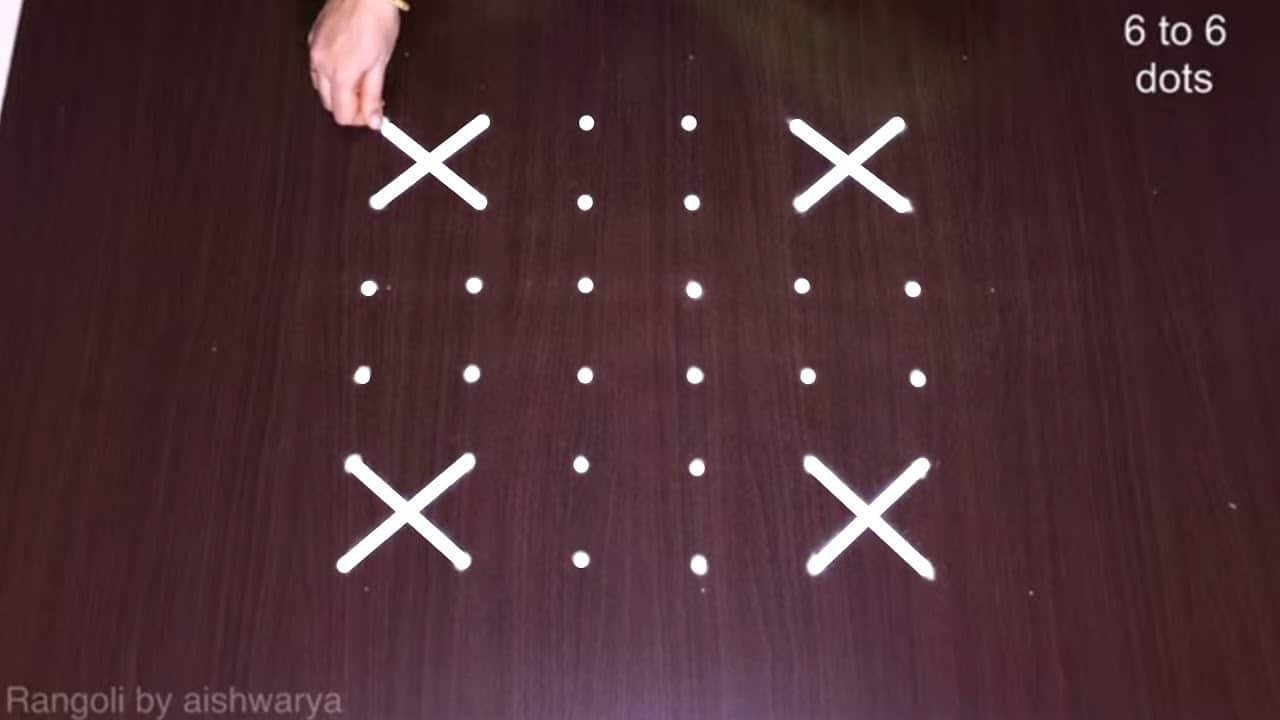
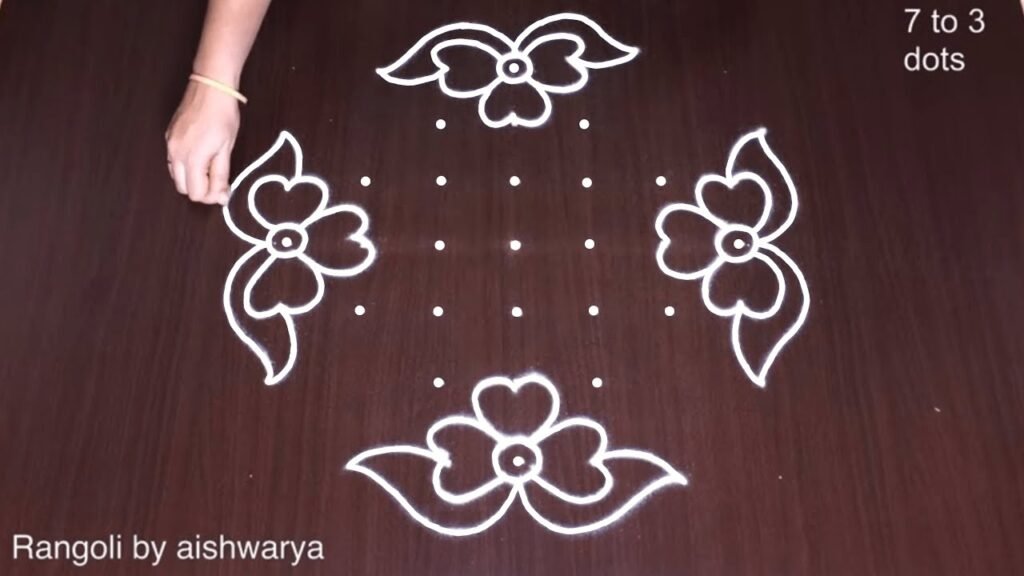
Construction falls into two great modes. Grid-based work lays counted dots first and builds the design on them — connecting the dots or looping around them — producing the disciplined geometry of the southern traditions. Freehand work draws directly: petals, vines, birds, lamps, and borders composed by eye. Most regional styles keep both, and a third axis crosses them: the daily register, modest designs renewed each dawn, and the festival register, where the same practice expands into street-scale colour. The vocabulary the designs carry — lotus and peacock, lamp and kalash, star and spiral — descends from two sources, observation of nature and the geometric repertoire, and is catalogued in this encyclopedia’s motifs chapter.
Cultural Context
The practice’s meanings begin with its placement. A drawing at the threshold marks the boundary between home and world and greets everyone who crosses it — a wordless daily statement that the household is awake, ordered, and prepared to receive. The ethnographic record documents these senses in depth: auspiciousness, welcome, protection, the day begun properly. Per this encyclopedia’s standing rule, such meanings are attributed — held by communities of practice — while the drawing itself is the observable fact.
Its deepest philosophical statement is its impermanence. Every rangoli is made in full knowledge that it will not survive the day, and the tradition treats that not as loss but as the point: the practice values the making over the made, renewal over preservation, and what persists is not any design but the knowledge and discipline that produce the next one. The festival calendar supplies the great occasions — Diwali above all, with the harvest festivals of the south and the regional new years — when the daily art becomes public celebration.
Regional Variations
The practice is a family of named traditions, each with its own article or chapter as sources permit: the Tamil kolam with its dot-grid and knot systems; the Telugu muggulu with its Sankranti street-scale; Karnataka’s rangavalli; Kerala’s ritual kalamezhuthu; Maharashtra’s rangoli proper; Bengal’s rice-paste alpana; Odisha’s jhoti chita; Rajasthan’s ochre-ground mandana; Kumaon’s aipan; Mithila’s aripan; Gujarat’s sathiya; the chowk poorana of the Gangetic plain. The names differ, the materials follow the local landscape, and the balance between daily and ceremonial differs — yet the family resemblance is unmistakable: ordinary ground made meaningful through temporary art.
What unites them runs deeper than technique. Nearly every tradition is household-transmitted — carried historically by women, taught by watching and doing — bound to threshold or ceremony, and drawn from local materials. This encyclopedia’s comparative chapter treats the family as a whole; the regional chapters treat each tradition on its own terms.
Related Topics
The two most documented member traditions are Kolam and Muggulu; the structural foundation is the Dot Grid; the practice’s placement is the subject of the essay The Threshold; the family resemblance across traditions is drawn in One Idea, Many Languages.
Gallery
References
- Vijaya Nagarajan, Feeding a Thousand Souls: Women, Ritual, and Ecology in India — An Exploration of the Kōlam, Oxford University Press, 2018.
- Marcia Ascher, “The Kolam Tradition”, American Scientist 90(1), 2002.
- Jyotsna Kilambi, “Toward an Understanding of the Muggu: Threshold Drawings in Hyderabad”, RES: Anthropology and Aesthetics 10, 1985.
Further Reading
- Marcia Ascher, Mathematics Elsewhere: An Exploration of Ideas Across Cultures, Princeton University Press, 2002 — the kolam chapter places the practice in world ethnomathematics.
This entry publishes at Evidence Level E2: its claims rest on at least two independently verified sources.
Cite this entry: “Rangoli.” Rangoli Encyclopedia, Rangoli Designs, https://rangolidesigns.net/encyclopedia/rangoli/ — a permanent URL under the encyclopedia’s stable-identity policy. Entry last reviewed 2026-07-28.