Definition
Kolam is the Tamil tradition of drawing geometric threshold designs in rice flour, practiced daily at dawn in Tamil Nadu and among Tamil communities worldwide. It is the most intensively studied member of the rangoli family, distinguished by its dot-grid foundations and its repertoire of continuous-line forms.
History
The kolam is transmitted as embodied knowledge: girls learn at the threshold beside their mothers and grandmothers, building a memorised repertoire that scholars record in the hundreds of designs per practitioner. Its documented study spans anthropology and mathematics — from Jyotsna Kilambi’s and Vijaya Nagarajan’s ethnographies of threshold drawing to the formal-language analyses begun in the 1970s by Gift and Rani Siromoney, who showed kolam families could be generated by array grammars.
Description
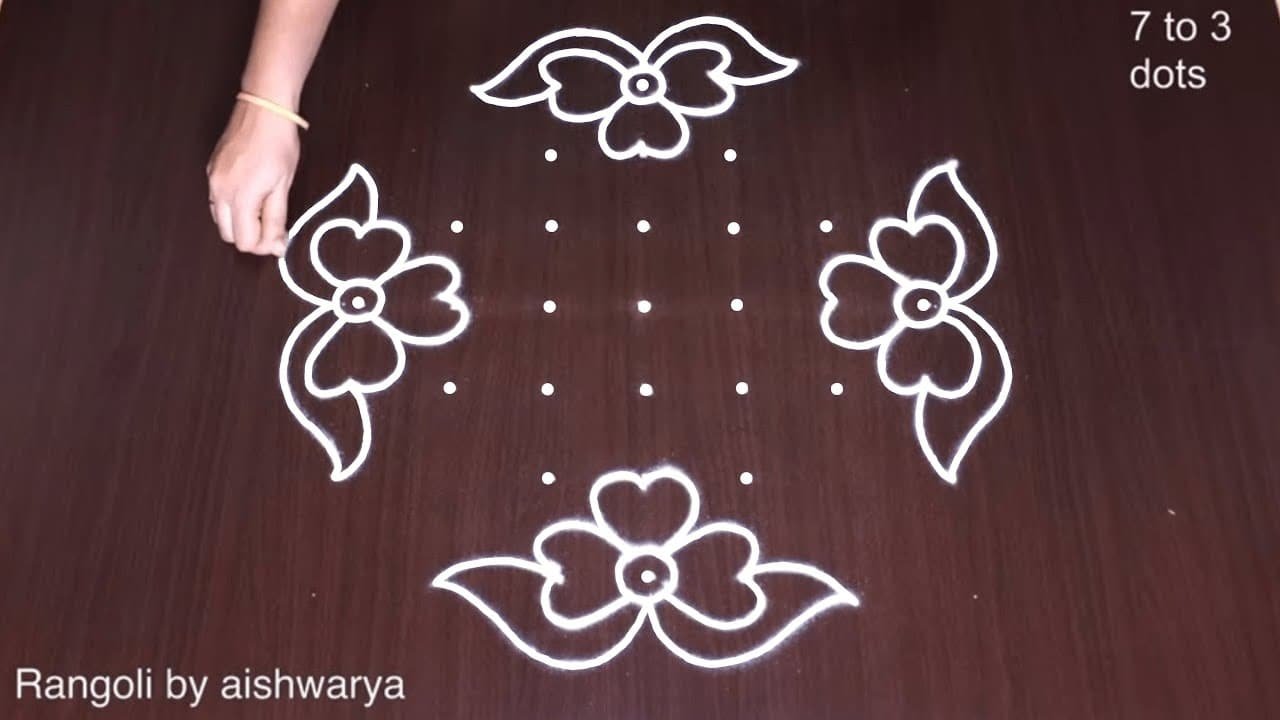
A kolam begins before sunrise on ground that has been swept and often dampened. The practitioner lays a grid of dots (pulli), then draws lines that connect the dots or loop around them, trickling dry rice flour in an unbroken motion. Daily kolams are white and take minutes; Friday and festival kolams grow elaborate, and in the month of Margazhi very large kolams fill the street before each house. By evening the design is gone — walked into the day it opened.
Cultural Context
Practitioners commonly describe the kolam as an auspicious welcome and a marker of the household’s well-being; its absence traditionally signals mourning. Nagarajan documents the widely held understanding of the rice-flour kolam as a morning offering to small creatures, and situates the practice as women’s public, ephemeral art — authorship on display to the whole street, renewed daily. In the interlaced forms, the unbroken line is often spoken of as binding or protective; these meanings are attributed, and vary by family and place.
Regional Variations
Within Tamil practice the major structural families are the pulli kolam, drawn by connecting a dot grid, and the sikku kolam, whose line weaves around the dots without touching them. Freehand and hybrid forms coexist with both. The neighbouring Telugu tradition, muggulu, shares the dot-grid method with its own vocabulary and festival calendar.
Related Topics
The parent practice is described in Rangoli. For the two structural families, see Pulli Kolam and Sikku Kolam; for the Telugu counterpart, Muggulu.
Gallery
References
- Vijaya Nagarajan, Feeding a Thousand Souls, Oxford University Press, 2018.
- Marcia Ascher, “The Kolam Tradition”, American Scientist 90(1), 2002.
- Gift Siromoney, Rani Siromoney & Kamala Krithivasan, “Array grammars and kolam”, Computer Graphics and Image Processing 3(1), 1974.
Further Reading
- Kiwamu Yanagisawa & Shojiro Nagata, “Fundamental Study on Design System of Kolam Pattern”, Forma 22, 2007.