Definition
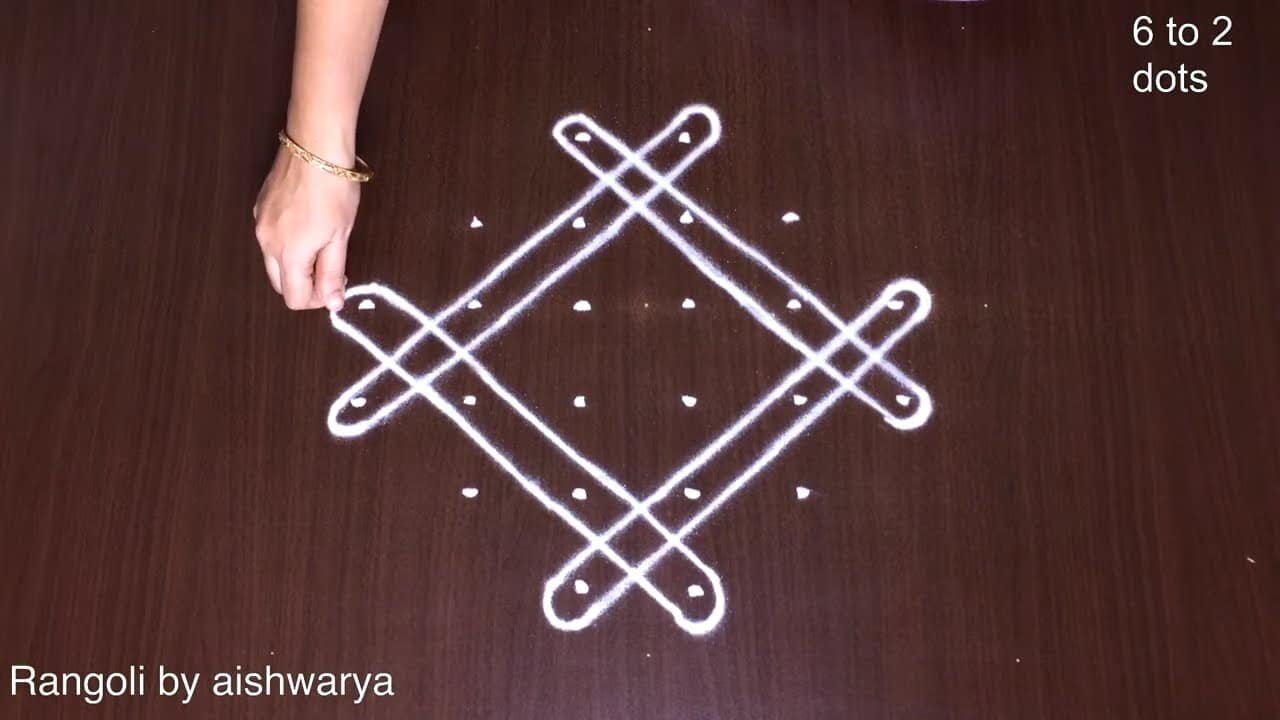
Sikku kolam — “knot” or “tangle” kolam, also called chikku — is the interlaced family of the Tamil kolam: a continuous line that winds around a grid of dots without touching them, crossing over itself to form a woven, knot-like pattern. In the ideal form prized by practitioners, a single unbroken loop encloses every dot and returns to its start.
History
The sikku family is the kolam’s most mathematically celebrated branch. The Siromoneys’ array-grammar work generated sikku classes formally; Ascher analysed their single-line structure within world ethnomathematics; and later studies — including Yanagisawa and Nagata’s design-system analysis — connected sikku construction to knot diagrams and Eulerian paths, the same mathematics that asks whether a figure can be drawn without lifting the pen.
Description
The practitioner lays the pulli grid, then draws a line that passes diagonally between dots, curving around each and crossing earlier strands at clean intersections. The line never touches a dot and, in the strict form, never ends: drawn in one motion, it closes on itself with every dot enclosed. Larger sikku designs may use several closed loops; reducing their number toward one is part of the form’s difficulty. The finished kolam reads as a weave — over, under, over — though it lies flat in flour.
Cultural Context
The unbroken line carries the family’s attributed meanings: practitioners and scholars alike record it described as continuity, as protection — a boundary with no gap for misfortune to enter — and as a meditation, since the drawing demands the whole path be held in mind. Nagarajan documents sikku kolams among the forms drawn at thresholds precisely for these voiced qualities. As throughout, the geometry is observable; the meanings are held.
Regional Variations
Interlaced dot-grid drawing is strongest in Tamil practice, but the method travels: knot-style designs appear in Telugu muggulu repertoires, and single-line traditions elsewhere — from Celtic knotwork to Vanuatu sand drawing — are the sikku kolam’s frequent comparators in the scholarly literature, a resemblance of structure rather than of lineage.
Related Topics
The parent tradition is Kolam; the counted-grid sibling is Pulli Kolam; the umbrella practice is Rangoli.
Gallery
Gallery images will be added as the design library grows for this tradition.
References
- Marcia Ascher, “The Kolam Tradition”, American Scientist 90(1), 2002.
- Gift Siromoney, Rani Siromoney & Kamala Krithivasan, “Array grammars and kolam”, Computer Graphics and Image Processing 3(1), 1974.
- Kiwamu Yanagisawa & Shojiro Nagata, “Fundamental Study on Design System of Kolam Pattern”, Forma 22, 2007.
Further Reading
- Vijaya Nagarajan, Feeding a Thousand Souls, Oxford University Press, 2018.