

Definition
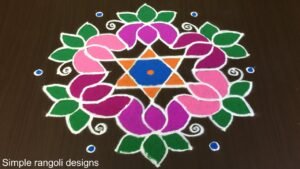
The lotus is the most widespread flower motif in rangoli: a radially symmetric bloom of four, six, eight, or sixteen petals, drawn open as if seen from above. It appears at every scale — as the centre of a small daily design, as a border unit, as a corner embellishment, and as the organising form of large festival compositions.
The drawn flower refers to the sacred lotus (Nelumbo nucifera), the aquatic plant whose blossoms rise on upright stems above the water rather than floating on it. Its natural structure — symmetrical petals radiating from a prominent circular centre — is already a rangoli diagram before any stylisation begins, which is much of the reason the motif organises compositions so readily.
History
The lotus is a foundational form across Indian sacred and decorative art: it recurs through sculpture, temple architecture, coins, manuscripts, murals, and textiles across more than two millennia, and it crosses religious boundaries — Hindu, Buddhist, and Jain traditions all employ it, each reading its own meanings into the shared form. No other flower carries a comparable weight in the subcontinent’s visual record.
Within the threshold arts specifically, the ethnography records the lotus among the standard repertoire elements practitioners learn early. Its petal geometry maps naturally onto both dot grids and radial freehand work, so the form arrives almost as soon as the grid does — a four-petal bloom is among the first designs a learner can complete correctly.
Description
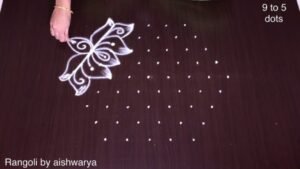
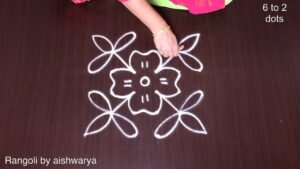
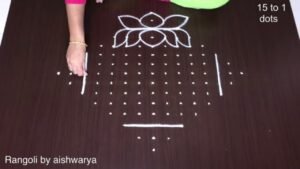
Drawn on a grid, the lotus emerges from symmetric dot-connections — petal tips at the outer dots, a small square or circle at the heart. Freehand, it is built petal by petal around a centre. Petal counts follow the composition’s order: fourfold on square grids; six-, eight-, and sixteenfold in radial layouts. The eight-petal form is the workhorse of the family, balanced enough to anchor a design of almost any size.
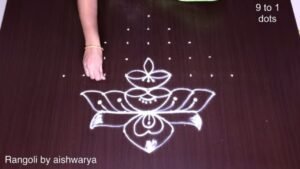
The construction logic is worth stating, because it explains the motif’s reach. Each petal is a pair of mirrored arcs meeting at a tip; the flower is that unit repeated by rotation around a marked centre, which is exactly the operation — one element, turned and repeated — that rangoli’s radial grammar is built on. A practitioner who can draw one clean petal can draw the whole flower at any count the grid supports, and the open centre left inside the petals becomes the natural seat for a dot, a lamp, or a written blessing. The lotus is, in this sense, the radial structure taught by example.
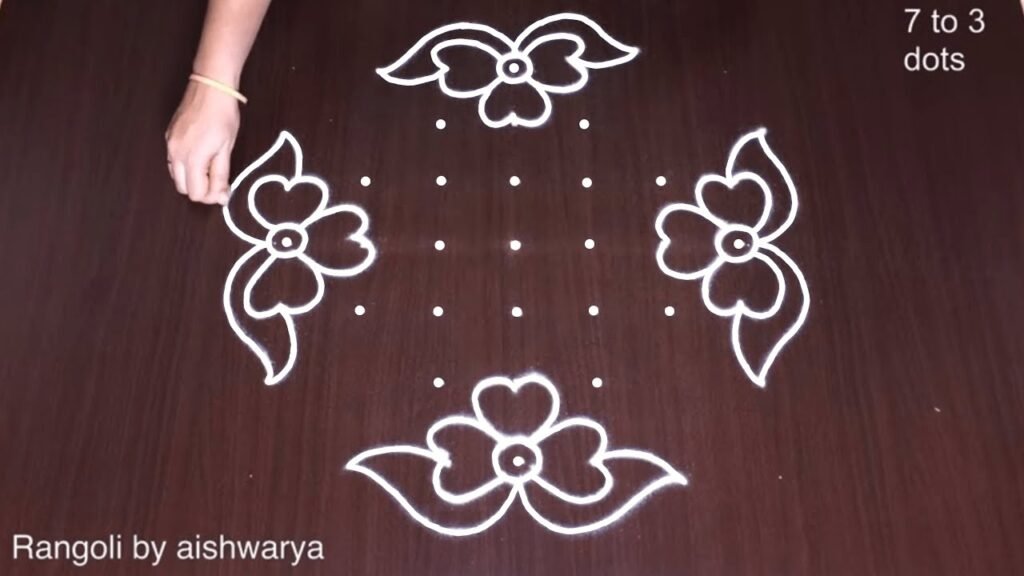
Artists move freely between naturalistic and stylised registers. Naturalistic lotuses keep the flower’s botanical profile; stylised and geometric lotuses simplify it toward pure radial ornament — petals as pointed ellipses, the centre as concentric circles — because geometric clarity strengthens symmetry and reads cleanly at threshold scale. Both registers remain instantly recognisable as the same flower.
The variation catalogue tracks scale and occasion. Four-petal blooms suit small daily designs and grid corners; eight-petal forms anchor mid-size compositions and supply the classic centre for radial festival work; sixteen-petal lotuses organise large ceremonial designs, their doubled symmetry filling the space between centre and border. Highly ornamental interpretations exaggerate the petals into pure decoration; the identity survives because the radial logic — petals around a marked centre — is the motif’s true signature.
Cultural Context
The lotus’s symbolic career begins with an observation: the plant grows in muddy water and produces immaculate flowers. From that fact, centuries of reflection drew meanings of purity amid imperfection, spiritual growth, renewal, and transcendence — the possibility of rising clean above one’s circumstances. Philosophical literature extends the image to the mind itself, comparing awakening understanding to a bud unfolding. These are attributed meanings, and communities hold several of them at once; the drawn form carries them without insisting on any single reading.
In Hindu iconography the flower accompanies Lakshmi, who stands or sits upon an open lotus, and the white lotus is associated with Saraswati; traditional narratives also describe Brahma emerging on a lotus from Vishnu’s navel. Through the Lakshmi association above all, the motif became a fixture of prosperity-facing occasions: Diwali and Lakshmi Puja, Navaratri, weddings, housewarmings, and harvest festivals. A lotus at the centre of a threshold design communicates auspicious welcome before any other symbol is read.
The philosophical register runs deeper than iconography. The flower’s gradual opening at sunrise supplied Indian literature with one of its most durable metaphors — wisdom unfolding petal by petal through patience, discipline, and experience — and the image travelled with Buddhism across Asia, where the lotus throne and lotus emblem carried the same essential sense of awakening rising clean of its surroundings. Jain art employs the flower in manuscript and temple ornament with its own inflections. One flower, many traditions: few symbols cross doctrinal lines so easily while keeping their core meaning intact.
Modern botany added a footnote the tradition would recognise: the leaf’s microscopic surface causes water to bead and roll away carrying dirt — the “lotus effect” now studied in materials science. The observation that made the flower a symbol of purity was accurate all along.
Regional Variations
Every tradition draws it. Tamil kolam renders the lotus in dotted and interlaced forms; Telugu muggulu set it in chukkala grids and enlarge it for Sankranti; northern and western Diwali rangoli favour coloured freehand blooms; the rice-paste traditions of the east paint it in flowing line. The motif crosses traditions as easily as the festivals it serves, changing construction method while keeping its identity — the same flower spelled in different scripts.
Related Topics
Lotus compositions typically take the Radial Structure; the lamp it often surrounds is the Diya; its frequent festival setting is Diwali; the umbrella practice is Rangoli.
Gallery
References
- Vijaya Nagarajan, Feeding a Thousand Souls: Women, Ritual, and Ecology in India — An Exploration of the Kōlam, Oxford University Press, 2018.
Further Reading
- Marcia Ascher, “The Kolam Tradition”, American Scientist 90(1), 2002.
This entry publishes at Evidence Level E1: common knowledge within the tradition, anchored to a verified standard reference.
Cite this entry: “Lotus.” Rangoli Encyclopedia, Rangoli Designs, https://rangolidesigns.net/encyclopedia/lotus/ — a permanent URL under the encyclopedia’s stable-identity policy. Entry last reviewed 2026-07-28.