Definition
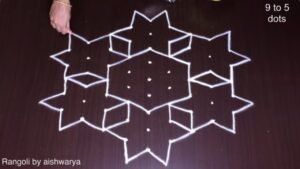
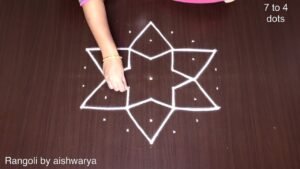
The star motif renders radiating points around a centre — most canonically eight of them, the form Indian tradition ties to the ashtadala, the eight-petalled lotus of stylised geometry. Stars appear as central emblems, as layered mandala foundations, and as repeated border units, and the eight-pointed construction doubles as one of rangoli’s fundamental working methods: divide the field into eight, and the rest of the composition follows.
The motif sits exactly on the boundary between figure and structure. Drawn small, it is an ornament among ornaments; drawn as a composition’s base, it is the armature everything else grows on — geometry disguised as decoration.
History
Eight-fold symmetry runs through Indian visual culture: temple ceilings and carved panels, stone lattice screens, painted mandalas, manuscript borders, textiles, jewellery, woodwork, and metal craft all return to it. Sometimes the eight points appear explicitly as a star; as often they arrive as an eight-petalled flower or two overlapped squares — the same construction wearing floral or architectural dress. The ashtadala lotus is the tradition’s signature version: each petal at a measured station around the centre, botany conducted by protractor.
The construction’s antiquity has a practical explanation: eight is the division a practitioner can make with nothing but folding logic — halve, halve, and halve again — so eight-fold layouts were achievable at the threshold long before any formal geometry named them. The star was always the accessible precision.
Description
Two standard constructions produce the eight-pointed form: overlapping squares — two equal squares, one rotated forty-five degrees — and radial division — a circle cut into eight sectors, points raised on the axes. Practitioners often begin large mandala compositions exactly this way, the eight divisions laid first and the ornament layered outward. Variant counts appear — four-, five-, six-, and twelve-pointed stars all occur — but the eightfold form dominates because its axes match the grid’s naturally: four cardinal, four diagonal.
In finished designs the star serves three roles: central emblem, establishing balance before surrounding ornament develops; layered pattern, each ring repeating the eight stations at greater radius; and border unit, small stars strung along an edge. Circle-and-star combinations — angular points inside or around curved bands — give compositions their liveliest geometry, movement and stability in one figure.
Cultural Context
The star’s attributed meanings follow its geometry: radiance, balance, completeness, guidance, harmony extended equally in every direction. The form has no front and no favoured side — every ray receives the same weight — and observers have long read that as generosity of order: light shared without preference. The night sky supplies the natural referent and the sense of steadiness; the ashtadala’s petal-reading adds the lotus’s own associations of purity and unfolding. The symbolism is held, never inherent; the drawn form is points around a centre, measured.
The educational register is real and current: eight-fold construction is a standing demonstration of rotational symmetry and angular division, and geometry teaching reaches for rangoli’s stars precisely because the mathematics is visible in the making. Of all the motifs, the star is the one whose drawing most resembles its analysis.
Perception research adds a footnote to the tradition’s instinct: highly symmetric radial patterns are processed with unusual efficiency by the visual system, their balanced organisation reading as order and calm even at great decorative richness. The practice discovered the effect empirically — which is why elaborate compositions so often set an eight-fold figure at the centre first, establishing equilibrium before the ornament develops around it. The star is where a big design goes to keep its balance.
Regional Variations
Star forms appear across every tradition: counted-grid stars in southern kolam and muggulu practice, coloured stellar mandalas in the northern and western festival styles, painted stars in the eastern arts, and rayed figures within the ceremonial diagram traditions. The variety of regional treatments conceals one shared construction — eight stations around a centre — which is why a star drawn anywhere reads everywhere.
Related Topics
The star’s floral twin is the Lotus in its eight-petalled form; its structural family is the Radial Structure and the Dot Grid that stations its points; its celestial companions are the Sun and Moon; its rotational relative is the Swastika.
Gallery
References
- Gift Siromoney, Rani Siromoney & Kamala Krithivasan, “Array grammars and kolam”, Computer Graphics and Image Processing 3(1), 1974.
- Marcia Ascher, “The Kolam Tradition”, American Scientist 90(1), 2002.
Further Reading
- Vijaya Nagarajan, Feeding a Thousand Souls: Women, Ritual, and Ecology in India — An Exploration of the Kōlam, Oxford University Press, 2018.
This entry publishes at Evidence Level E2: its claims rest on at least two independently verified sources.
Cite this entry: “Star.” Rangoli Encyclopedia, Rangoli Designs, https://rangolidesigns.net/encyclopedia/star/ — a permanent URL under the encyclopedia’s stable-identity policy. Entry last reviewed 2026-07-28.