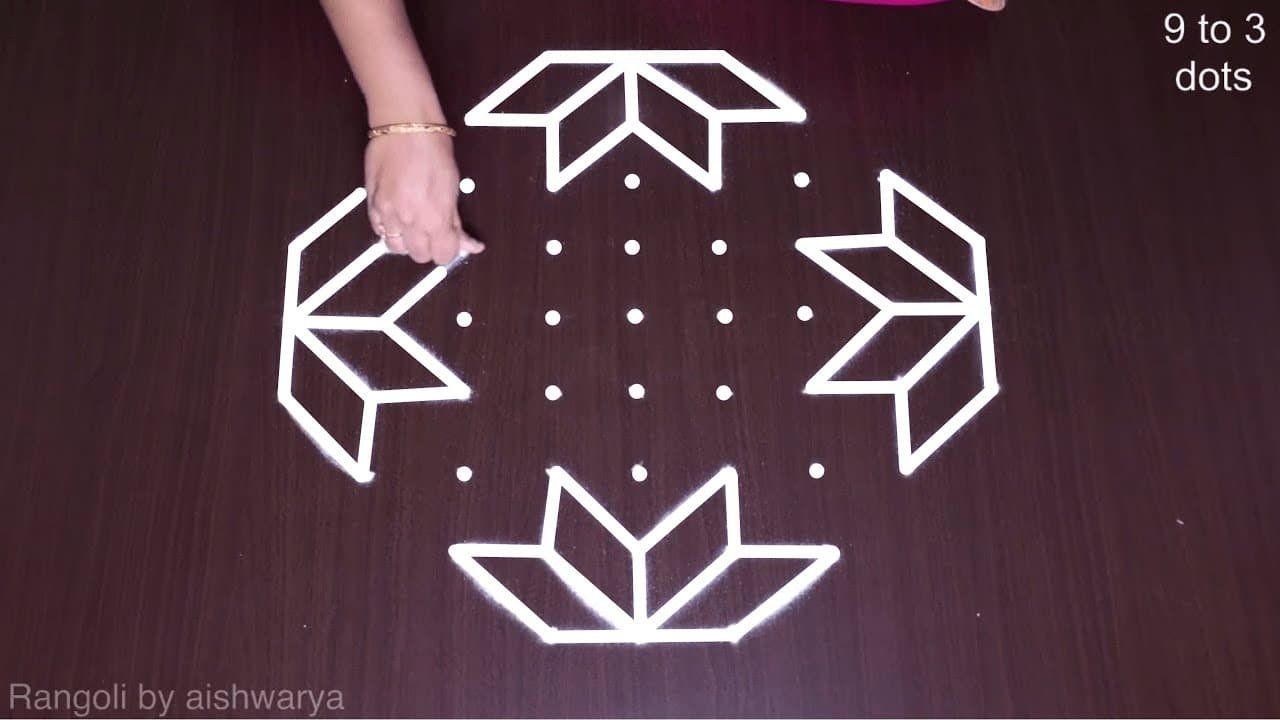
Rangoli could, in principle, be drawn anywhere — a courtyard centre, a rooftop, an interior floor. Overwhelmingly, across regions and centuries, it is drawn at the door. That choice is the practice’s founding philosophical statement, and understanding it explains more about the art than any motif or technique.
A place that belongs to two worlds
The threshold is the one part of a house that faces both ways. It divides outside from inside, public from private, journey from rest — and at the same time it is where those pairs meet: where strangers become guests, where the household steps into the world each morning and returns each evening, where festivals are announced to the street. Tamil practice names that place directly — the vasal, the entrance the morning kolam is drawn upon — and the naming matters: the design belongs to a specific architectural feature, not to a decorative surface chosen at random. The doorway is a boundary that joins as much as it separates, and the drawing placed on it takes on exactly that double character: it marks the edge of the home while extending the home’s care outward.
Liminal ground
The scholarly vocabulary calls such places liminal — transitional spaces that many cultures single out for ceremony, protection, and decoration. Doorways attract ritual attention across the world; India’s distinction is to have made the attention daily, artistic, and renewable. The ethnographic literature on the southern threshold arts — Nagarajan’s study of the Tamil kolam, Kilambi’s account of Hyderabad’s muggu, published under the exact title “threshold drawings” — documents a practice in which marking the boundary each dawn is inseparable from keeping the household’s relations with the world in order.
The first greeting
A threshold drawing is a greeting delivered before any word is spoken. It tells the visitor that the house is awake, swept, and prepared — that arrival has been anticipated. And its audience is radically wide: not the collector or the gallery visitor but everyone who passes — neighbours, schoolchildren, vendors, guests, the household itself returning home. Most art waits to be sought out; this art stands where the day’s traffic already flows. Placed at the one spot everyone must cross, its beauty is offered to the community rather than reserved for the household that made it.
Daily transitions
Because it sits on the boundary, the drawing also marks time. Leaving for work and returning, setting out and coming home, the day’s small departures and arrivals all cross it. The morning drawing acknowledges these ordinary transitions — it says that crossings matter, that the day’s beginning deserves a made thing. The philosophy here is modest and profound at once: meaning is attached not to monuments but to the most repeated movements of ordinary life.
Designing for a doorway
The location shapes the art. A doorway offers limited ground and constant traffic, so entrance compositions developed their own design logic: compact centres placed before the door, symmetrical motifs balancing its two sides, rectangular borders following the frame, designs elegant enough to honour the crossing and practical enough not to obstruct it. The architecture becomes part of the composition — the drawing is fitted to the door the way a verse is fitted to a metre.
The modern threshold
Urban India moved the boundary — apartment landings, school gates, office lobbies, community halls — and the practice moved with it, as it has through every earlier change of architecture. Wherever an entrance means anything, the logic of decorating it survives. The threshold, it turns out, was never really an architectural feature. It is the idea that the place where worlds meet deserves beauty — and that idea fits any door.
References
- Vijaya Nagarajan, Feeding a Thousand Souls: Women, Ritual, and Ecology in India — An Exploration of the Kōlam, Oxford University Press, 2018.
- Jyotsna Kilambi, “Toward an Understanding of the Muggu: Threshold Drawings in Hyderabad”, RES: Anthropology and Aesthetics 10, 1985.
Further Reading
- Marcia Ascher, Mathematics Elsewhere: An Exploration of Ideas Across Cultures, Princeton University Press, 2002.
This entry publishes at Evidence Level E2: its claims rest on at least two independently verified sources.
Cite this entry: “The Threshold: Rangoli at the Boundary.” Rangoli Encyclopedia, Rangoli Designs, https://rangolidesigns.net/encyclopedia/the-threshold/ — a permanent URL under the encyclopedia’s stable-identity policy. Entry last reviewed 2026-07-30.