
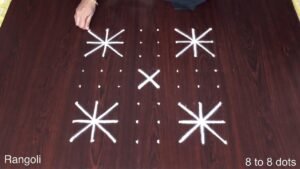
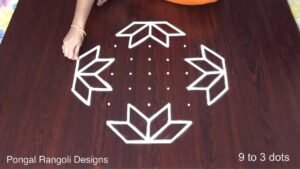
Definition
Margazhi is the Tamil month spanning mid-December to mid-January — the kolam season proper, when the daily practice intensifies into a month of pre-dawn drawing that ends at Pongal. If the tradition has a high season, this is it: the month in which the art is at its earliest, largest, and most public.
History
The month’s special status is central in the ethnography: Nagarajan documents Margazhi as the period when kolams are drawn earliest, largest, and most competitively — the month in which the practice is most visible as a shared public art, and in which much of a practitioner’s repertoire is displayed. The month’s devotional frame is old: Margazhi is the month of dawn worship in the Tamil Vaishnava and Shaiva traditions alike, its early hours prized for temple-going and hymn-singing, and the devotional literature associated with the month — sung before sunrise through its thirty days — belongs to the same pre-dawn hour as the drawing itself.
Description
Households rise earlier than usual; designs go down before first light on washed ground, and their scale rises through the month. Streets acquire a day-by-day gallery as neighbouring thresholds answer one another — a practitioner’s month-long sequence read and remembered by the whole street — and the month’s final mornings carry the largest work of the year in anticipation of the festival. The month also concentrates the tradition’s social life: informal competition, admiration between households, and the transmission that happens when a street’s best hands draw where everyone passes.
Cultural Context
Margazhi is described in Tamil devotional culture as a month of heightened auspiciousness and discipline — a month kept for worship rather than weddings, its dawns for the divine rather than the ordinary calendar — and the dawn kolam is commonly spoken of as its household observance: practice as devotion, kept daily. The month’s cool season and long nights give the drawing its setting; the discipline of rising for it is named by practitioners as part of the observance itself. These framings are attributed to the tradition’s own voices, documented in the ethnography.
Regional Variations
Margazhi is a Tamil observance; the Telugu lands keep the same weeks as Dhanurmasam, escalating toward Sankranti — one season, two vocabularies, two drawing traditions, compared in full in Muggulu at Sankranti. Within Tamil practice the month is kept most fully where street culture survives it: village frontages and temple neighbourhoods carry the classic month-long sequence.
Related Topics
The month culminates at Pongal; the baseline it intensifies is Daily Practice; the tradition it belongs to is Kolam; the social life of the season — skill read from the street — is the subject of A Women’s Art.
Gallery
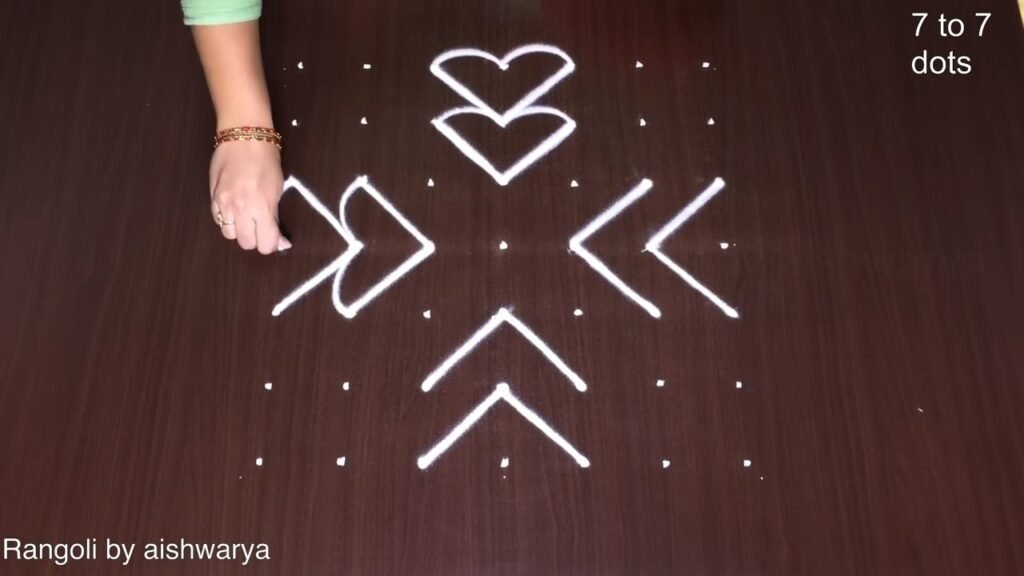
References
- Vijaya Nagarajan, Feeding a Thousand Souls: Women, Ritual, and Ecology in India — An Exploration of the Kōlam, Oxford University Press, 2018.
Further Reading
- Jyotsna Kilambi, “Toward an Understanding of the Muggu: Threshold Drawings in Hyderabad”, RES: Anthropology and Aesthetics 10, 1985.
This entry publishes at Evidence Level E1: common knowledge within the tradition, anchored to a verified standard reference.
Cite this entry: “Margazhi.” Rangoli Encyclopedia, Rangoli Designs, https://rangolidesigns.net/encyclopedia/margazhi/ — a permanent URL under the encyclopedia’s stable-identity policy. Entry last reviewed 2026-07-28.