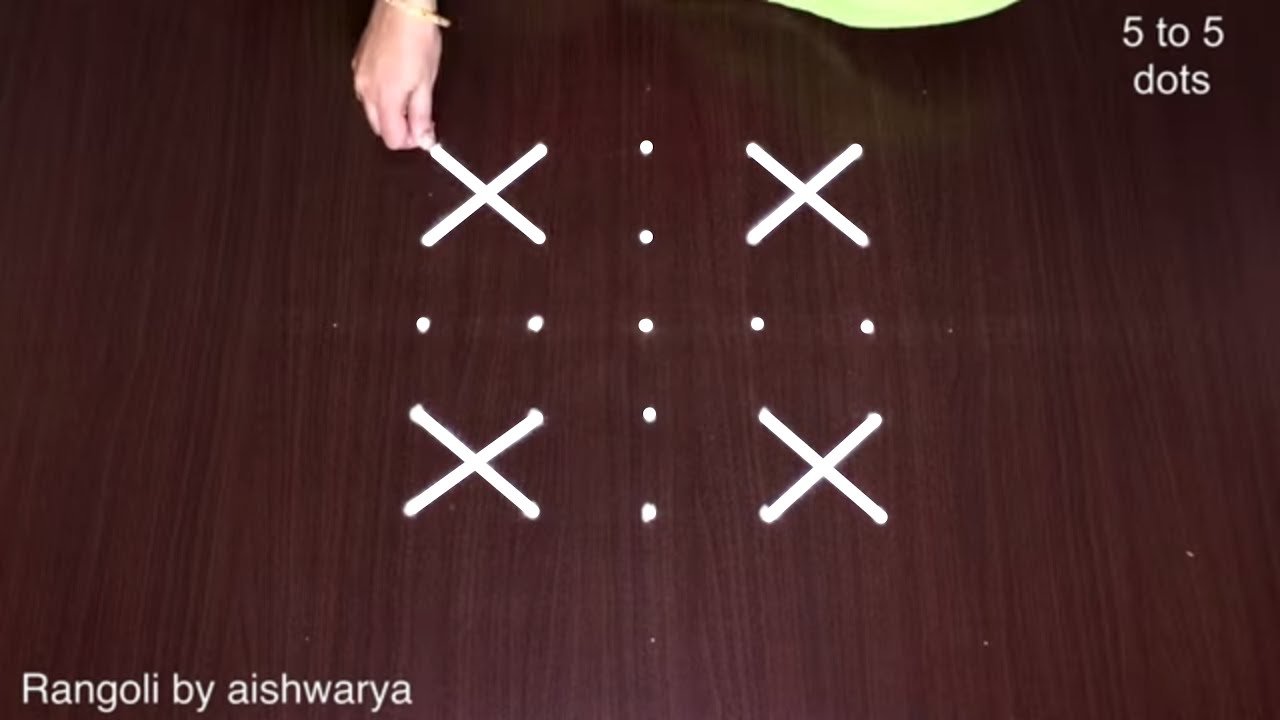
The word that names this entire art form belongs, historically, to one region. Rangoli is the Marathi term — most scholarly explanations connect it to older Sanskrit expressions around colour and pleasing ornament, with the details still debated — and its homeland is Maharashtra and neighbouring western India. As the word travelled and became the umbrella for every Indian floor-art tradition, the practice it originally named carried on at home: one of the most flexible, most visible, and most continuously domestic traditions in the family.
A freehand tradition
Where the southern traditions build on counted dot grids, Maharashtra’s rangoli is predominantly freehand. Designs develop directly from the hand’s judgement — flowing curves under balanced symmetry, floral ornament over geometric frames — and the style’s signature is exactly that combination: compositions that read as structured and spontaneous at once. Practised artists produce strikingly symmetrical work with no measuring instruments at all, by the trained eye alone. The working sequence is consistent enough to state: prepare the surface, fix the centre, establish the symmetry, draw the principal outlines, add the decorative detail, refine the borders, and only then bring in colour where the occasion calls for it — structure first, ornament last, at every scale. The tradition also keeps named styles of its own — the dotted tipkyanchi rangoli and the devotional sanskar bharti school among them — whose full treatments await their sources.
White by day, colour by festival
The tradition runs on a two-register palette. Daily designs are typically white — finely ground stone powder, rice flour, or limestone — valued for clarity, elegance, and speed on an ordinary morning. Festivals open the colour box: turmeric and vermilion, coloured earths, flower petals, and today’s commercial powders turn the same thresholds polychrome. The practice’s own understanding is worth stating: colour enhances the tradition but does not define it — the white design was never the plain version, it is the baseline art.
The motif vocabulary
Centuries of practice built a recognisable repertoire: florals first — lotus, petals, blossoms, garlands — then nature’s cast of peacocks, parrots, butterflies, vines, and mango forms; sacred objects including lamps, the kalasha vessel, footprints, conch, Om, and the ancient auspicious swastika in its Indian context; and abstract ornament — spirals, stars, concentric borders. Motifs carry layered meanings that shift with occasion and household, and no authoritative manual has ever governed them — variation between families is the tradition’s texture, not its noise.
The festival calendar
The practice keeps Marathi time. Diwali brings its most elaborate designs; Gudi Padwa, the regional new year, its most auspicious; Navaratri and Sankranti, weddings, naming ceremonies, and housewarmings each call for the art. During festival seasons whole neighbourhoods decorate together, and the community layer — exhibitions, competitions, schools and cultural organisations, with cities like Pune hosting practitioners across generations — has grown around the household base without replacing it.
The threshold habit
Underneath the public life sits the daily act: the entrance swept and sprinkled, the design drawn, the household opened. The sequence reads as care made visible — hospitality announced before any guest arrives — and it is where the learning happens, children absorbing the practice by watching it made every morning. Maharashtra’s rangoli has adapted to apartment thresholds and urban surfaces like every living tradition, but its centre has not moved. The name went out to the world; the reference practice is still at the door.
References
- Vijaya Nagarajan, Feeding a Thousand Souls: Women, Ritual, and Ecology in India — An Exploration of the Kōlam, Oxford University Press, 2018.
- Jyotsna Kilambi, “Toward an Understanding of the Muggu: Threshold Drawings in Hyderabad”, RES: Anthropology and Aesthetics 10, 1985.
Further Reading
- Marcia Ascher, “The Kolam Tradition”, American Scientist 90(1), 2002.
This entry publishes at Evidence Level E2: its claims rest on at least two independently verified sources.
Cite this entry: “Rangoli at Home.” Rangoli Encyclopedia, Rangoli Designs, https://rangolidesigns.net/encyclopedia/rangoli-at-home/ — a permanent URL under the encyclopedia’s stable-identity policy. Entry last reviewed 2026-07-29.