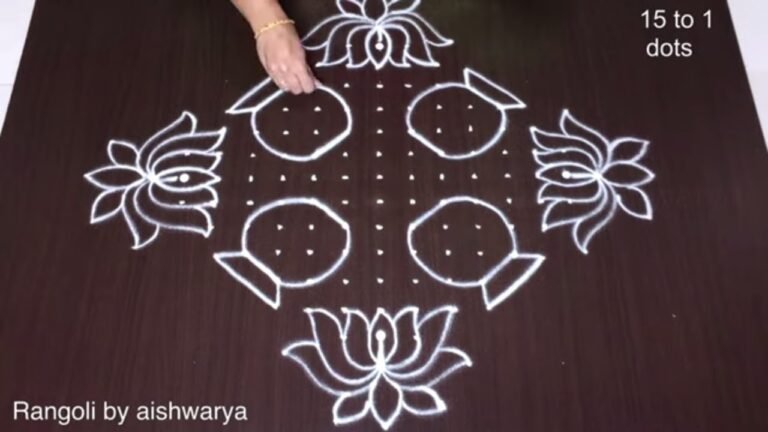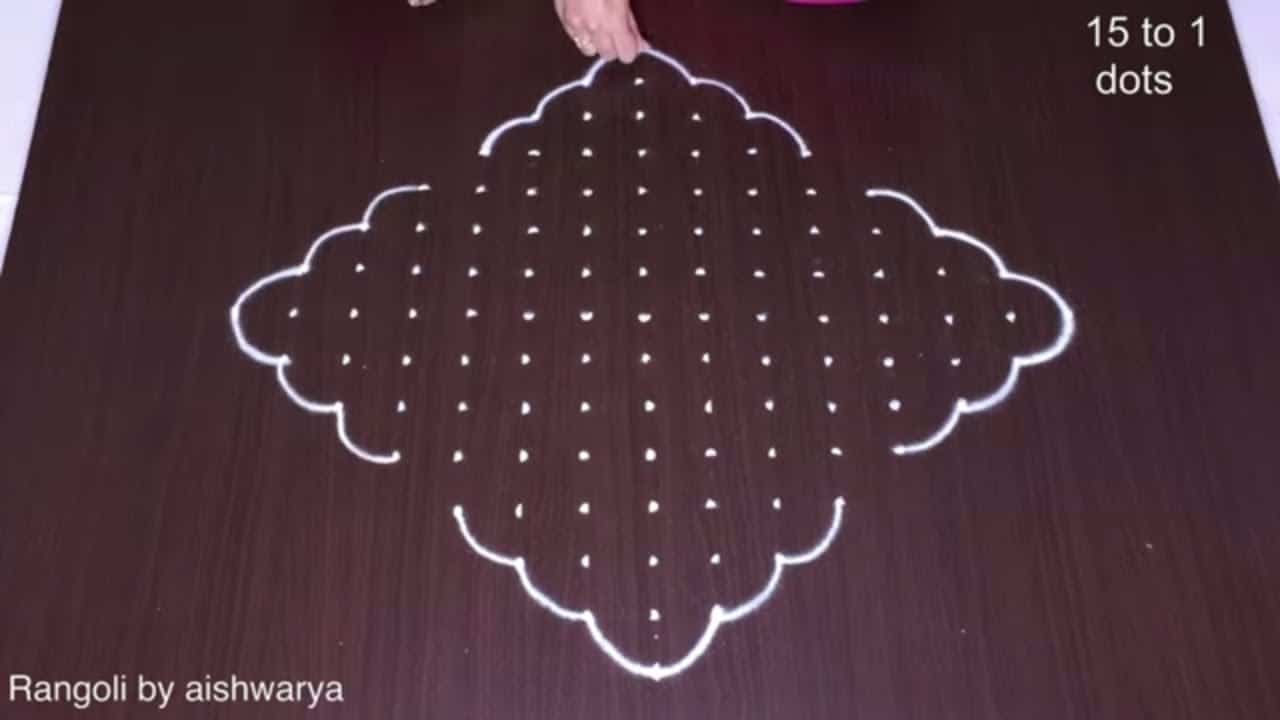
This harvest festival kolam 15×1 tutorial walks you through every step from the dot grid to the final pattern.

For another beginner-friendly variation, try 7 Into 7 Dots Festival Rangoli.
Learn more about the tradition of Rangoli on Wikipedia.
Looking to learn Harvest Festival Kolam 15 1? This step-by-step guide walks you through every line, dot, and curve.
Looking for a grand ner pulli kolam big design for Pongal 2026? This 15×1 straight-dot butterfly rangoli is elegant, festive, and perfect for large entrances. In this video, I guide you step by step to create a symmetrical 15×1 dots rangoli using a straight-line ner pulli layout. If you are searching for ner pulli kolam pongal or structured festival designs, this tutorial will help you understand spacing, alignment, and smooth curve connections.
We begin by placing the complete 15 x 1 dots rangoli grid clearly to form a strong foundation. Then the butterfly structure develops gradually, transforming the straight dot layout into beautiful butterfly rangoli designs with dots. How to construct a proper 15 pulli kolam ner pulli grid How to create balanced 15 dots kolam ner pulli patterns
How to refine curves in butterfly muggulu with dots How to draw neat 15 chukkala muggulu with dots This design works beautifully as pongal kolam 2026 new designs ner pulli and is also ideal for those searching for 15 to 1 rangoli designs. Because of its large straight layout, it fits perfectly under ner pulli kolam with dots big size and competition-style decorations.
If you are looking for 15 chukkala muggulu easy or simple 15×1 dots kolam, this structured method makes it beginner-friendly while still looking grand and impressive. Watch till the end to see how the full straight-dot grid transforms into an elegant butterfly chukkala muggulu suitable for Pongal and festive mornings. If you enjoy large straight-dot kolams, explore more ner pulli and structured rangoli tutorials on the channel.
Tip: Work from the centre outward. It keeps the symmetry honest and prevents the design from drifting off-balance.
About this design: Harvest Festival Kolam 15X1 is a beginner-friendly pattern that comes together in just a few minutes. Once you have practised the harvest festival kolam 15×1 dot grid, you can scale it up for festival mornings or scale it down for a daily doorstep. Many learners on our channel make this harvest festival kolam 15×1 their go-to design once they get the rhythm of the curves.
Harvest Festival Kolam 15X1 — Step by Step Guide
Here is how to draw it, line by line. Take your time on the corners and the symmetry will take care of itself.
- Clear a flat surface and set down your dot grid using rice flour or chalk.
- Confirm the dot spacing is even — uneven dots are the biggest cause of wobbly curves.
- Begin tracing from the centre outward, following the curves shown in the video above.
- Fill the petals and sections with your chosen colours, working one area at a time.
- Finish the edges with a fine line for a sharp, photograph-ready result.
What You Will Learn
- Ner Pulli Kolam Big
- Butterfly Rangoli Designs With Dots
- Easy Butterfly Kolam With Dots
- Pongal Kolam 2026 New Designs Ner Pulli
- Butterfly Chukkala Muggulu
- Ner Pulli Kolam Pongal
Frequently Asked Questions
How do I draw this rangoli?
Begin with the dot grid — this is the skeleton of the design. With rice flour or chalk, place each dot at equal intervals. Then trace the curves slowly, one section at a time.
Is this suitable for beginners?
Beginner-friendly is exactly the right description. The video walks through every line clearly and you can match the pace.
What materials do I need?
Powder (white for outlines, colours for filling), a flat surface, and a dot stencil if you want absolute precision. Beyond that, just your hand and a steady pace.
How long does it take?
A 3 min 55 sec video shows the complete sequence. On paper or floor, expect to spend around a quarter of an hour from grid to finished pattern.
Half the skill of kolam is learning to slow down. Put on some music, give yourself the time, and let the curves come naturally.


Leave a Reply