If you enjoy dot-grid muggulu, Kolangal For Beginners is a satisfying pattern that comes together in just a few minutes.
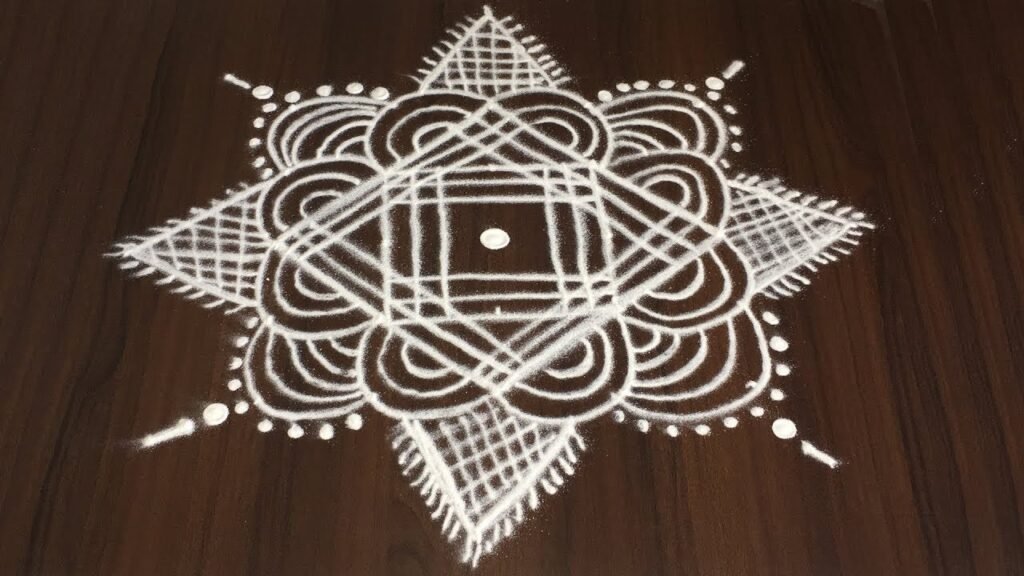
For another beginner-friendly variation, try 9 Dots Chukkala Muggulu For Festivals.
Looking for a very easy 5×5 dots rangoli that beginners can draw without confusion? This cute and creative kolam design is perfect for learning symmetry in a simple way. In this video, we create a 5×5 dots very easy rangoli design using a balanced square grid. The 5 by 5 dot format is one of the best starting points for beginners because it provides clear spacing and natural alignment.
How to place the 5×5 dot grid evenly Connecting dots smoothly to build a symmetrical base Maintaining equal spacing on all sides
Simple finishing touches to keep the design neat This design is compact and ideal for small entrances, apartment doorways, and pooja spaces. Even though it is simple, the clean structure gives it a polished and attractive look. If you are just starting your kolam journey, the 5×5 grid helps you understand balance, proportion, and curve control. Once comfortable with this layout, you can easily expand into 6×6 or 7×7 dot patterns.
Watch till the end to see the full symmetrical reveal — the final design shows how structured dots can transform into a charming and elegant kolangal pattern. Save this 5×5 dots design and try it at your entrance to build your confidence step by step.
Tip: Practice on paper first if you are new to dot kolam. The grid is the same; only the surface changes.
This delightful 5×5 dots kolangal design is an excellent choice for beginners who want to learn the basics of rangoli. The structured grid makes it easy to visualize and draw, allowing you to focus on creating symmetry and balance. As you practice, you’ll find that this compact design is not only perfect for small entrances but also suitable for pooja spaces, showcasing the beauty of simplicity. For those looking to explore more options, check out this 14 to 2 Pongal Special Pot Kolam for inspiration.
As you become more comfortable with the 5×5 pattern, you’ll discover that it lays a strong foundation for more complex designs. Understanding how to connect the dots smoothly will enhance your skills and prepare you for larger grids, like the 7×7 dots rangoli. This design is a wonderful starting point for anyone interested in the art of kolangal, and you can learn more about its cultural significance in Indian traditions by visiting this link. For those ready to take on a bigger challenge, consider trying the 7 Into 7 Dots Festival Rangoli next.
About this design: Kolangal For Beginners is a beginner-friendly pattern that comes together in just a few minutes. Once you have practised the kolangal for beginners dot grid, you can scale it up for festival mornings or scale it down for a daily doorstep. Many learners on our channel make this kolangal for beginners their go-to design once they get the rhythm of the curves.
Kolangal For Beginners — Step by Step Guide
Read through the steps before you begin so the sequence feels familiar when you start drawing.
- Clear a flat surface and set down your dot grid using rice flour or chalk.
- Confirm the dot spacing is even — uneven dots are the biggest cause of wobbly curves.
- Begin tracing from the centre outward, following the curves shown in the video above.
- Fill the petals and sections with your chosen colours, working one area at a time.
- Finish the edges with a fine line for a sharp, photograph-ready result.
What You Will Learn
- 5X5 Dots Very Easy Rangoli
- Cute Creative Kolam 5X5
- Beginner 5X5 Dot Rangoli
- 5X5 Dots Kolangal Design
- Simple 5X5 Muggulu
- 5 By 5 Pulli Kolam
Frequently Asked Questions
How do I draw this rangoli?
Begin with the dot grid — this is the skeleton of the design. With rice flour or chalk, place each dot at equal intervals. Then trace the curves slowly, one section at a time.
Is this suitable for beginners?
Yes, and it is one we recommend to first-timers. The small grid keeps the design manageable while still teaching the core technique.
What materials do I need?
Powder (white for outlines, colours for filling), a flat surface, and a dot stencil if you want absolute precision. Beyond that, just your hand and a steady pace.
How long does it take?
Plan for roughly 2 min 57 sec to watch and 15 minutes to draw. The second attempt is always cleaner than the first — that is the nature of dot kolam.
Practice this design a few times and you will find your own variations emerging. That is half the joy of kolam — every artist leaves a fingerprint on the pattern.
Leave a Reply