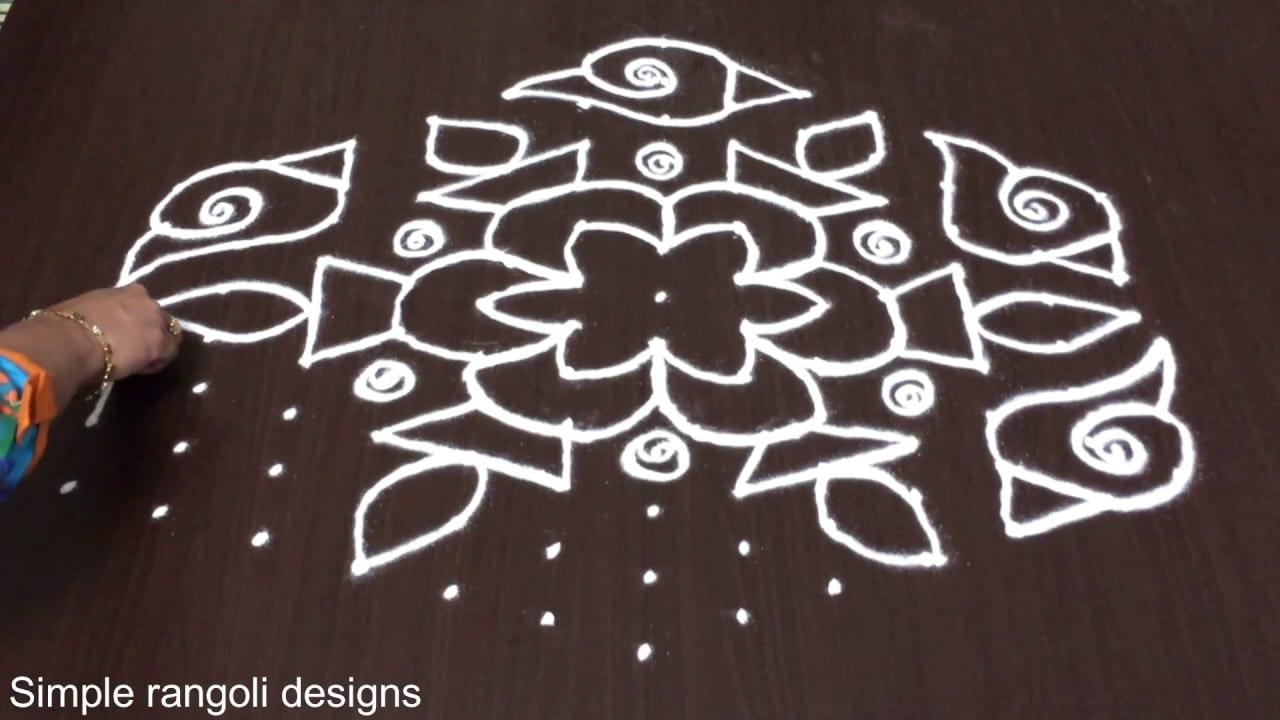
There is something timeless about Shankh Kolams Design — the symmetry, the rhythm of the dots, and the soft curves it produces.
For another beginner-friendly variation, try Beautiful Rangoli With 7 Dots.
Learn more about the tradition of Rangoli on Wikipedia.
Want to draw a powerful and traditional Shankh Kolam using dots? This 13 to 7 dots Shankh Muggu is perfect for grand entrances and special pooja days. In this video, I show you how to create a big shankh kolam using a 13–7 decreasing dot grid, explained clearly step by step. The conch (shankh) symbol represents positivity, auspicious beginnings, and sacred vibrations in Indian tradition, making this design ideal for festivals, vrat days, and temple-style home decorations.
We begin by placing the 13 to 7 straight dot structure, ensuring proper alignment and symmetry. Then, the curved outer shell of the shankh is drawn carefully around the dots, followed by inner detailing that gives the design a bold and majestic appearance. How to place a 13–7 decreasing dot grid properly How to form smooth shankh curves using dot guidance
How to maintain proportion in big muggu designs How to finish the outer edges neatly for a grand look This rangoli is ideal for those searching for “big muggu rangoli kaise banai jati hai” and wanting a structured, traditional approach instead of random drawing. The final reveal shows a beautifully balanced conch design that looks impressive at the entrance.
Watch till the end to see the full transformation from simple dots to a complete devotional kolam. If you enjoy large dot-based designs, explore more 13 to 7 dots kolams, festival muggulu, and traditional symmetrical rangoli patterns on the channel.
Tip: Use chalk to lightly mark your dot grid first — it wipes away cleanly once your rangoli is finished.
About this design: Shankh Kolams Design is a beginner-friendly pattern that comes together in just a few minutes. Once you have practised the shankh kolams design dot grid, you can scale it up for festival mornings or scale it down for a daily doorstep. Many learners on our channel make this shankh kolams design their go-to design once they get the rhythm of the curves.
Shankh Kolams Design — Step by Step Guide
Follow the steps below to recreate this design at home. Pause the video whenever you need — there is no hurry.
- Clear a flat surface and set down your dot grid using rice flour or chalk.
- Confirm the dot spacing is even — uneven dots are the biggest cause of wobbly curves.
- Begin tracing from the centre outward, following the curves shown in the video above.
- Fill the petals and sections with your chosen colours, working one area at a time.
- Finish the edges with a fine line for a sharp, photograph-ready result.
What You Will Learn
- Shankh Kolam 13 To 7 Dots
- Shankh Muggu Design
- 13 To 7 Dots Rangoli
- Big Shankh Kolam
- Shankh Rangoli Step By Step
- 13 7 Dots Kolam
Frequently Asked Questions
How do I draw this rangoli?
Begin with the dot grid — this is the skeleton of the design. With rice flour or chalk, place each dot at equal intervals. Then trace the curves slowly, one section at a time.
Is this suitable for beginners?
It is one of the more forgiving designs in our collection. Beginners often pick it as a confidence-builder before moving on to larger grids.
What materials do I need?
Just three things: powder (white plus any colours you want), a flat dry surface, and a few minutes of focus. A small bowl per colour helps keep things tidy.
How long does it take?
You will see a 3 min 8 sec walkthrough above. Drawing it yourself is usually a 12–18 minute affair, slightly slower the first time.
Once you get the rhythm of this design, try scaling it up or experimenting with colours. The grid stays the same; the personality changes.
Leave a Reply