
Definition
The conch motif draws the shankha — the large marine shell of the Indian Ocean — as a spiral form with pointed apex and broad opening, usually shown resting on its side or upright among other sacred emblems. Unlike floral and animal motifs, the conch depicts a ritual instrument: the drawn form stands for an object that is itself sounded in ceremony.
That double identity — natural object and instrument — gives the motif its particular role. A conch in a rangoli marks the composition as ceremonial: it is the visual counterpart of the note that opens worship.
History
Conch shells served as signal and ceremonial instruments in many ancient cultures, but South Asia gave the shell an unusually rich symbolic life: epic narratives name individual warriors’ conches, temple hymns compare the sound to awakening consciousness, and the shell recurs through sculpture, bronze icons, coins, ritual vessels, and manuscript ornament across centuries and across Hindu, Buddhist, and Jain traditions alike.
The shell’s history is also material and coastal. Communities along the Indian shoreline collected, carved, polished, and traded conches for centuries; in Bengal, carved conch bangles (shakha) remain part of traditional bridal attire. From ocean to workshop to temple, the object crossed from nature into craft into rite — and the drawn motif carries that whole journey.
Description
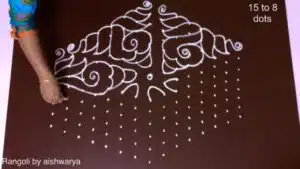
Artists render the conch in profile: the spiral body in two or three nested curves, the apex drawn to a point, the opening flared, often with a few radiating lines suggesting sound. Stylisation simplifies the shell toward pure spiral without losing its identity, and the form integrates readily with floral borders, circular compositions, and symmetrical festival layouts.
Compositionally the conch is a director of attention: spiral forms lead the eye inward to a focal point, so the motif works both as symbol and as visual device. It appears as a central emblem in devotional designs, beside the lotus in paired-auspicious arrangements, flanking lamps, kalashas, or footprints, and within festival designs of the Vishnu, Lakshmi, and Krishna occasions.
The spiral the artists simplify is worth a moment of attention in its own right. The shell’s expanding curve follows the growth geometry found throughout nature — in other shells, in unfurling plants, in the arrangement of certain flowers — an order artists recognised and used long before mathematics described it formally. Drawing the conch, the practitioner draws one of nature’s canonical curves.
Cultural Context
The conch’s meanings gather around sound and beginning. Blown before worship, temple ritual, festivals, and household ceremonies, the shankha announces the transition from ordinary time to sacred occasion — preparation as much as proclamation. The drawn conch attributes exactly that to a composition: purity, auspicious commencement, protection, sacred attention. In Vaishnava iconography the conch is one of Vishnu’s four emblems — his own shell bears the name Panchajanya — alongside the discus, mace, and lotus, naming sacred sound and preservation; Buddhist symbolism reads the white conch as the proclamation of teaching; Jain ornament employs the shell as well. All of it is attribution, resting on an observable spiral.
Alone among the common rangoli emblems, the conch has an auditory identity as strong as its visual one — artists draw its spiral while priests and households sound its note, and the two acts reinforce one another. Few ritual objects unite sight and sound so completely, and the motif owes part of its ceremonial weight to that doubled presence.
Literature fixed the shell’s ceremonial voice early. Epic narrative gives named conches to its warriors, announcing arrival and intent; temple hymns compare the note to the awakening of consciousness; devotional poetry treats the sound as presence itself. Across these registers the conch almost never appears as a mere instrument — its voice marks the boundary between silence and sound, preparation and action, ordinary life and sacred time. The drawn spiral inherits the whole of that: a rangoli that includes a conch has, in effect, already sounded it.
The spiral itself contributes a quieter sense. Its expanding curve reads as continuity and unfolding order, which is why the motif sits so naturally within rangoli’s radial grammar even when no ritual reference is intended.
Regional Variations
The conch appears wherever ceremonial rangoli is drawn: among the emblems of northern and western festival designs, in southern kolam renderings in line, and in the rice-paste traditions of the east — Bengal’s alpana gives the shell particular prominence, in step with the region’s conch-craft heritage. Coastal regions generally accord the motif the greatest presence, a visible trace of the shell’s maritime origins.
Contemporary design keeps the shankha current: jewellery, architecture, graphic identity, textiles, and festival decoration all reinterpret the spiral, often in minimalist line that would sit comfortably in a kolam. The motif adapts easily because its essential content — a single elegant curve carrying the idea of beginning — asks nothing of materials or scale. Drawn in powder at a threshold or cast in a modern logo, it remains the same announcement.
Related Topics
The conch typically keeps company with the Lotus, Diya, and Kalash in ceremonial arrangements; its footprint companion is Lakshmi’s Feet; its festival settings include Diwali and Navaratri.
Gallery
References
- Vijaya Nagarajan, Feeding a Thousand Souls: Women, Ritual, and Ecology in India — An Exploration of the Kōlam, Oxford University Press, 2018.
Further Reading
- Marcia Ascher, Mathematics Elsewhere: An Exploration of Ideas Across Cultures, Princeton University Press, 2002.
This entry publishes at Evidence Level E1: common knowledge within the tradition, anchored to a verified standard reference.
Cite this entry: “Conch.” Rangoli Encyclopedia, Rangoli Designs, https://rangolidesigns.net/encyclopedia/conch/ — a permanent URL under the encyclopedia’s stable-identity policy. Entry last reviewed 2026-07-28.