
Design facts
- Dot grid
- 5 to 3 dots — tapering from 5 dots across the middle down to 3
- Structure
- Sikku/Interlaced
- Tradition
- Kolam, Sikku Kolam
- Motif
- Lampstand
- Video
- 8 min 42 s, uploaded 26 June 2021
- Views
- 127,000 on YouTube as of 4 October 2026
Step by step: how to draw 5 Into 3 Dots Vilakku Kolam Designs
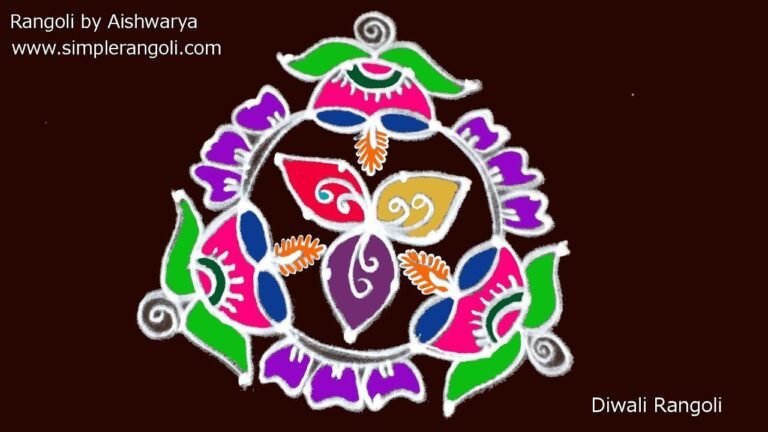
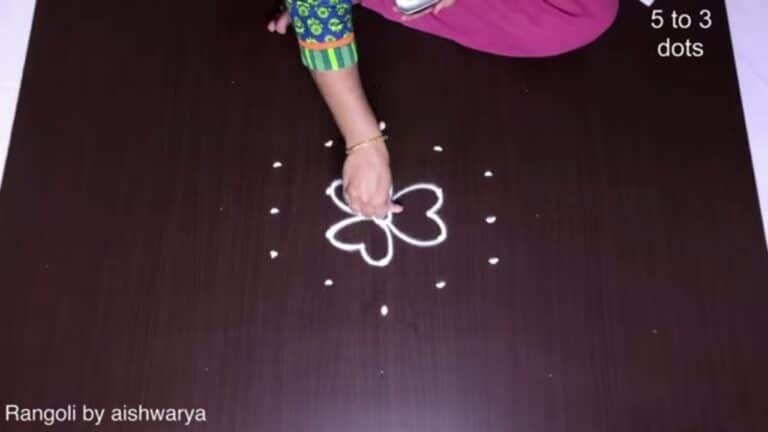
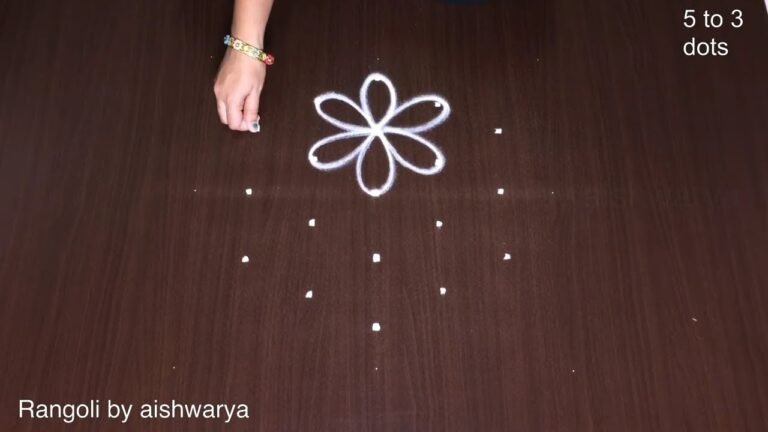
- Lay out the dot grid captioned on screen as 5 to 3 dots and work outward from the middle dot; the finished pattern is symmetrical about both the horizontal and the vertical centre line.
- At the very centre draw a small circle with a single dot inside it, then ring that circle with eight narrow loop-petals so it reads as a round rosette.
- Enclose the rosette in a wide flat hexagon: two long horizontal sides top and bottom, and short slanting sides closing it off at the left and right.
- Carry each hexagon side outward as a straight arm so the hexagon becomes a six-pointed star; put a small many-petalled flower at each of the four slanting corners and a pair of splayed petals at the left and right corners.
- Around the star draw three long ovals of the same size crossing through the same centre, one lying flat and the other two tilted about sixty degrees each way, so their rounded ends make six lobes around the design.
- Wherever two ovals cross on the rim, cap the point with a large spiral and fan two or three tulip-shaped petals outward above it; the top and bottom of the design each get the fullest version, a big spiral under three petals.
- Inside every lobe set a pair of big spirals facing each other with a pointed leaf between them, and run a short chain of small beads down the inside of the arc ending in a teardrop combed with fine fan lines.
- At the far left and far right tips draw a small arrowhead pointing outward with three beads in a row in front of it, then finish in your chosen colours; the pattern is built from many separate strokes, not one unbroken looping line.
Further reading
- Shojiro Nagata, “How Many Loops Kolam Loop Pattern Consists of”, Forma 30, 9–18 (2015). doi:10.5047/forma.2015.003
- Venkatraman Gopalan & Brian K. VanLeeuwen, “A topological approach to creating any pulli kolam, an artform from South India”, Forma 30, 35–41 (2015). doi:10.5047/forma.2015.005

Leave a Reply