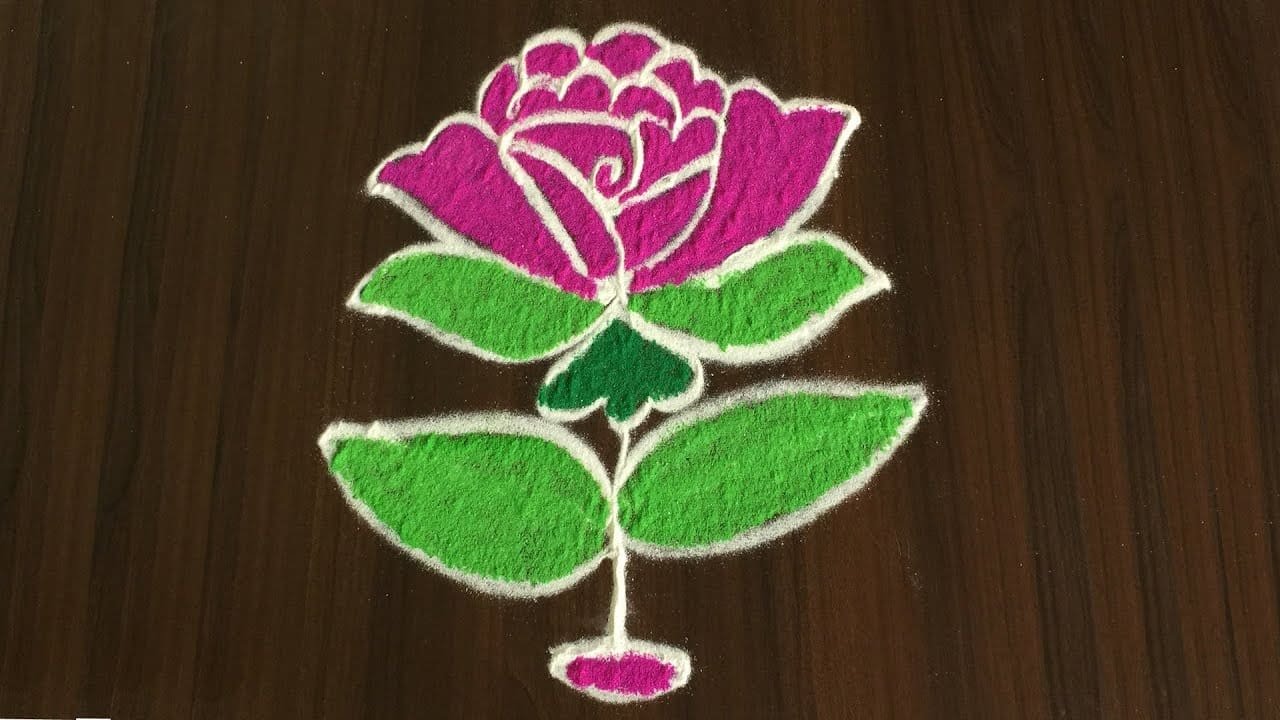
Looking to learn Dusshera Rose Kolam Rangoli? This step-by-step guide walks you through every line, dot, and curve.
For another beginner-friendly variation, try 7 To 4 Diya Kolam For Pooja Room At Home.
Learn more about the tradition of Rangoli on Wikipedia.
Looking for a small and elegant 5×3 dots rose kolam for Dussehra? This Vijaya Dashami special floral rangoli is perfect for a graceful festive entrance. In this video, we create a 5×3 dots Dussehra rose kolam, using a compact decreasing dot grid that forms a neat and symmetrical floral layout. The 5 by 3 format is ideal for small spaces while still allowing beautiful rose patterns to stand out clearly.
🌸 What You’ll Learn Step by Step: How to place the 5×3 decreasing dots accurately Forming soft rose petal shapes using smooth curves
Maintaining symmetry in a small grid layout Simple finishing touches to enhance the festive look During Dussehra and Vijaya Dashami, decorating the entrance with floral kolam symbolizes celebration, positivity, and new beginnings. This design keeps the structure simple yet visually attractive, making it perfect for home entrances, pooja spaces, and apartment doorways.
The 5×3 dot format is beginner-friendly and quick to complete, while still giving a festive appearance suitable for Navaratri celebrations. Watch till the end to see the full rose formation — the final symmetrical reveal makes the design truly satisfying. If you enjoy small 5×3 dot kolam, explore other festive grids like 7-4 and 9-5 to expand your Navaratri rangoli collection.
Save this design for Dussehra and recreate it for a bright and beautiful Vijaya Dashami celebration.
Tip: Practice on paper first if you are new to dot kolam. The grid is the same; only the surface changes.
This design belongs to the broader tradition of rangoli and kolam art practised across South India. Explore more in our 5 to 3 dots Rangoli Designs collection.
About this design: Dusshera Rose Kolam Rangoli is a beginner-friendly pattern that comes together in just a few minutes. Once you have practised the dusshera rose kolam rangoli dot grid, you can scale it up for festival mornings or scale it down for a daily doorstep. Many learners on our channel make this dusshera rose kolam rangoli their go-to design once they get the rhythm of the curves.
Dusshera Rose Kolam Rangoli — Step by Step Guide
Use the steps below as a reference card while the video plays. Most learners finish on the second attempt.
- Clear a flat surface and set down your dot grid using rice flour or chalk.
- Confirm the dot spacing is even — uneven dots are the biggest cause of wobbly curves.
- Begin tracing from the centre outward, following the curves shown in the video above.
- Fill the petals and sections with your chosen colours, working one area at a time.
- Finish the edges with a fine line for a sharp, photograph-ready result.
What You Will Learn
- 5X3 Dots Dussehra Kolam
- Rose Kolam 5X3 Dots
- Vijaya Dashami Rangoli Design
- Navaratri Muggulu 5X3
- 5-3 Dots Floral Rangoli
- 5X3 Pulli Kolam
Frequently Asked Questions
How do I draw this rangoli?
The grid comes first. Use a soft chalk to dot the surface, count twice to confirm the spacing, then start connecting them following the video. Work from the centre outward.
Is this suitable for beginners?
It is one of the more forgiving designs in our collection. Beginners often pick it as a confidence-builder before moving on to larger grids.
What materials do I need?
You will need rice flour or rangoli powder (white, plus your choice of colours), a flat surface like a clean floor or courtyard, and optionally a dot stencil if you are new to grid-drawing.
How long does it take?
The tutorial is 2 min 8 sec long. With practice the actual drawing settles around 10 minutes; the first time will likely take twice that.
When you draw this, focus on the first three dots — get those right and the whole pattern follows. The rest is just patience and a steady hand.
Leave a Reply