



Definition
The dot grid is the structural foundation of India’s counted threshold designs: an array of dots laid on the prepared ground before any line is drawn, serving as the coordinate system on which the design is built. Tamil practice calls the dots pulli, Telugu practice chukkala; the structure is the same — position fixed first, form added second.
As a structure — this encyclopedia’s term for the geometric scaffold beneath a design — the dot grid is the most consequential in the corpus: the majority of the southern traditions’ designs, from simple daily figures to the great knot kolams, stand on it.
History
The grid’s history is inseparable from the traditions that use it: laid every morning for as long as the practice reaches, taught as the learner’s first skill, and carried in memory as the counts that name designs. Its formal history is younger and distinguished: the 1974 array-grammar work treated the dot lattice as the scaffold for pattern rules, and the ethnomathematical literature has analysed the counted grids as hand-built coordinate systems ever since. The structure is the part of the practice that mathematics recognised first, because it is the part that most resembles mathematics.
Behind the practical structure stands an old idea held lightly: the bindu — the point as origin, the mark from which form unfolds — runs through Indian philosophy, sacred diagramming, and art. The grid does not preach the idea; it performs it, every morning, dots becoming designs becoming dust.
Description
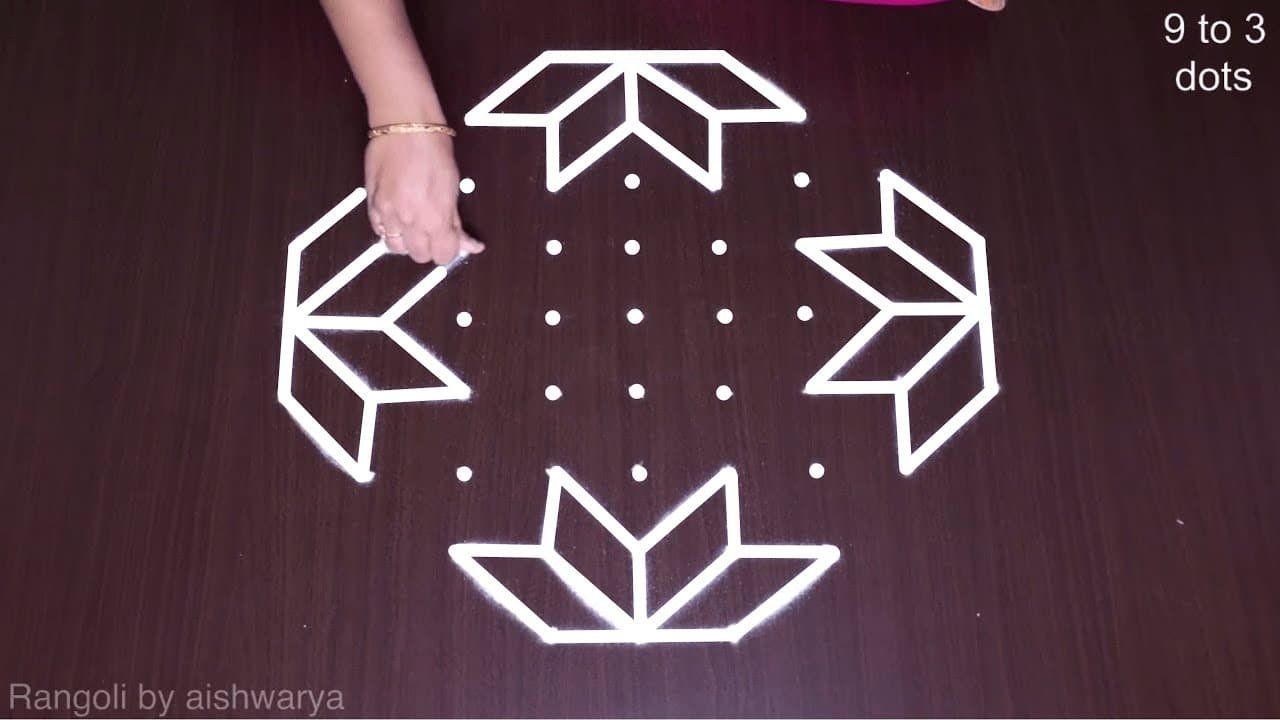
Laying the grid is a skill in itself: dots placed by eye and finger-gauge at even spacing, in true rows, to a chosen count — and done well it takes a practised hand under a minute. Two conventions govern arrangement: the straight lattice (rows and columns aligned — Tamil ner pulli) and the staggered lattice (each row offset into the gaps of the last — idukku pulli), with the staggered form favoured for interlaced and radial work because its diagonals run naturally.
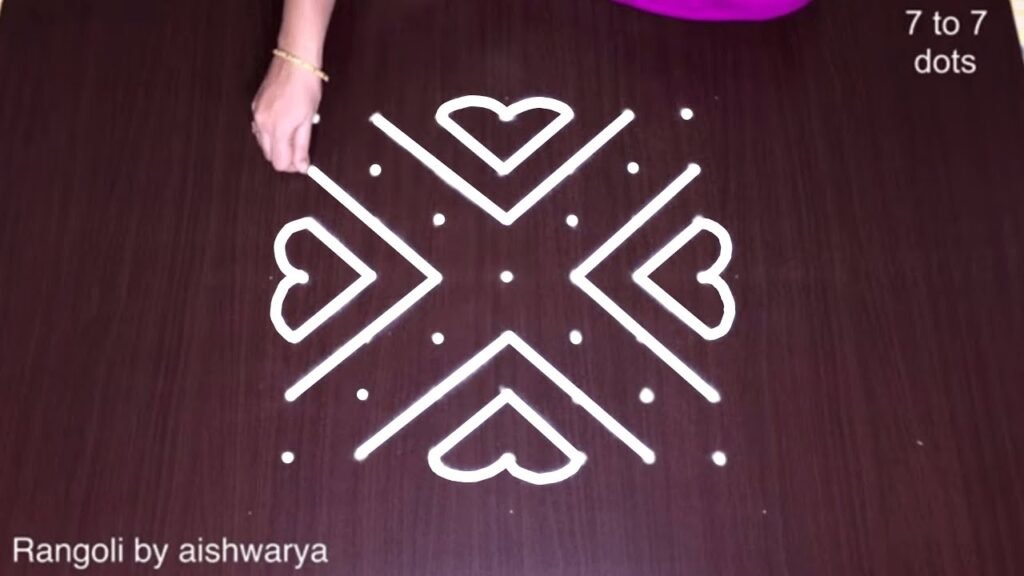
Counts identify grids and, through them, design families. The southern conventions name diamond and stepped grids by their extremes — “seven to one”, “eleven to six”, “twenty-one to eleven” — each count fixing a lattice shape and the family of designs that fit it; this platform’s design library documents dozens of counted families in current use, from small daily grids to festival arrays of a hundred dots and more. On the finished design the grid usually remains visible: the dots sit inside the loops or at the line-joins, the scaffold showing through the building.
Cultural Context
The grid’s cultural work is coordination. It is the tradition’s curriculum — learners begin at small counts and graduate upward; its mnemonic system — repertoires are stored and recalled by count; and its shared language — the count is the first thing one practitioner asks another about an unfamiliar design. A structure this useful needs no symbolism to earn its place, and the meanings that do attach — order, preparation, potential — are practitioners’ senses resting on an observable array of dots.
The grid also embodies the practice’s quiet epistemology: precision without instruments. No ruler measures the spacing and no protractor sets the angles; accuracy lives in the trained eye and hand, renewed daily. The counted grid is what disciplined estimation looks like when it has been practised for a lifetime — the reason researchers could treat threshold drawings as mathematical objects at all.
The care the grid receives reflects how errors behave: every later element depends on the dots’ placement, so a miscount or a drifting row propagates through the whole design, surfacing as crossings that will not close and petals that will not meet. Practitioners therefore give the grid as much attention as the drawing it will carry — often more — and a spoiled grid is simply swept away and relaid, the structure’s own economics: seconds spent on placement save a whole design.
Regional Variations
The structure spans the southern traditions — pulli grids in Tamil practice, chukkala in Telugu, counted grids in Karnataka’s rangavalli — with conventions travelling essentially unchanged while the ornament above them changes accent. The freehand-dominant traditions of the west and east largely work without it, which is precisely the structural divide this encyclopedia’s comparative material maps: grid geometry in the south, brush-line freedom in the east, each aesthetic downstream of its method.
Related Topics
The grid’s principal users are Pulli Kolam and Sikku Kolam in Tamil practice and Muggulu in Telugu; its structural siblings are the Radial Structure and Line Structure; the traditions’ parent article is Rangoli.
Gallery
References
- Gift Siromoney, Rani Siromoney & Kamala Krithivasan, “Array grammars and kolam”, Computer Graphics and Image Processing 3(1), 1974.
- Marcia Ascher, “The Kolam Tradition”, American Scientist 90(1), 2002.
- Vijaya Nagarajan, Feeding a Thousand Souls: Women, Ritual, and Ecology in India — An Exploration of the Kōlam, Oxford University Press, 2018.
Further Reading
- Marcia Ascher, Mathematics Elsewhere: An Exploration of Ideas Across Cultures, Princeton University Press, 2002.
This entry publishes at Evidence Level E2: its claims rest on at least two independently verified sources.
Cite this entry: “Dot Grid.” Rangoli Encyclopedia, Rangoli Designs, https://rangolidesigns.net/encyclopedia/dot-grid/ — a permanent URL under the encyclopedia’s stable-identity policy. Entry last reviewed 2026-07-28.