This 9×9 krishnastami rangoli tutorial walks you through every step from the dot grid to the final pattern.
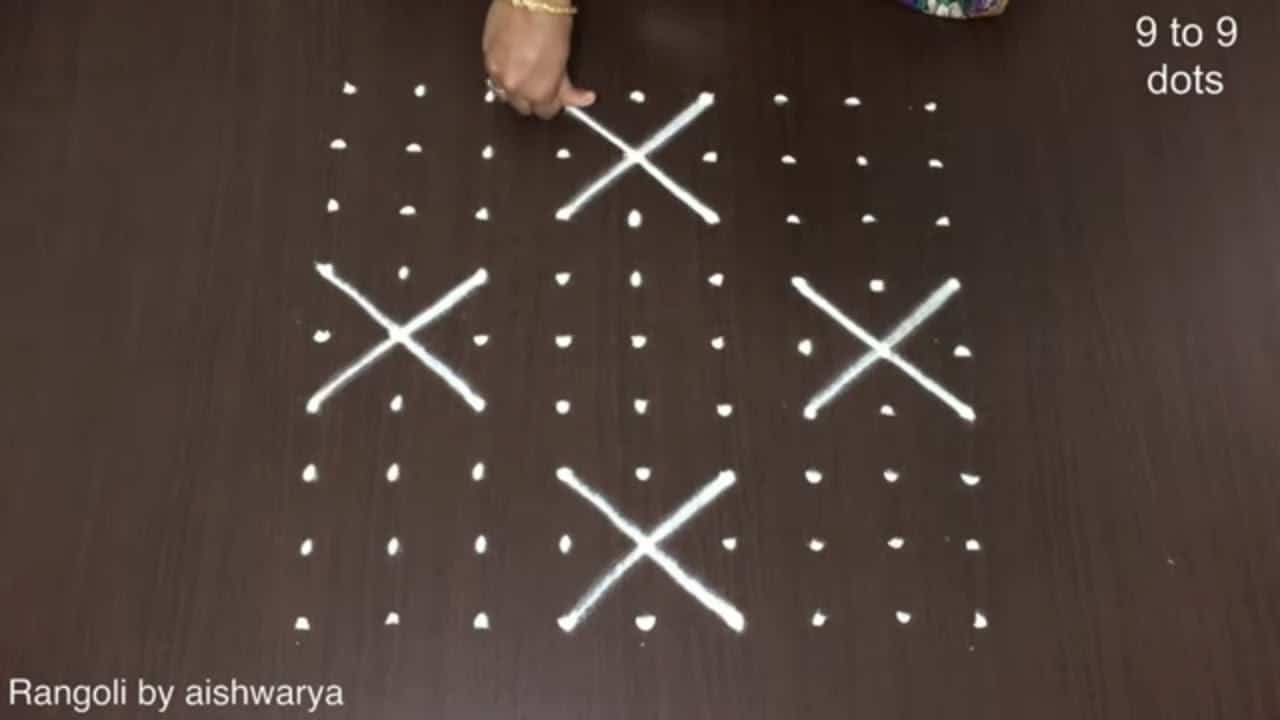
9 9 Krishnastami Rangoli Small has become a favourite among learners on our channel — and once you try it, you will see why.
9 * 9 Krishnastami rangoli small | Krishna Jayanthi muggulu designs with dots | RamRangoli Aishwarya Thank you so much for watching Channel
My Ram Rangoli Channel Contains : Rangoli Designs Sankranthi Muggulu
Diwali Rangoli Ratham Muggulu Kolam Designs
Muggulu Designs Chukkala Muggulu Easy Rangoli
Simple Rangoli Easy Rangoli Designs Dhanurmasam Muggulu
Melikala Muggulu Geethala Muggulu Sivarathri Muggulu
Tip: Work from the centre outward. It keeps the symmetry honest and prevents the design from drifting off-balance.
The 9×9 Krishnastami Rangoli is a delightful design often created for the celebration of Krishna Jayanthi, marking the birth of Lord Krishna. This intricate pattern features nine dots arranged in a square grid, making it accessible for beginners who wish to embrace the festive spirit through art. With its symmetrical layout, this rangoli allows for creative expression while honoring traditional motifs. For those interested in similar designs, exploring the Peacock Rangoli for Diwali can provide additional inspiration.
Typically adorned with bright colors and floral themes, the 9×9 Krishnastami Rangoli can be customized to reflect personal style or regional preferences. The use of vibrant powders can infuse life into the design, making it a focal point during festivities. For a broader array of styles, the Big Creative Deepam Rangoli showcases another aspect of traditional rangoli art. To learn more about the cultural significance of rangoli, visit this page for a deeper understanding of its history and variations.
9X9 Krishnastami Rangoli — Step by Step Guide
Use the steps below as a reference card while the video plays. Most learners finish on the second attempt.
- Set out a 9×9 square dot grid — nine rows of nine evenly spaced dots — and work in white powder; the finished pattern is a square with four-fold symmetry.
- At the exact centre draw a small square block with four rounded corner bumps, and inside it a four-petal flower: a flat oval petal to the left and right, a rounded petal above and below, and a tiny circle at the middle.
- From each rounded corner of that centre block run a straight line outward on the diagonal, heading for the corresponding corner of the grid.
- From the top, bottom, left and right of the centre block run a short straight stem out toward the middle of each side of the square.
- At the end of each of those four stems draw a flower of about six narrow pointed petals radiating from a single point, then fill every petal with fine straight strokes drawn from the flower's centre outward.
- At each of the four corners draw two large rounded lobes meeting at the corner, with a small rounded heart shape tucked into the angle that faces the centre.
- Into the outer angle of each corner pair set a pointed leaf shape, and trim its outer edge with a curved row of about eight small round beads.
- Let each corner motif touch the two mid-side flowers next to it so the eight outer motifs ring the design as a square border, and leave the four panels between the diagonals empty.
What You Will Learn
- Simple Rangoli Designs
- Rangoli
- Muggulu
- Rangoli Designs
- Rangoli Kolam
- Kolam
Frequently Asked Questions
How do I draw this rangoli?
It looks complex but follows a simple rhythm: dots first, then loops. Mark the grid, take a breath, and trace the curves at a steady pace. The pattern emerges on its own.
Is this suitable for beginners?
It is one of the more forgiving designs in our collection. Beginners often pick it as a confidence-builder before moving on to larger grids.
What materials do I need?
Powder (white for outlines, colours for filling), a flat surface, and a dot stencil if you want absolute precision. Beyond that, just your hand and a steady pace.
How long does it take?
The video runs 3 min 2 sec. In practice, most learners take between 10 and 20 minutes — a little longer the first time, faster as the pattern becomes familiar.
There is real pleasure in finishing a kolam at your own doorstep — even more so when the pattern is one you have practised before. Make this one of those.
Leave a Reply