If you enjoy dot-grid muggulu, Simple Rangoli Designs For 4 is a satisfying pattern that comes together in just a few minutes.
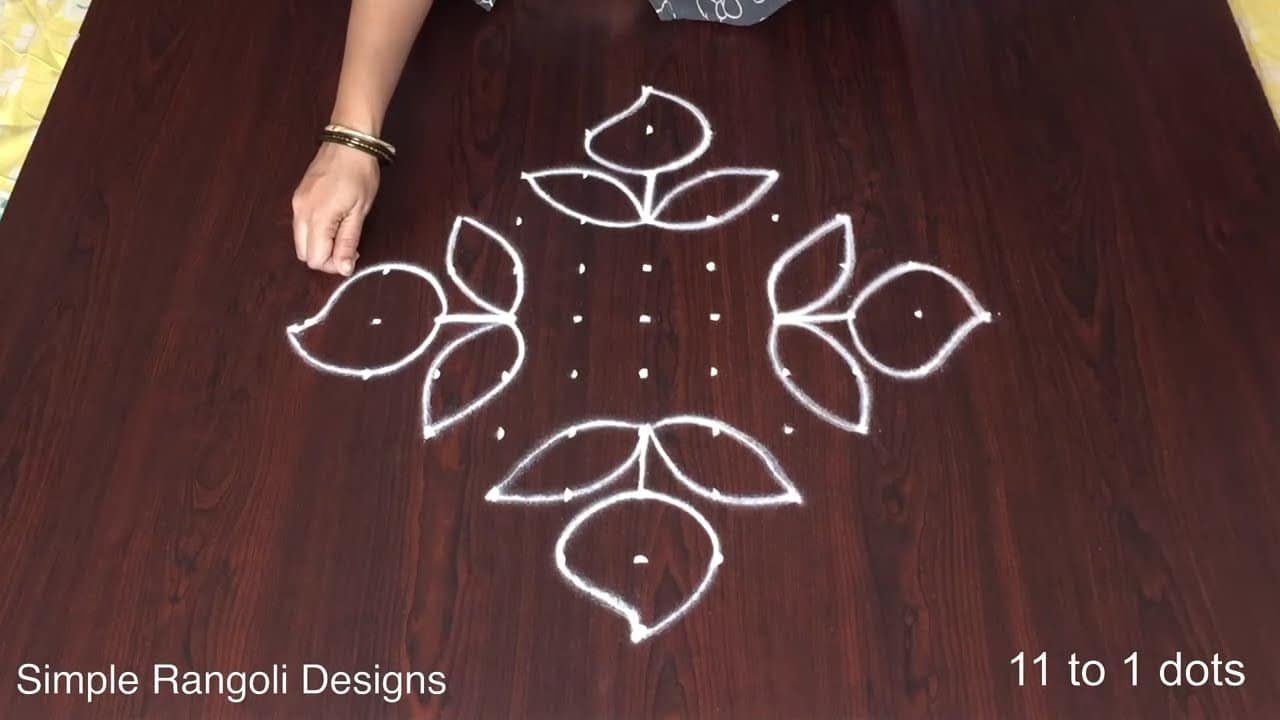
Looking for beautiful Simple Rangoli Designs for Ugadi? This 11 to 1 dots kolam is a creative and traditional muggulu perfect for festive entrances. In this video, I guide you step by step to create a neat 11 to 1 dots rangoli using a structured decreasing dot grid. If you enjoy traditional muggulu with dots, this design will help you create elegant curves and balanced symmetry.
We begin by placing the 11 to 1 dot structure clearly to build a strong foundation. Then the curved framework develops gradually into a graceful festive kolam pattern. Because of the decreasing dot layout, this design is easy to follow and beginner-friendly. How to draw a proper 11 to 1 dots kolam grid How to create traditional ugadi rangoli designs
How to design neat daily creative muggulu How to maintain symmetry in kolam with dots This design works beautifully as an Ugadi entrance rangoli and can also be used as a daily decorative kolam. Even though the grid is larger, the structured dot placement makes the design simple to practice.
If you enjoy drawing chukkala muggulu designs, elegant rangoli with dots, or traditional kolam designs, this tutorial will help you improve your rangoli skills. Watch till the end to see how the 11 to 1 dots grid transforms into a graceful Ugadi kolam.
Tip: Work from the centre outward. It keeps the symmetry honest and prevents the design from drifting off-balance.
This 11 to 1 dots kolam is a delightful choice for Ugadi, offering a graceful blend of tradition and simplicity. The structured decreasing dot grid allows for easy navigation, making it suitable for beginners. As you create this rangoli, you’ll appreciate the elegance of the curves and the balanced symmetry that add a festive touch to your entrance. For those who enjoy drawing intricate designs, this rangoli serves as a perfect introduction to simple easy rangoli concepts.
Incorporating this design into your Ugadi celebrations can enhance the festive atmosphere. The gradual development of the pattern from the foundational grid makes it approachable for anyone looking to practice their skills. This kolam can also serve as a daily decorative piece, showcasing your creativity throughout the year. If you are interested in exploring more traditional designs, you might also like the Chukkala Muggulu for Sankranthi for inspiration. For further insights into this beautiful art form, check out Rangoli on Wikipedia.
About this design: Rangoli Designs For Ugadi is a beginner-friendly pattern that comes together in just a few minutes. Once you have practised the rangoli designs for ugadi dot grid, you can scale it up for festival mornings or scale it down for a daily doorstep. Many learners on our channel make this rangoli designs for ugadi their go-to design once they get the rhythm of the curves.
Rangoli Designs For Ugadi — Step by Step Guide
Pace yourself through the steps — kolam rewards patience more than speed.
- Clear a flat surface and set down your dot grid using rice flour or chalk.
- Confirm the dot spacing is even — uneven dots are the biggest cause of wobbly curves.
- Begin tracing from the centre outward, following the curves shown in the video above.
- Fill the petals and sections with your chosen colours, working one area at a time.
- Finish the edges with a fine line for a sharp, photograph-ready result.
What You Will Learn
- Ugadi Rangoli With Dots
- Ugadi Rangoli Side Designs
- Ugadi Rangoli Simple
- Ugadi Rangoli Easy
- Rangoli Ugadi Special
- Ugadi Rangoli Designs With Dots
Frequently Asked Questions
How do I draw this rangoli?
Start by marking an even dot grid on a flat, clean surface. Once the grid is in place, connect the dots following the curves shown in the video. Even spacing between dots is the single biggest factor for a clean finish.
Is this suitable for beginners?
Absolutely. You can pause and rewind the video at every step. The pattern is straightforward once you have the grid down.
What materials do I need?
Rice flour, coloured rangoli powders, and a clean stretch of floor or paper. Some draw with chalk first to set the grid before powdering over it.
How long does it take?
The video clocks in at 3 min 37 sec. Allow about quarter of an hour to draw the design at a comfortable pace.
Practice this design a few times and you will find your own variations emerging. That is half the joy of kolam — every artist leaves a fingerprint on the pattern.
Leave a Reply