This sankranti muggulu for beginners tutorial walks you through every step from the dot grid to the final pattern.
Learn more about the tradition of Rangoli on Wikipedia.
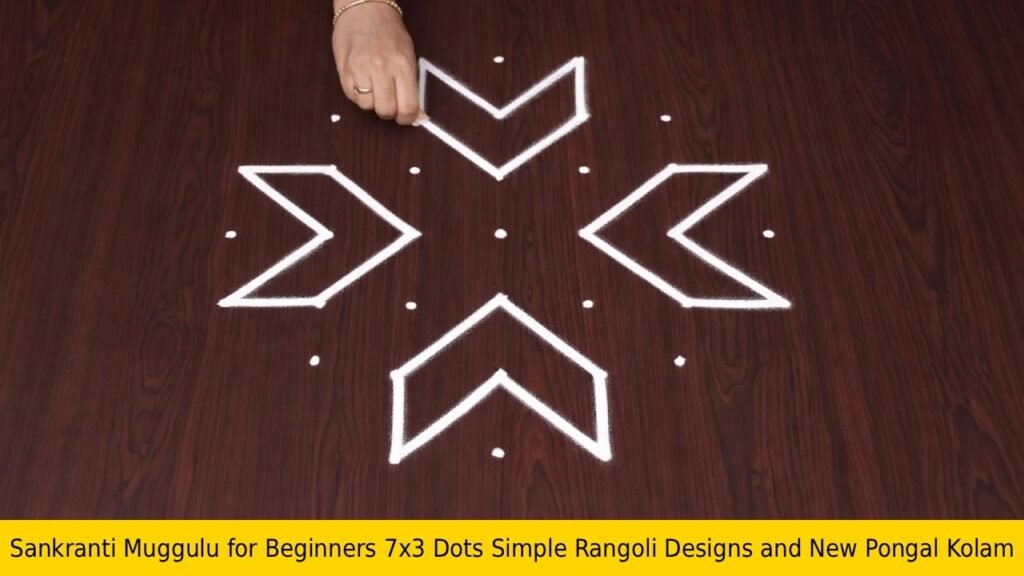
7X3 Dots Rangoli is a beautiful kolam pattern you can draw right at your doorstep — perfect for beginners and seasoned rangoli artists alike.
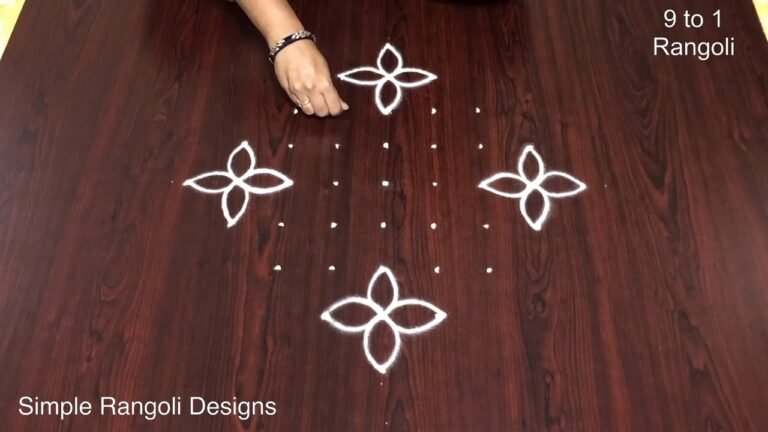
Looking for a compact and festive 7×3 dots rangoli for Sankranthi? This simple design is perfect for Pongal and small entrance decoration. In this video, I show you step by step how to draw a beautiful 7×3 dots kolam that is neat, symmetrical, and beginner-friendly. This pongal kolam with dots uses a small rectangular grid, making it easy to recreate even if you are new to rangoli with dots.
We begin by placing the 7×3 dot structure clearly to build a strong foundation. Then, smooth curves are developed gradually to transform the grid into a festive pattern. This method helps you create simple sankranthi rangoli designs that look clean and balanced. If you enjoy structured dot kolam designs, this tutorial will improve your spacing and curve control. Even first-time learners can confidently try this simple rangoli with dots using the easy layout shown in the video. How to construct a proper grid for muggulu with dots
How to maintain symmetry in easy kolam with dots How to refine compact chukkala muggulu designs How to create a neat beginners kolam with dots
This design works beautifully as a traditional sankranthi kolam and is also suitable as a festival kolam with dots for Pongal mornings. Because of its size, it can be used as a small rangoli with dots for apartments, doorsteps, and pooja spaces. Watch till the end to see the full transformation from a simple 7×3 grid into elegant sankranti muggulu designs that are festive and traditional. If you enjoyed this tutorial, explore more rangoli with dots and small-grid kolam patterns on the channel.
Tip: Use chalk to lightly mark your dot grid first — it wipes away cleanly once your rangoli is finished.
This design belongs to the broader tradition of rangoli and kolam art practised across South India. Explore more in our Kolam for Pongal collection.
About this design: Sankranti Muggulu For Beginners is a beginner-friendly pattern that comes together in just a few minutes. Once you have practised the sankranti muggulu for beginners dot grid, you can scale it up for festival mornings or scale it down for a daily doorstep. Many learners on our channel make this sankranti muggulu for beginners their go-to design once they get the rhythm of the curves.
Sankranti Muggulu For Beginners — Step by Step Guide
Follow the steps below to recreate this design at home. Pause the video whenever you need — there is no hurry.
- Clear a flat surface and set down your dot grid using rice flour or chalk.
- Confirm the dot spacing is even — uneven dots are the biggest cause of wobbly curves.
- Begin tracing from the centre outward, following the curves shown in the video above.
- Fill the petals and sections with your chosen colours, working one area at a time.
- Finish the edges with a fine line for a sharp, photograph-ready result.
What You Will Learn
- 7X3 Dots Rangoli
- Sankranti Muggulu Designs
- Pongal Kolam With Dots
- 7X3 Dots Kolam
- Simple Sankranthi Rangoli
- Rangoli With Dots
Frequently Asked Questions
How do I draw this rangoli?
It looks complex but follows a simple rhythm: dots first, then loops. Mark the grid, take a breath, and trace the curves at a steady pace. The pattern emerges on its own.
Is this suitable for beginners?
It is one of the more forgiving designs in our collection. Beginners often pick it as a confidence-builder before moving on to larger grids.
What materials do I need?
White rice flour for the outline, coloured powders for the fill, and a clean dry floor. That is the essentials list — you can add a stencil if you prefer.
How long does it take?
The video clocks in at 2 min 50 sec. Allow about quarter of an hour to draw the design at a comfortable pace.
After you draw this, take a picture before the day blows it away. Kolam is impermanent by design, but a photo lets you revisit the version you drew.

Leave a Reply