Definition
The coconut motif draws the fruit of the coconut palm (Cocos nucifera) — an oval form with fibrous crown, often shown resting on mango leaves atop a kalash — and, in fuller compositions, the palm itself. It is one of the vocabulary’s principal emblems of offering: the fruit that begins ceremonies across much of India, drawn at the thresholds where those ceremonies begin.
The motif’s most familiar setting is borrowed directly from ritual practice: the coconut crowning the leaf-ringed vessel, the purna kalasha’s summit. Drawn alone or in that ensemble, the coconut marks a composition as ceremonial.
History
The coconut palm has shaped coastal India for centuries — Kerala’s very name is widely connected with the palm (kera) — and its usefulness is proverbial: fruit, water, oil, fibre, timber, and leaves, nearly nothing wasted. Coastal communities built livelihoods on it, from coir rope to boat craft, and that total usefulness fed the symbolism: a thing whose every part gives became the natural emblem of generosity and completeness.
In ritual history the coconut became the standard auspicious offering — presented at weddings, housewarmings, temple visits, harvest festivals, and inaugurations — carrying sincerity, humility, and dedicated intention. Its artistic record follows: temple sculpture, coastal murals, folk painting, festival decoration, and the threshold arts.
Description
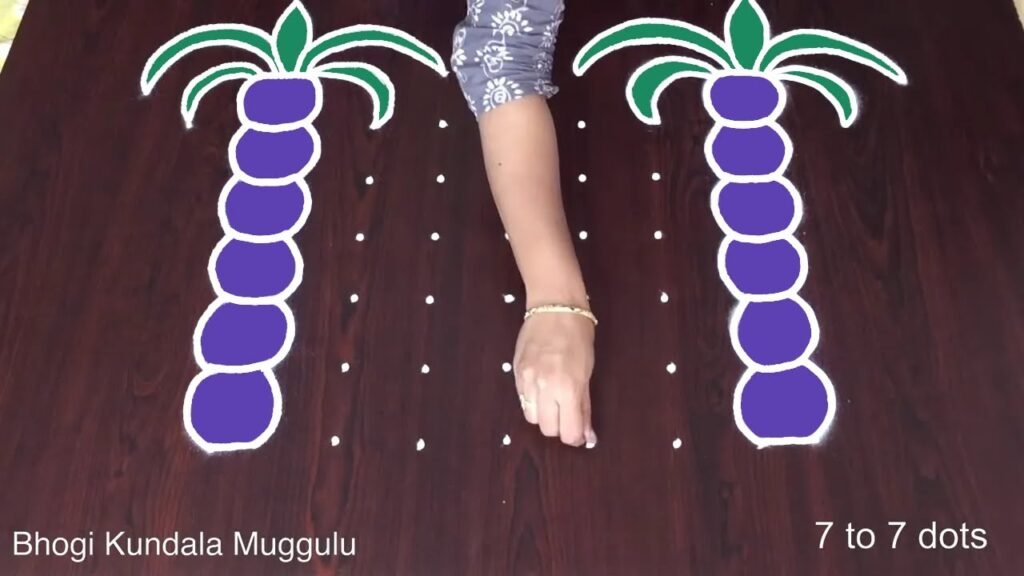
The drawn coconut is an oval or rounded triangle with the fibre tuft marked at the crown, usually detailed with concentric lines. Its standard settings: atop the kalash between mango leaves — the most compact form of the full ceremonial ensemble; whole, with leaves, as an offering emblem; and as the palm, a curved trunk with radiating fronds, in compositions that reach for the coastal landscape. Stylised coconut forms also join floral schemes as rounded counterweights among petals.
The kalash pairing carries the geometry: the coconut’s dome completes the vessel’s vertical axis, and design practice values the ensemble precisely for that stable, centred profile — base, body, neck, leaves, crown, a single upward line of forms.
Cultural Context
The coconut’s symbolism grew from its structure: a hard, plain shell protecting pure water and nourishing flesh and the seed of a future palm. Communities read the layers — worth beneath appearance, purity within toughness, potential inside the ordinary — and the offering practice added intention: to present a coconut is to present something whole and unopened, complete in itself. Purity, selflessness, wholeness, auspicious beginning: attributed senses, resting on an observable oval with a tufted crown.
The sustainability reading is old practice newly named: coconut-growing communities used every part of tree and fruit centuries before anyone spoke of circular economies, and contemporary designs increasingly celebrate the palm in exactly those terms.
The fruit itself has one more quality the symbolism quietly uses: it travels. A coconut can float across open sea and germinate on a far shore — the palm colonised the tropics partly by drifting to them — and the emblem of self-contained completeness is therefore also an emblem of resilience in motion: everything needed for a new beginning, carried safely inside a plain shell.
Regional Variations
The motif is strongest where the palm grows — the coastal south and west, with Kerala, coastal Karnataka, Tamil Nadu, and Goa giving it the deepest presence — while the kalash-and-coconut ensemble travels everywhere ceremonial rangoli is drawn. Inland traditions draw the fruit chiefly in that ritual setting; coastal ones add the palm and the landscape it stands in.
Related Topics
The coconut’s ceremonial seat is the Kalash, ringed with Mango leaves; its fellow offering emblems are the Diya and Conch; its festival settings include Onam and Pongal.
Gallery

References
- Vijaya Nagarajan, Feeding a Thousand Souls: Women, Ritual, and Ecology in India — An Exploration of the Kōlam, Oxford University Press, 2018.
Further Reading
- Marcia Ascher, Mathematics Elsewhere: An Exploration of Ideas Across Cultures, Princeton University Press, 2002.
This entry publishes at Evidence Level E1: common knowledge within the tradition, anchored to a verified standard reference.
Cite this entry: “Coconut.” Rangoli Encyclopedia, Rangoli Designs, https://rangolidesigns.net/encyclopedia/coconut/ — a permanent URL under the encyclopedia’s stable-identity policy. Entry last reviewed 2026-07-28.