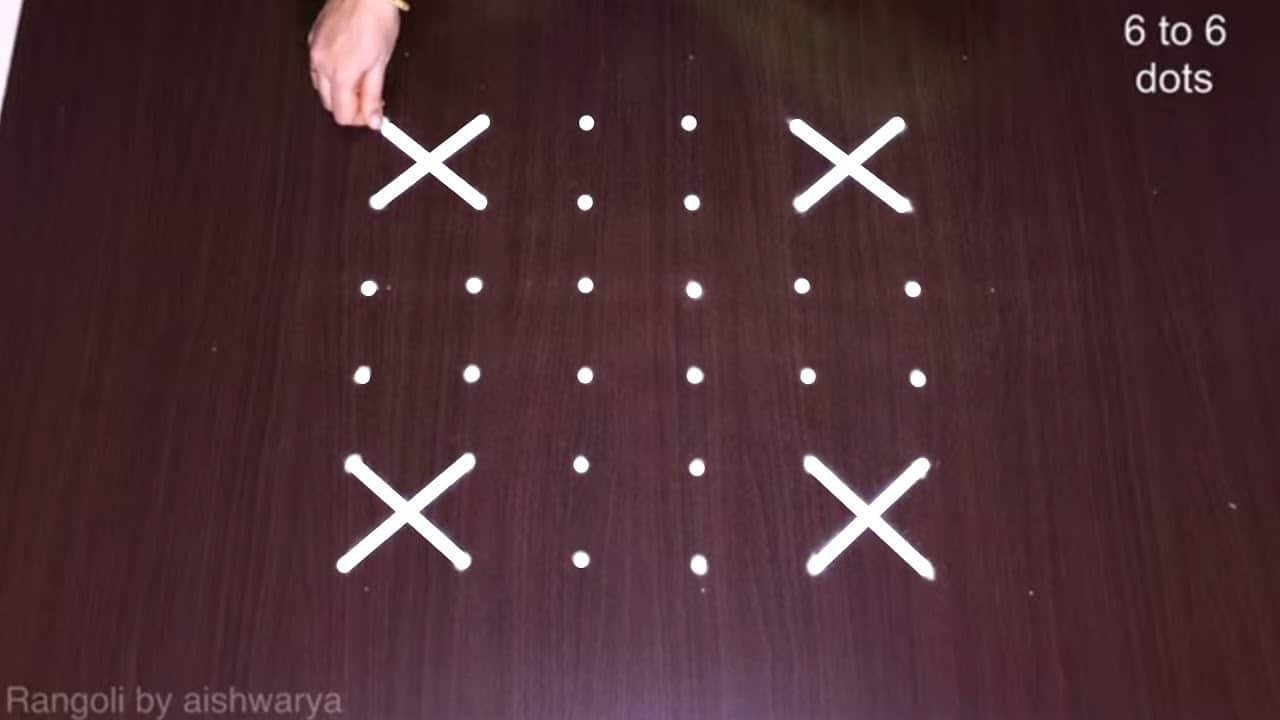
Definition
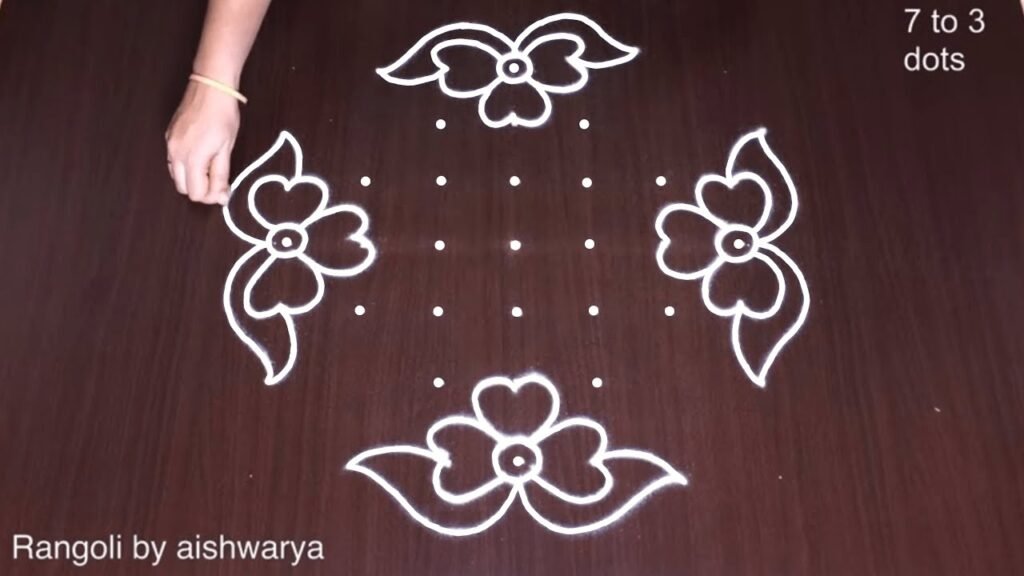
The radial structure organises a design around a single centre: petals, rings, and spokes repeat at equal angles so the composition reads identically from every side. It is the structure of flower-form rangoli, of lamp-centred festival pieces, and of most designs meant to be walked around rather than viewed from one edge.
History
Centre-out composition is visible throughout the library’s corpus and across the documented regional styles, though the kolam-centred scholarly literature treats it within general design repertoires rather than as a separately studied form; this article therefore keeps its historical claims deliberately modest.
Description
The drawer fixes a centre — often a dot, a lamp position, or a small square — and establishes the first ring or petal count; everything after is angular repetition. Fourfold, sixfold, and eightfold symmetries are the common orders in the library. Radial designs may sit on a dot grid, borrow interlacing for their rings, or be entirely freehand: radial describes the organising geometry, not the method.
Cultural Context
Radial compositions are widely favoured for occasions where the design surrounds an object of attention — a lamp at Karthigai or Diwali, a pot at harvest — and practitioners commonly describe the equal-from-all-sides form as suited to welcome without direction. As throughout, these are attributed readings.
Regional Variations
Every tradition in this encyclopedia produces radial work: flower kolams in Tamil practice, ring-built muggulu, and the concentric petal bands of freehand festival rangoli. The pookalam flower carpet is radial structure at its largest scale.
Related Topics
Radial designs frequently begin on a Dot Grid or are drawn Freehand; the lamp so often at their centre is the Diya motif.
Gallery
References
- Vijaya Nagarajan, Feeding a Thousand Souls: Women, Ritual, and Ecology in India — An Exploration of the Kōlam, Oxford University Press, 2018.
- Marcia Ascher, Mathematics Elsewhere: An Exploration of Ideas Across Cultures, Princeton University Press, 2002.
Further Reading
- Marcia Ascher, “The Kolam Tradition”, American Scientist 90(1), 2002.
This entry publishes at Evidence Level E2: its claims rest on at least two independently verified sources.
Cite this entry: “Radial Structure.” Rangoli Encyclopedia, Rangoli Designs, https://rangolidesigns.net/encyclopedia/radial-structure/ — a permanent URL under the encyclopedia’s stable-identity policy. Entry last reviewed 2026-07-28.