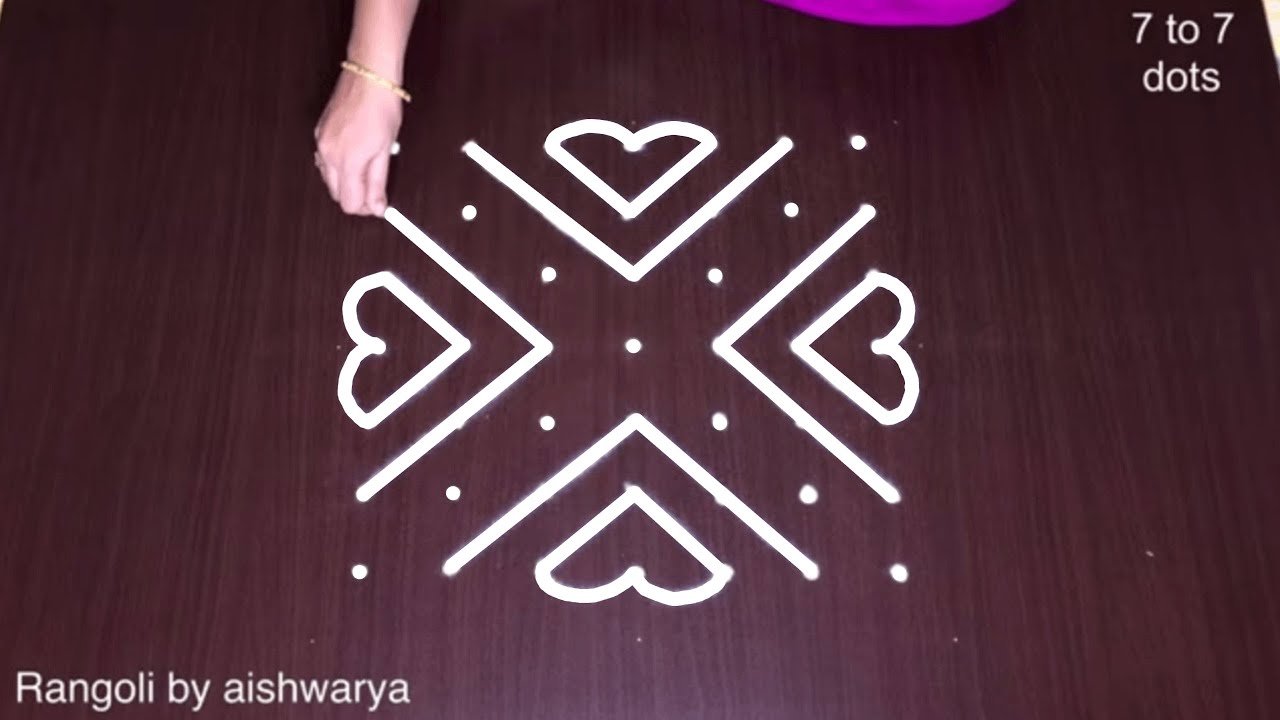
The motif entries in this chapter can be read one at a time, like dictionary entries. This essay is about the language they belong to — how rangoli’s symbols carry meaning, why one motif can say several things at once, and what makes a vocabulary of drawn forms durable enough to pass through centuries without a written grammar.
Symbols carry more than one meaning
A lotus in a rangoli is never only a flower. It may stand for natural beauty, purity, spiritual awakening, prosperity, and artistic order — simultaneously, without contradiction. The lamp motif works the same way: light, knowledge, hope, welcome, celebration. This layering is not vagueness; it is how symbolic systems achieve density. The meanings reinforce one another, and an experienced viewer holds several at once, the way a reader hears both the sense and the music of a line of verse.
Context decides
Which meaning is doing the work depends on where the motif appears. The same lotus reads differently in household worship, in a festival composition, in a mathematically strict kolam, in a ceremonial aripan diagram. Region, festival, rite, and family custom all select among a motif’s senses — which is why no entry in this chapter assigns a single fixed meaning, and why this encyclopedia’s regional chapters carry the variations. A symbol is not a code with one key; it is a word whose sense sharpens in a sentence.
Two sources: nature and geometry
Nearly the whole vocabulary descends from two parents. The first is observation: flowers opening at dawn, birds in the garden and the monsoon sky, fish, cattle, vines, the sun and moon — forms the practice stylised into ornament without losing their identities. The second is geometry: the dot, the circle, the square, the triangle, the star, the spiral — forms with no model in the landscape, carrying older associations of order, balance, and continuity. Rangoli’s characteristic look is the fusion of the two: organic imagery composed on mathematical scaffolding, the peacock’s curve balanced inside the grid’s discipline. Neither parent dominates, and the pairing is the tradition’s signature.
Symbols as memory
The vocabulary survives because it is transmitted the way the designs themselves are: by watching and doing. A child learning a motif from an elder learns three things at once — how to draw it, when it belongs, and what it says. The ethnographic record of the southern traditions documents exactly this bundled transmission, in which repertoire, occasion, and meaning travel together from hand to hand. A motif is therefore a small archive: it stores observation, belief, and convention in a form that needs no writing to persist — only practice.
A living vocabulary
None of this is static. Motifs stylise further over time, new imagery enters, colour ranges widen with new materials, regional conventions borrow from one another, and contemporary designers set old symbols to new themes. What is remarkable is how little the core has moved: the lotus still means what centuries of use have made it mean; the lamp still welcomes. A tradition is not preserved by exact repetition but by each generation extending the conversation — and the vocabulary endures precisely because it is still being spoken, morning after morning, rather than merely remembered.
Reading a design
Stand before a large festival rangoli and the language assembles itself in stages: first the colour, which carries the mood; then the motifs, each with its senses; then the structure holding them; and finally the open spaces that let the whole breathe. What looked at first like decoration resolves into a composed statement — welcome, celebration, gratitude, pride — legible to anyone who has learned even a little of the vocabulary. The entries in this chapter are that vocabulary, one word at a time.
References
- Vijaya Nagarajan, Feeding a Thousand Souls: Women, Ritual, and Ecology in India — An Exploration of the Kōlam, Oxford University Press, 2018.
- Jyotsna Kilambi, “Toward an Understanding of the Muggu: Threshold Drawings in Hyderabad”, RES: Anthropology and Aesthetics 10, 1985.
Further Reading
- Marcia Ascher, Mathematics Elsewhere: An Exploration of Ideas Across Cultures, Princeton University Press, 2002.
This entry publishes at Evidence Level E2: its claims rest on at least two independently verified sources.
Cite this entry: “A Language Without Words.” Rangoli Encyclopedia, Rangoli Designs, https://rangolidesigns.net/encyclopedia/language-without-words/ — a permanent URL under the encyclopedia’s stable-identity policy. Entry last reviewed 2026-07-28.