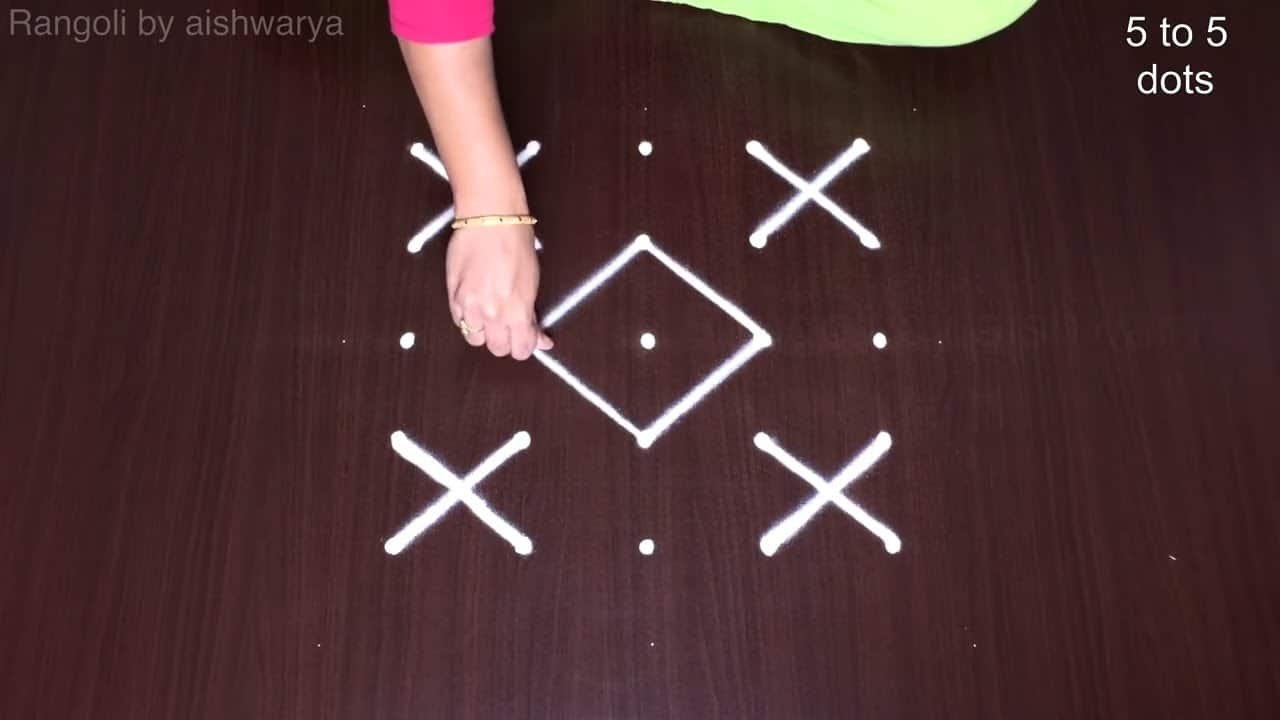
The family resemblance among eastern India’s floor arts is a substance. Rice is soaked, ground, and mixed with water into a smooth white liquid, and that liquid changes everything: applied with the fingertips, it behaves like paint rather than powder — continuous strokes, brush-like line, curves that flow instead of pour. The instrument is the hand itself — fingertips, a twist of cloth, simple improvised applicators — with line thickness and rhythm set entirely by the movement of the fingers, which is why practitioners describe the finished work as close to calligraphy. Three documented traditions share the medium and speak it in three distinct voices.
Alpana: Bengal’s flowing hand
The Bengali tradition takes its name from the Sanskrit alimpana — to adorn — and its character from pure freehand work: no dot grids, designs developed directly on the surface from the artist’s judgement and rhythm. The line is lyrical, with graceful curves, soft asymmetries, and generous open space. Its motif vocabulary is devotional and natural at once — the lotus, Lakshmi’s footprints drawn walking into the house at Lakshmi Puja, the conch, the fish that carries fortune and fertility in Bengali culture, creepers and mandala rounds — and its calendar runs through Durga, Lakshmi, Kali, and Saraswati Pujas, weddings, and household ceremony. Alpana also has an unusual modern history: the artistic circle around Santiniketan, Rabindranath Tagore’s cultural centre, took the folk form seriously alongside modern art education and carried it to national and international attention. The tradition’s foundational text belongs to the same circle: Abanindranath Tagore’s Banglar Brata (1919) documented the women’s brata rites and their alpana together, binding the designs to the vows they serve — the study this encyclopedia’s Alpana entry rests on.
Jhoti chita: Odisha’s walls and floors
Odisha’s tradition — jhoti naming the rice-paste motifs, chita the painted designs — is distinguished by its reach: it decorates walls as readily as floors, running across entrances, courtyards, prayer rooms, and granaries until the house itself becomes the artwork. The technique is the fingertip’s, producing white line work of almost calligraphic quality, and the motifs carry the agricultural east — rice sheaves for harvest and abundance beside the lotus, creepers, birds, and Lakshmi’s footprints. Its great season is Manabasa Gurubar, the Thursdays of the month of Margashirsha, when households prepare elaborate designs for the worship of Lakshmi; heritage settings such as the artists’ village of Raghurajpur keep the practice visible within Odisha’s broader craft culture.
Aripana: Mithila’s ceremonial diagrams
In the Mithila region of northern Bihar — one of South Asia’s oldest centres of literary and artistic culture, the same environment that produced Madhubani painting — the rice-paste art turns ceremonial. Many aripana designs are ritual diagrams in the strict sense: compositions made for particular occasions — weddings above all, sacred thread ceremonies, harvest observances, household worship — with the ceremony literally conducted upon the artwork. The geometry is measured and dignified: concentric circles, lotus forms, sacred feet, fish and grain motifs, balanced with a restraint that reads as concentration rather than austerity. Aripana and Madhubani painting are distinct arts — one temporary and on the ground, the other portable on walls, paper, and cloth — but they share Mithila’s symbolic vocabulary, and scholars read them together as one visual culture.
One medium, three voices
The same white liquid, three identities: Bengal’s lyric freehand, Odisha’s architectural reach, Mithila’s ceremonial precision. What they hold in common besides the paste is the keeping — all three transmitted for generations by women, household to household, occasion by occasion — and the register of renewal: designs made fresh for each festival, each Thursday, each wedding, in a medium that was always meant to return to the earth it briefly decorated.
References
- Vijaya Nagarajan, Feeding a Thousand Souls: Women, Ritual, and Ecology in India — An Exploration of the Kōlam, Oxford University Press, 2018.
- Jyotsna Kilambi, “Toward an Understanding of the Muggu: Threshold Drawings in Hyderabad”, RES: Anthropology and Aesthetics 10, 1985.
- Abanindranath Tagore, Banglar Brata, Visva-Bharati, first published 1919.
Further Reading
- Marcia Ascher, “The Kolam Tradition”, American Scientist 90(1), 2002.
This entry publishes at Evidence Level E2: its claims rest on at least two independently verified sources.
Cite this entry: “The Rice-Paste Line.” Rangoli Encyclopedia, Rangoli Designs, https://rangolidesigns.net/encyclopedia/rice-paste-line/ — a permanent URL under the encyclopedia’s stable-identity policy. Entry last reviewed 2026-07-29.