
Definition
Alpana is the floor-art tradition of Bengal: designs in liquid rice paste, drawn with the fingertips in flowing white line, made by women as part of household rites. The name is traditionally connected to the Sanskrit alimpana, “to adorn”; the practice belongs to the wet-line family of the eastern traditions rather than the dry-powder south.
History
Alpana carries the oldest foundational study in this encyclopedia’s bibliography: Abanindranath Tagore’s Banglar Brata, first published in 1919, which treated the women’s brata rites of Bengal — and the alpana drawn for them — as serious folk culture worth documenting. Tagore’s central observation binds the art to its keepers: it is in the genuine women’s bratas, he writes, in their rhymes and their alpana, that one finds “the imprint of a people’s mind” — their thought and their effort — and he distinguished these household rites sharply from priestly, scriptural observance. The artistic circle around Santiniketan later carried the form into modern art education, giving alpana an institutional life most floor arts never had.
Description
Rice is soaked and ground into a smooth white liquid that behaves like paint: applied with the fingertips or a twist of cloth, it produces continuous, brush-like strokes — lyrical curves, soft asymmetries, generous open space. Alpana is freehand work; no dot grid underlies it, and its line flows where the southern traditions’ counted geometry pours. The medium and its behaviour are described in full in The Rice-Paste Line.
Cultural Context
The alpana is not decoration that happens near a rite — it is a component of the rite. Designs are made for particular bratas, the vows women keep for household welfare, and the drawing belongs to the vow’s performance; Tagore recorded rite-design pairings as part of the tradition’s fabric, and held that the brata itself is humanity’s common property, bound to no single creed. One recorded pairing shows how literal that binding is: for the Bahudhara brata, kept in desire of rain, eight stars are drawn in the alpana, while the accompanying rite imitates rainfall itself — water poured over a tree’s crown through a perforated earthen pot. The design is not an illustration of the vow; it is one of the vow’s required acts. Tagore states the governing idea directly: the alpana is the picture of the wish, and the rhyme its echo. His fullest example is the Bhaduli brata, kept for travellers: rivers, seas, forests, wild animals and boats are drawn in alpana around the votary, and she moves from figure to figure holding a flower to each and speaking its rhyme — at the river, “River, river! Where do you go? Give news of father and brother!” — a rite he places in a world where news of someone travelling by water could arrive no faster than the water itself. He is careful about what the flower means: it is not worship of the drawn river or tiger but a reckoning mark, “like a red pencil stroke in an account book, to keep the count right”, recording that this wish has been declared. The same accounting appears in the Bahudhara rhyme, which calls the eight stars to witness eight flowers set in eight directions — the drawn design, the spoken wish and the counted offering forming one act. The custodianship is the family pattern this encyclopedia documents across traditions: women, transmitting by demonstration — the subject of A Women’s Art.
Regional Variations
Alpana belongs to the Bengali cultural region, with its great seasons at the goddess festivals — Durga, Lakshmi, Kali, and Saraswati Pujas — when courtyards and worship spaces receive their fullest designs; at Lakshmi Puja, Lakshmi’s footprints are drawn walking into the house. The Santiniketan lineage gave the form a second register: alpana as taught and exhibited art, alongside the household practice it came from. Within the wet-line family, Odisha’s jhoti chita and Mithila’s aripana are sister voices, each treated in The Rice-Paste Line.
Related Topics
The medium is The Rice-Paste Line; the custodianship is A Women’s Art; the festival context is Navaratri, whose eastern form is Durga Puja; the comparative frame is One Idea, Many Languages.
Gallery
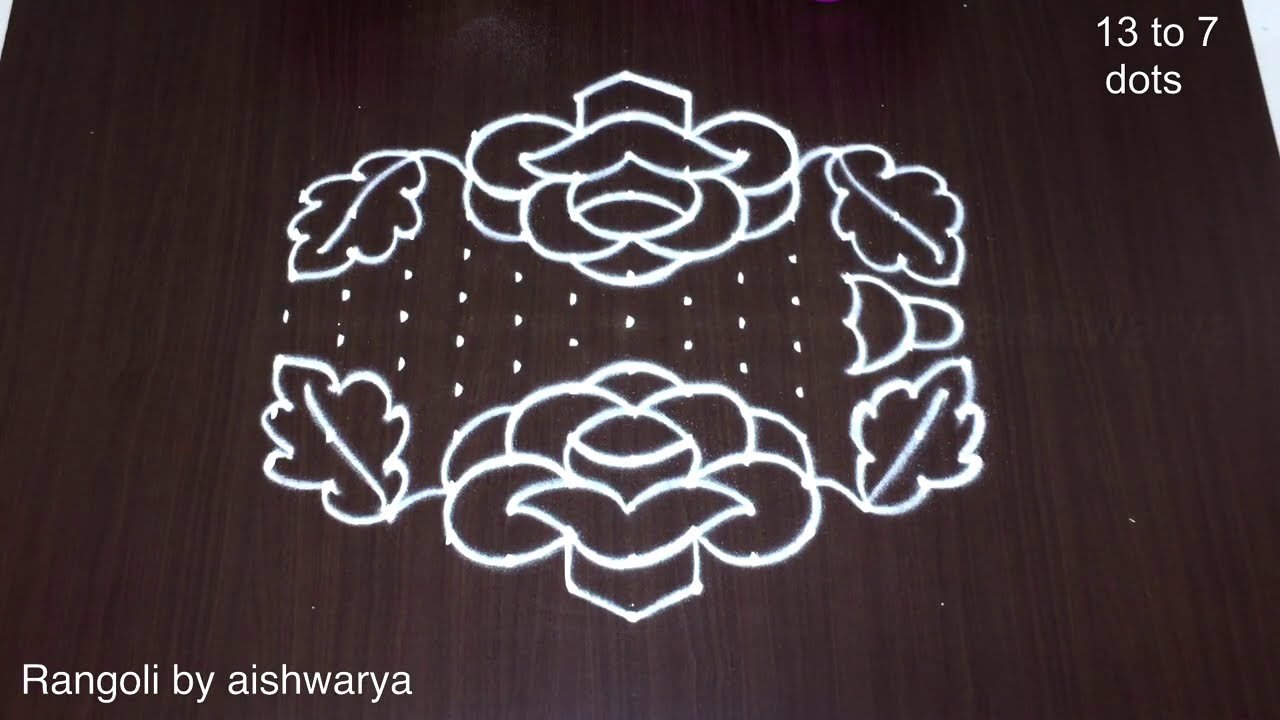
Durga Puja Alpana Rangoli — from the design library.
References
- Abanindranath Tagore, Banglar Brata, Visva-Bharati, first published 1919.
Further Reading
- Vijaya Nagarajan, Feeding a Thousand Souls: Women, Ritual, and Ecology in India — An Exploration of the Kōlam, Oxford University Press, 2018 — for the documented daily practice of the southern sister tradition.
This entry publishes at Evidence Level E1: common knowledge within the tradition, anchored to a verified standard reference.
Cite this entry: “Alpana.” Rangoli Encyclopedia, Rangoli Designs, https://rangolidesigns.net/encyclopedia/alpana/ — a permanent URL under the encyclopedia’s stable-identity policy. Entry last reviewed 2026-07-30.