Definition
The spiral motif is the curve that turns without closing: a line winding outward (or inward) around a centre, expanding with every revolution. Between the circle, which repeats, and the straight line, which departs, the spiral develops — and that is its meaning and its use: it is the rangoli vocabulary’s figure of growth, and its most natural instrument of visual movement.
Drawn singly, doubled, or radiating in sets from a centre, the spiral appears wherever a composition wants living energy — coiled at corners, unwinding along borders, or carrying a whole design’s motion from its heart.
History
The spiral is among humanity’s oldest drawn forms, and nature supplied the models: seashells, fern fronds unfurling, climbing vines, whirlpools, horns — growth after growth following the same curved logic, from seed arrangements to (as later astronomy found) the galaxies themselves. Indian decorative arts absorbed the form early and everywhere: temple carving, bronze work, manuscript borders, textiles, and pottery all carry spiral ornament, freestanding or merged into floral scrolls and stylised foliage.
Mathematics later named the family’s members — Archimedean, logarithmic, Fibonacci-related — and traced why growth so often takes the shape; the practice needed none of the names. Threshold artists have drawn balanced spirals freehand for as long as the arts have existed, controlling curvature and spacing entirely by hand and eye.
Description
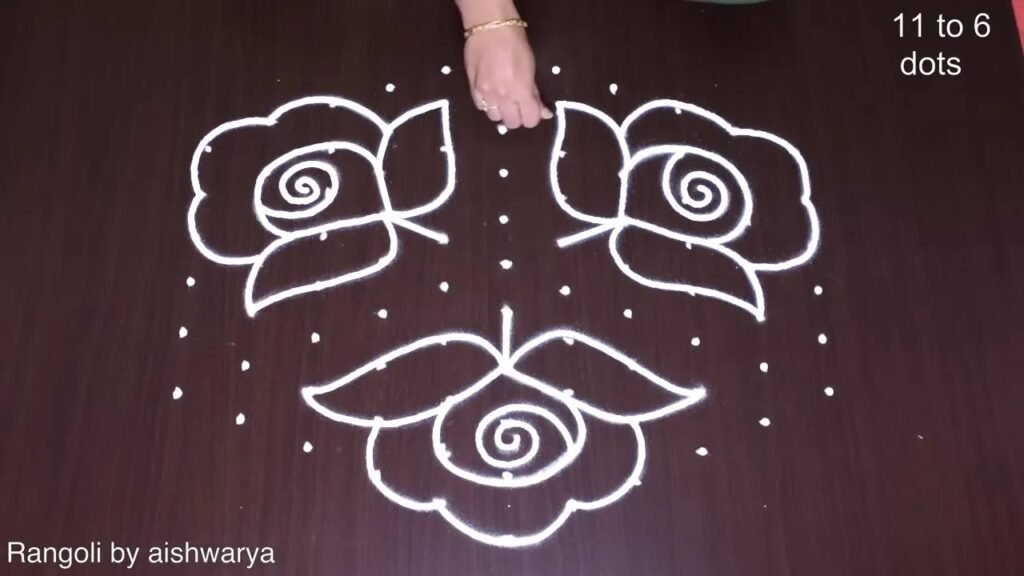
The drawn spiral is an exercise in steadiness: one continuous stroke, radius growing evenly, spacing between passes held constant. Uneven growth is instantly visible, which makes the form a favourite test and teacher of hand control. The repertoire includes the single coil, the double spiral of paired complementary curls, floral spirals with petals stationed along the expanding curve, vine spirals joining larger motifs, and the spiral mandala — multiple coils radiating symmetrically from one centre.
Compositionally the spiral is the eye’s escort: it leads the gaze along its path, so artists use it to move attention — into a centre, around a border, between motifs. Where the chakra implies rotation in place, the spiral implies travel; a design with spirals in it reads as happening rather than arranged.
Cultural Context
The spiral’s readings follow from its geometry: a circle returns unchanged, a spiral returns changed — each cycle at a new radius, carrying what came before. Communities made it the figure of growth, transformation, and the unfolding journey: progress that circles without repeating. The senses are theirs to bring; the drawn fact is a curve that will not close, and the fact does most of the arguing.
The motif also carries the practice’s own signature in miniature: like the kolam line, the spiral is continuous, hand-governed, and patient — complexity accumulated one steady turn at a time. It is perhaps the vocabulary’s plainest image of how the tradition itself grows.
Its double form deserves a note: two spirals coiling toward one another — or outward from a shared stem — make one of ornament’s oldest paired figures, read as complementary forces in balance. Rangoli uses the pair at corners and along borders, where the opposed curls hold each other visually still; a single spiral travels, but a double spiral rests, and the practice deploys each accordingly.
Regional Variations
Spiral work appears in every tradition — coiled units in the southern grid arts, flowing scrollwork in the freehand festival styles, painted curls in the eastern rice-paste arts, and spiral ornament throughout the ceremonial diagram traditions. The form merges so readily with vines and floral scrolls that its boundaries blur by design; wherever a curve grows as it turns, the spiral is present.
Related Topics
The spiral’s natural bearer is the Conch, nature’s own drawn spiral; its botanical kin is the Creeper; its radial relatives are the Chakra and Mandala; its drawing culture belongs to Freehand practice.
Gallery
References
- Vijaya Nagarajan, Feeding a Thousand Souls: Women, Ritual, and Ecology in India — An Exploration of the Kōlam, Oxford University Press, 2018.
Further Reading
- Marcia Ascher, Mathematics Elsewhere: An Exploration of Ideas Across Cultures, Princeton University Press, 2002.
This entry publishes at Evidence Level E1: common knowledge within the tradition, anchored to a verified standard reference.
Cite this entry: “Spiral.” Rangoli Encyclopedia, Rangoli Designs, https://rangolidesigns.net/encyclopedia/spiral/ — a permanent URL under the encyclopedia’s stable-identity policy. Entry last reviewed 2026-07-28.