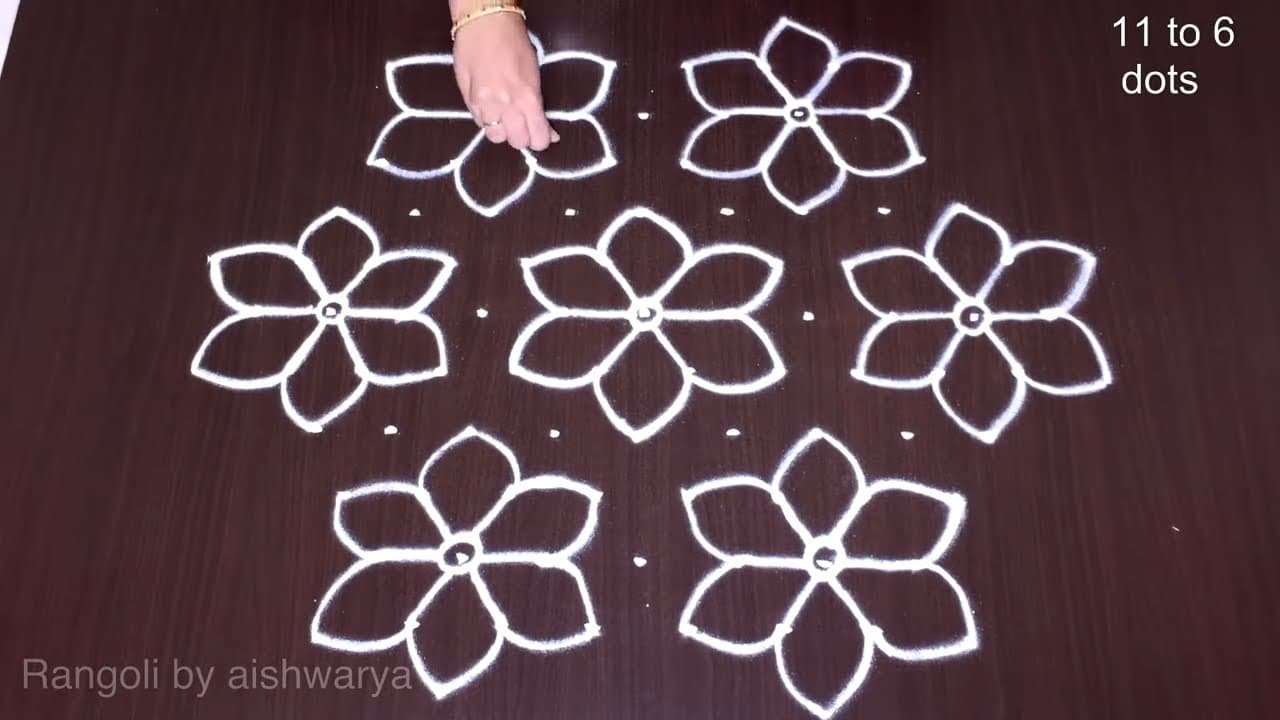
If one mathematical idea defines this art above all others, it is symmetry — and symmetry, despite its endless appearances, comes in exactly four kinds on a flat surface. Reflection, rotation, translation, and glide reflection are the complete alphabet: every balanced threshold design ever drawn is spelled from these four letters, alone or in combination.
Reflection: balance across a line
A figure has reflection symmetry when an imaginary line divides it into two halves, each the mirror of the other. It is the most familiar symmetry — butterflies, faces, doorways — and the practice uses it constantly: doorway compositions balanced left and right, lotuses folded across a vertical axis, borders mirrored along their length. The practitioner’s mirror is imagined, never drawn; years of practice make the invisible axis precise, and many artists think only half a design while drawing, the other half following from the relationship already established.
Rotation: balance around a point
Rotational symmetry needs no mirror — the figure repeats itself as it turns about a centre. Mathematics counts it by order: a design of order eight matches itself every 45 degrees, since the full circle divides as 360 over the order. This is the symmetry of the radial families — petalled centres, stars, mandala compositions — and its discipline is the equal division of the circle, performed by eye. A design of order eight welcomes viewers from every direction equally: radial balance has no front and no back, which is why circular compositions suit courtyards and open spaces where no single approach is privileged.
Translation: balance by repetition
Translational symmetry is repetition through space: a motif repeated at equal intervals along a line, nothing rotated, nothing mirrored — simply moved. This is the mathematics of every border, running vine, and festival walkway: one carefully designed unit, repeated with consistent spacing, becomes an arbitrarily long composition. The repetition is rhythm made visible — each motif a beat — and it is also economy: the artist designs once and extends indefinitely, which is how modest units become courtyard-length ornament.
Glide reflection: the walker’s symmetry
The fourth symmetry is the subtlest: reflect a motif across a line, then slide it along that same line. Neither operation alone recreates the pattern; together they produce the alternating rhythm of footprints on sand — left, right, left, each a mirrored step forward. Borders built this way alternate leaning motifs — a leaf pointing left, its reflection pointing right, both advancing — giving long compositions movement that plain repetition lacks. It is the hardest of the four to spot and one of the most used, precisely because alternation defeats monotony without disturbing order.
The four together
Real designs rarely use one symmetry alone. A festival composition may hold a rotationally symmetric centre, mirrored inner motifs, translated border units, and glide-reflected chains — different symmetries at different scales, nested without conflict. That layering is the tradition’s compositional depth: viewed close, each unit shows its own order; viewed whole, the orders assemble into a larger one. And because each of the four operations preserves shape and size exactly — mathematics calls them isometries — complexity accumulates without distortion.
Why it matters
The four symmetries are not decoration theory; they are the complete inventory of ways a flat pattern can be balanced, the same inventory crystallography and design science use. The comparative literature on cultural pattern analyses exactly these operations in the world’s decorative arts, and the threshold traditions supply some of its richest material: a practice that never wrote the word “isometry” has been composing with all four, fluently, for as long as anyone has watched.
References
- Marcia Ascher, Mathematics Elsewhere: An Exploration of Ideas Across Cultures, Princeton University Press, 2002.
- Vijaya Nagarajan, Feeding a Thousand Souls: Women, Ritual, and Ecology in India — An Exploration of the Kōlam, Oxford University Press, 2018.
Further Reading
- Marcia Ascher, “The Kolam Tradition”, American Scientist 90(1), 2002.
This entry publishes at Evidence Level E2: its claims rest on at least two independently verified sources.
Cite this entry: “The Four Symmetries.” Rangoli Encyclopedia, Rangoli Designs, https://rangolidesigns.net/encyclopedia/four-symmetries/ — a permanent URL under the encyclopedia’s stable-identity policy. Entry last reviewed 2026-07-28.