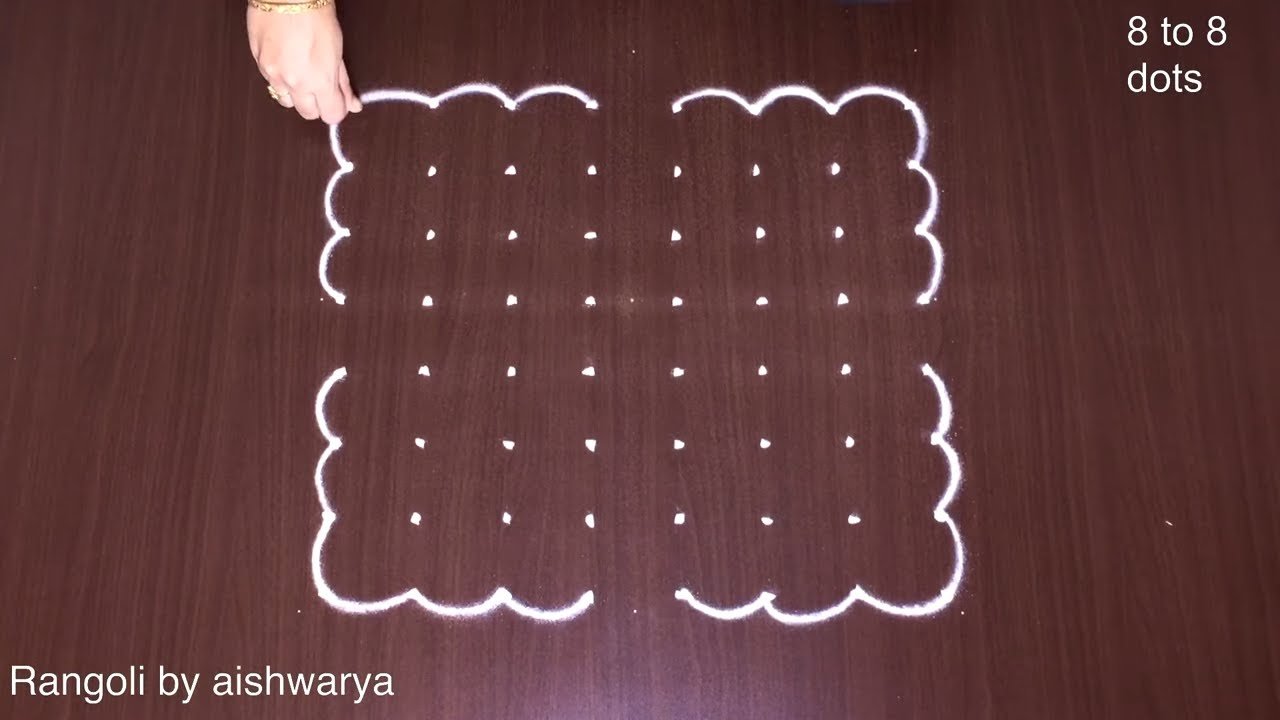
In 1736 Leonhard Euler settled a puzzle about the seven bridges of Königsberg — could a walk cross each bridge exactly once? — and in settling it founded graph theory, the mathematics of networks. For generations before and since, Tamil households have been drawing designs governed by the same question: can one unbroken line complete the whole figure without retracing? The knot kolam and the Königsberg walk are the same problem, discovered twice.
What Euler saw
Euler’s insight was that the puzzle’s geography didn’t matter — only its connections did. Reduce the city to points (vertices) and links (edges), and the walk’s possibility depends purely on how the network joins up. A route that travels every edge exactly once is now called an Eulerian path; one that also returns to its start, an Eulerian circuit. Whether either exists is decided by the network’s structure alone — a fact with no regard for what the network looks like.
The kolam as a network
A continuous-line kolam abstracts the same way. Let the crossings be vertices and the curve-segments between them edges, and the drawn design becomes a graph; the artist’s single unbroken line is precisely a traversal of that graph — ideally an Eulerian circuit, since the classic sikku closes where it began. The research literature makes exactly this reading: the kolam’s continuous families analysed as graphs, their single-line property as traversal, their construction as a network problem solved by hand at dawn.
The topology underneath
A second branch of mathematics reads the same designs more loosely. Topology — geometry with stretching allowed — ignores exact shapes and asks only about connection: is the figure one piece or several? how many closed loops? what regions do they enclose? Under this reading a kolam keeps its identity through every stylistic variation: drawn larger, narrower, or rounder, the design remains the same object so long as nothing is cut and no crossing is added or lost. That is why one design can fit a doorway or a courtyard and remain itself — its structure lives in its connections, not its measurements — and why the enclosed regions, the pattern’s breathing spaces, count as part of the mathematics. The topological reading has since become constructive: a 2015 study states the pulli kolam’s three mandatory rules formally — every line orbit closed, every dot encircled, no two lines overlapping along a length — and gives a five-step method that generates every possible kolam for any arrangement of dots, the practice’s rule-set turned into a complete generative theory. The multi-loop case has its own exact result: for the standard N×M lattice, the number of loops a kolam decomposes into is the greatest common divisor of N and M — the same arithmetic that governs a billiard ball’s path reflecting around a table — so a 9×6 grid yields exactly three loops, and a lattice closes as a single unbroken line precisely when its two dimensions share no common factor.
Drawing as planning
For the practitioner the theory is lived as foresight. At every junction the line’s route is a commitment: a wrong early choice can strand a region that the single line can no longer reach without retracing. Completing a large knot design therefore means holding the whole route in mind — local decisions serving a global plan — which is the same local-versus-global tension that network algorithms manage. The tradition’s masters resolve it from memory, before sunrise, without notation; the efficiency of a practised drawing, every movement contributing and nothing repeated, is the Eulerian ideal performed rather than proved. The distinction between open and closed runs through the whole family: an open path ends elsewhere than it began, a closed circuit returns — and the tradition’s strong preference for closure is a choice with meaning as well as mathematics, the completed round carrying the sense of wholeness that an unfinished walk cannot.
Two discoveries, one structure
Graph theory now runs the modern world’s networks — routing, circuits, communication — and its founding question turns out to be the knot kolam’s daily discipline. Neither tradition borrowed from the other; the structure is simply real, and both found it. That is the deepest thing the one-line problem teaches: mathematical objects do not belong to mathematics. A household that has drawn closed traversals for generations owns the idea in the most practical sense there is — and the formal theory, arriving later, describes what the threshold already knew.
References
- Marcia Ascher, “The Kolam Tradition”, American Scientist 90(1), 2002.
- Gift Siromoney, Rani Siromoney & Kamala Krithivasan, “Array grammars and kolam”, Computer Graphics and Image Processing 3(1), 1974.
- Venkatraman Gopalan & Brian K. VanLeeuwen, “A topological approach to creating any pulli kolam, an artform from South India”, Forma 30, 2015.
- Shojiro Nagata, “How Many Loops Kolam Loop Pattern Consists of”, Forma 30, 2015.
Further Reading
- Kiwamu Yanagisawa & Shojiro Nagata, “Fundamental Study on Design System of Kolam Pattern”, Forma 22, 2007.
This entry publishes at Evidence Level E2: its claims rest on at least two independently verified sources.
Cite this entry: “The One-Line Problem: Euler and the Kolam.” Rangoli Encyclopedia, Rangoli Designs, https://rangolidesigns.net/encyclopedia/one-line-problem/ — a permanent URL under the encyclopedia’s stable-identity policy. Entry last reviewed 2026-07-28.