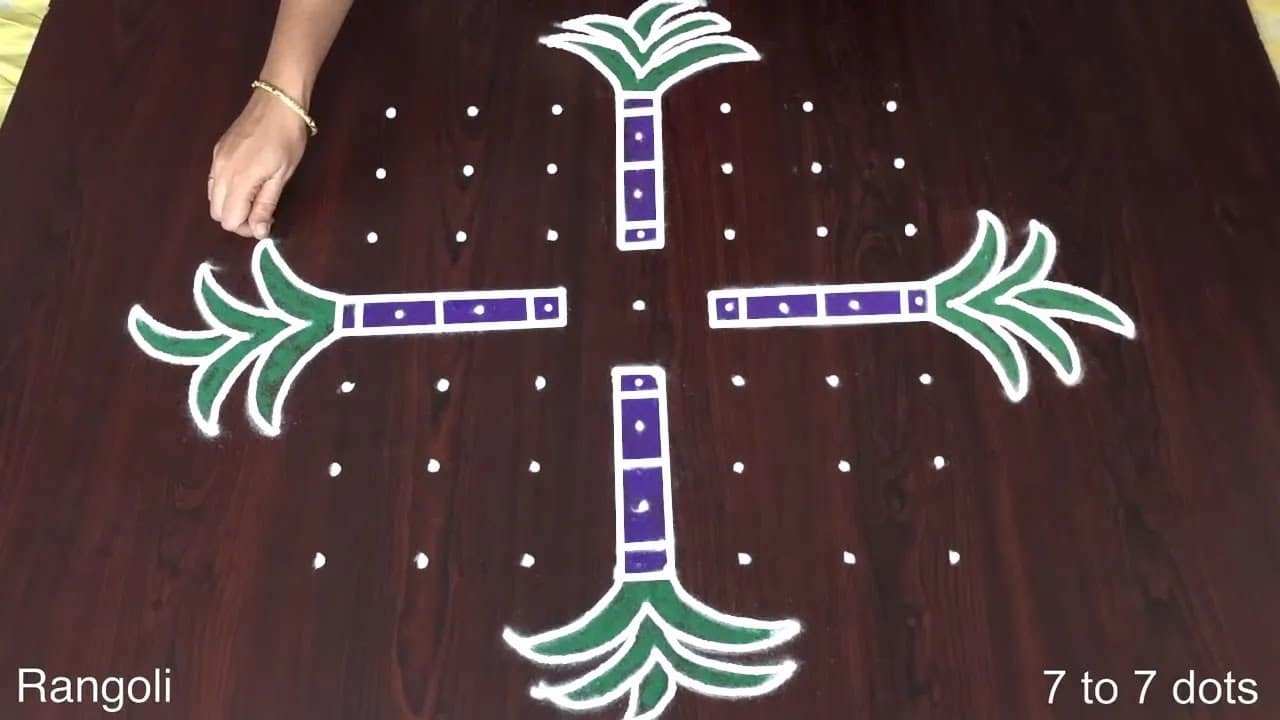
Definition
The cow motif — gau — draws the domestic animal in calm profile: broad oval body, rounded head, curved horns, slender legs, flowing tail, often garlanded and ornamented in the festival register. Where the elephant motif carries grandeur, the cow carries gentleness; it is the rangoli vocabulary’s figure of nourishment and quiet, dependable care.
The motif’s frequent companion is the calf — the cow-with-calf pairing is its most tender form — and its festival dress records a real practice: at harvest celebrations cattle are genuinely bathed, garlanded, and honoured, so the decorated drawn cow depicts an actual ceremonial sight.
History
Cattle stand at the beginning of the subcontinent’s agricultural story, and its art keeps them there: documented from Indus-era seals and rock paintings through temple sculpture, bronzes, miniatures, folk art, and textiles. Domestication gave communities milk, dairy, manure for the fields, and draught power; cow and ox together were the engine of traditional farming, and the animal’s artistic constancy reflects that economic centrality — the herd was the village’s stability made visible.
In Hindu tradition the cow gathered profound associations — nourishment, motherhood, generosity, ahimsa — and its most beloved artistic setting is pastoral: Krishna the cowherd among his cattle in Vrindavan, an image of harmony between people, animals, and landscape that painting and sculpture have returned to for centuries. The rangoli cow inherits that whole gentle iconography.
Description
The figure is drawn calm by convention: standing or resting, never in motion, the broad body providing a stable visual centre and the horns, ears, and tail adding graceful line. Artists simplify to oval body and circle head, then ornament — garlands, painted horns, ceremonial cloth — according to occasion. The cow-with-calf pairing composes naturally as a protective curve; the decorated festival cow takes centrepiece roles; stylised cows join border and procession schemes.
Design practice notes the animal’s suitability for symmetry: the resting profile balances readily, and the form survives high simplification because — as with the elephant — the silhouette carries the identity. It is among the easier large animals for a learner to draw acceptably and among the most rewarding for a practised hand to ornament.
Cultural Context
The cow’s attributed meanings restate its historical role: nourishment, generosity, maternal care, patience, peace, prosperity — abundance given daily and without aggression. The deeper ethical register ties the animal to compassion extended beyond the human: across Indian philosophical traditions, care for the cow stands for care for the living world, gratitude toward the sources of life rather than mere ownership of them. The meanings live in the practice, not the powder; what is drawn is a gentle quadruped with curved horns.
Behind the symbolism stands a system traditional villages ran for centuries: milk nourishing the family, manure feeding the fields and fuelling the hearth, draught power working the land — an integrated economy in which nothing was wasted and the animal’s well-being and the household’s were one. The modern vocabulary would call it sustainability; the festival that decorates the cattle simply calls it gratitude, and the drawn cow at the threshold keeps that account visible.
The motif’s great occasions are the harvest festivals: Mattu Pongal in Tamil Nadu — the Pongal day dedicated to cattle, when the animals are decorated and honoured for the year’s labour — and Govardhan Puja in the north, with regional harvest celebrations between. A cow drawn at a farmhouse threshold during Pongal is gratitude in powder, thanking the actual animals a few steps away.
Regional Variations
Cow motifs concentrate where agricultural festival cycles are strongest: the Tamil Pongal traditions give the animal its most prominent rangoli role, Telugu Sankranti practice includes cattle among its harvest imagery, and the northern Govardhan observances carry their own conventions. India’s many indigenous cattle breeds give regional artists slightly different models — hump, horn curve, dewlap — and the folk-painting traditions supply ornament vocabularies the floor art borrows freely.
Related Topics
The cow’s festival is Pongal; its harvest companions are the Sun and Kalash; its fellow figure of gentle strength is the Elephant; the umbrella practice is Rangoli.
Gallery
References
- Jyotsna Kilambi, “Toward an Understanding of the Muggu: Threshold Drawings in Hyderabad”, RES: Anthropology and Aesthetics 10, 1985.
- Vijaya Nagarajan, Feeding a Thousand Souls: Women, Ritual, and Ecology in India — An Exploration of the Kōlam, Oxford University Press, 2018.
Further Reading
- Marcia Ascher, “The Kolam Tradition”, American Scientist 90(1), 2002.
This entry publishes at Evidence Level E2: its claims rest on at least two independently verified sources.
Cite this entry: “Cow.” Rangoli Encyclopedia, Rangoli Designs, https://rangolidesigns.net/encyclopedia/cow/ — a permanent URL under the encyclopedia’s stable-identity policy. Entry last reviewed 2026-07-28.