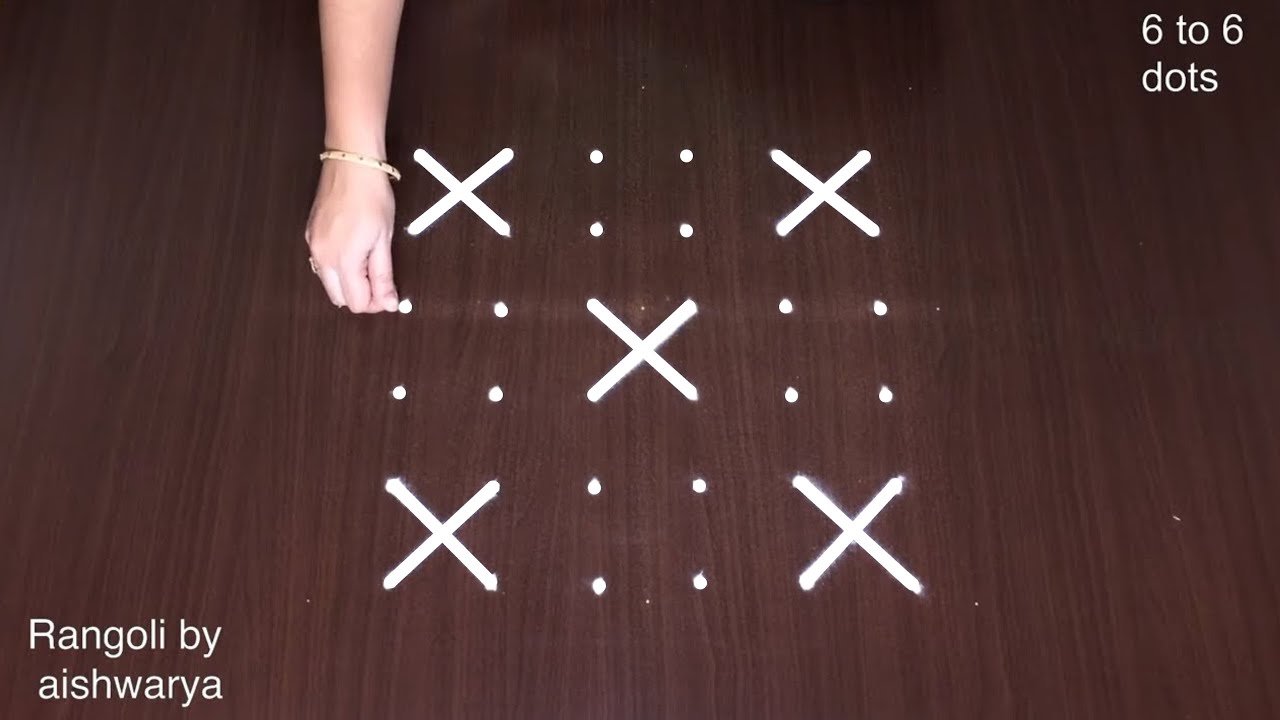
An art form that erases itself daily leaves historians almost nothing to excavate. Rain, feet, and the next morning’s sweeping have destroyed every rangoli ever drawn before the age of photography — so the tradition’s history must be reconstructed from everything around the missing artworks. Four kinds of evidence carry the weight.
Four windows on a vanished art
Archaeology recovers the settings, not the drawings: settlements, thresholds, courtyards, and the material culture of the societies that drew. Literature — Sanskrit and regional — attests decorated thresholds, ritual diagrams, and ceremonial ground-preparation without ever functioning as a manual for the modern practice. Artistic evidence — sculpture, painting, and eventually photography — occasionally depicts prepared ceremonial space. And living tradition supplies what the others cannot: techniques, motifs, and methods transmitted continuously within families, the same transmission the modern ethnography documents in detail.
The rule that governs this chapter
Not every beloved story about rangoli’s origins can be verified, and this encyclopedia does not pretend otherwise. Some accounts are archaeologically supported; some are documented in texts; some live in regional folklore and religious tradition. All have cultural value — but they are different kinds of knowledge, and the essays in this chapter mark the difference explicitly. Where a claim rests on documented evidence, it is stated; where it rests on continuity or inference, it is framed that way; where it is legend, it is honoured as legend.
Absence of evidence is not absence of practice
The single most important methodological fact about rangoli’s history: the medium guarantees that ancient examples cannot survive. Rice flour, chalk, petals, and coloured earth return to the ground within days. The lack of excavated rangoli therefore proves nothing about the practice’s antiquity — it reflects the material, not the history. Traditions of music, storytelling, and dance present the same profile: continuous for centuries, nearly invisible to the spade.
Why continuity counts as evidence
The strongest single argument for the practice’s depth is the practice itself. The daily kolam and muggu documented by modern scholarship — Nagarajan’s Tamil ethnography, Kilambi’s Hyderabad study — describe transmission systems (observation, imitation, correction, repetition) built to carry knowledge across generations without writing anything down. A tradition organised this way preserves its own history in living form; the historian’s task is to read it carefully, alongside every scrap the written record offers.
References
- Vijaya Nagarajan, Feeding a Thousand Souls: Women, Ritual, and Ecology in India — An Exploration of the Kōlam, Oxford University Press, 2018.
- Jyotsna Kilambi, “Toward an Understanding of the Muggu: Threshold Drawings in Hyderabad”, RES: Anthropology and Aesthetics 10, 1985.
Further Reading
- Marcia Ascher, Mathematics Elsewhere: An Exploration of Ideas Across Cultures, Princeton University Press, 2002.
This entry publishes at Evidence Level E2: its claims rest on at least two independently verified sources.
Cite this entry: “Reading the Evidence.” Rangoli Encyclopedia, Rangoli Designs, https://rangolidesigns.net/encyclopedia/reading-the-evidence/ — a permanent URL under the encyclopedia’s stable-identity policy. Entry last reviewed 2026-07-28.