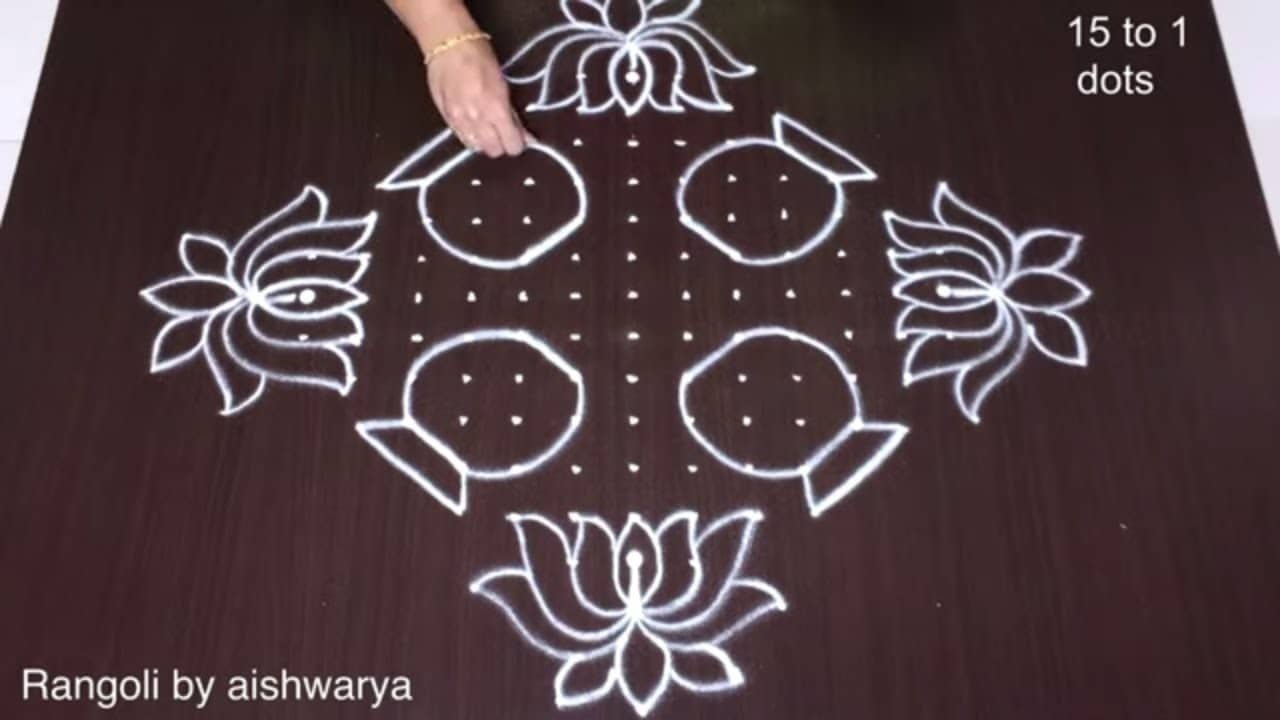
Between roughly 600 and 1700 CE, the floor-art traditions recognisable today took shape — not by invention at any single moment, but by regional differentiation within a shared culture of ceremony. Two engines drove the process: the temple, and the region.
The temple as art school
Early medieval India’s temples were far more than places of worship: they were artistic centres, schools, performance venues, and community spaces, built by dynasties — Pallava, Chola, Chalukya, Pala, and their peers — competing in architectural refinement. Temple ritual made preparation itself an art: courtyards swept, lamps lit, flowers laid, ground decorated for festivals renewed at every celebration. The devotional movements that spread from this era carried the same aesthetic into ordinary homes — preparing one’s threshold as an act of devotion — which is precisely the register in which the daily kolam and muggu are documented by modern scholarship. Temple inscriptions record the festivals and the patronage; the temporary decorations themselves, as always, went unrecorded in detail.
Regions become traditions
Across the same centuries, regional identity strengthened — languages, literatures, architectural schools — and floor art differentiated with it. The Tamil country refined the dot-grid and continuous-line systems whose daily practice built the kolam’s extraordinary precision; the Telugu lands developed the muggu’s festival scale and harvest imagery; rice-paste traditions flourished in the east as alpana and jhoti chita; the west and north shaped rangoli’s floral freehand, mandana’s bold ochre-ground geometry, aipan’s red-and-white ritual work, aripana’s ceremonial diagrams, sathiya’s auspicious marks. Local materials shaped local styles — shell lime on the coasts, rice flour on the plains, mineral pigments in the hills — and pilgrimage, trade, and marriage moved motifs between them continually. Diversity without isolation: the same lotus travels everywhere and belongs everywhere differently.
Continuity through empires
The political history of these centuries — sultanates, Vijayanagara, the Mughals, the Marathas — reshaped India’s monumental arts repeatedly. Household tradition tells a quieter story: thresholds went on being swept and drawn regardless of who ruled, and there is no evidence that imperial art displaced domestic floor drawing. New decorative vocabularies entered the wider culture; the practice absorbed what suited it and continued. Its historians call this history from below — carried in household memory rather than royal inscription, and largely sustained, in the domestic sphere, by generations of women whose transmission the modern ethnography documents in detail.
What the era establishes
By 1700, the map of traditions this encyclopedia’s Part II describes was recognisably drawn — regionally distinct, mutually connected, orally transmitted, and already old.
References
- Vijaya Nagarajan, Feeding a Thousand Souls: Women, Ritual, and Ecology in India — An Exploration of the Kōlam, Oxford University Press, 2018.
- Jyotsna Kilambi, “Toward an Understanding of the Muggu: Threshold Drawings in Hyderabad”, RES: Anthropology and Aesthetics 10, 1985.
Further Reading
- Marcia Ascher, “The Kolam Tradition”, American Scientist 90(1), 2002.
This entry publishes at Evidence Level E2: its claims rest on at least two independently verified sources.
Cite this entry: “Temples, Regions, and the Making of Traditions.” Rangoli Encyclopedia, Rangoli Designs, https://rangolidesigns.net/encyclopedia/making-of-traditions/ — a permanent URL under the encyclopedia’s stable-identity policy. Entry last reviewed 2026-07-28.