

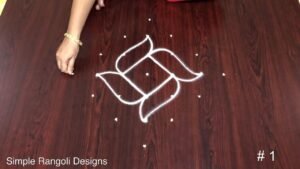
Definition
Navaratri is the nine-night autumn festival of the goddess, kept across India in regional forms in the month of Ashwin (September–October) — and at thresholds it is a season of sustained drawing: nine days of designs, refreshed daily, in the weeks that open the South Indian festival cycle’s densest stretch.
History
In the Tamil ethnography the festival’s household centrepiece is the golu — the tiered display of figures kept through the nine nights — with kolams drawn daily at the threshold and before the display; the goddess-focused Fridays that the drawing literature documents intensify within it. The nine nights traditionally honour the goddess in her successive forms, with the closing days — Saraswati Puja and Ayudha Puja, then Vijayadashami — each carrying household observances of their own, and the drawing keeping pace with the sequence.
Description
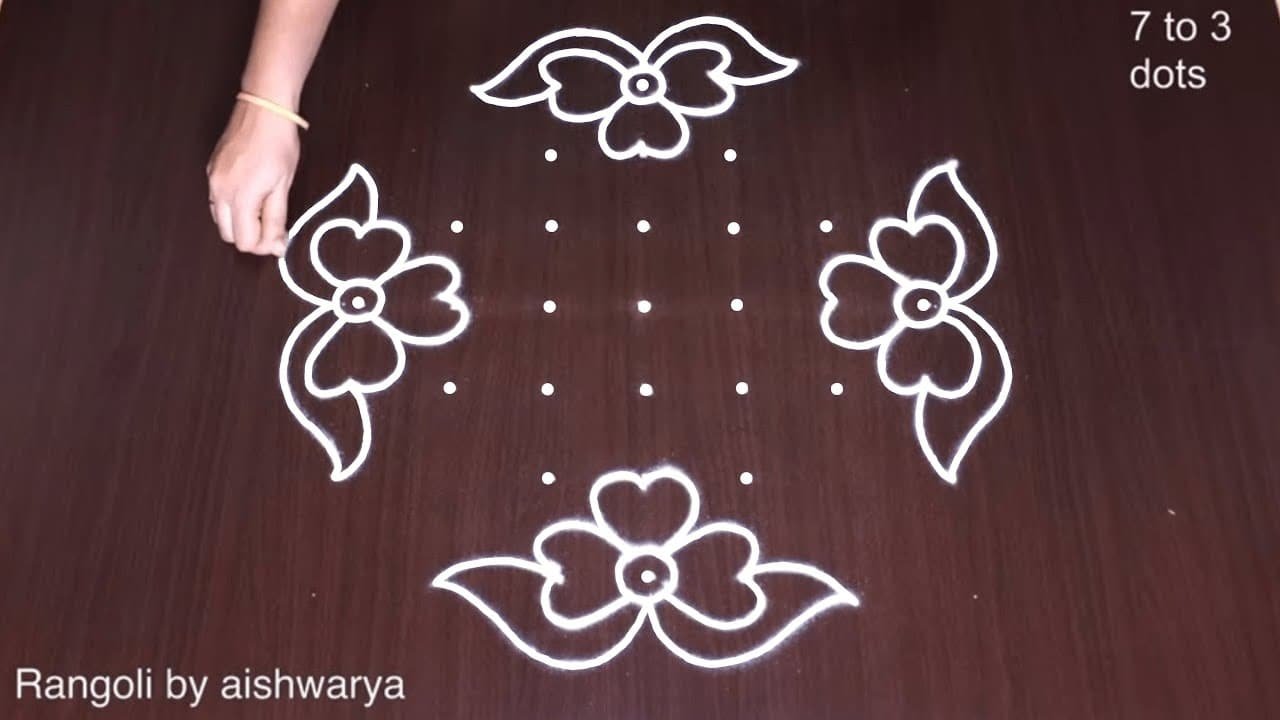
Navaratri drawing favours steadiness over single spectacle: a fresh design each morning for nine days, commonly goddess-oriented in motif — lotus forms, lamps, and the feet of Lakshmi — with scale rising toward the closing days. Before the golu itself a second, finer design marks the display’s ground, and visiting between households — the festival’s evening social round — means the season’s work is seen by more guests than any other stretch of the year.
Cultural Context
Each of the nine nights honours the goddess in a form, and the daily kolam is commonly described as part of the household’s welcome to her — the threshold kept continuously prepared through the festival, hospitality sustained rather than staged once. The season’s visiting culture makes the drawing double as reception: the design greets the goddess and the guests in the same gesture. As throughout this encyclopedia, the observances are observable; the welcome is attributed.
Regional Variations
Tamil and Telugu households keep the drawing-plus-display pattern; in the north the festival’s public forms — garba’s dance floors, Ramlila’s stages — dominate and threshold drawing is a smaller presence; Bengal’s Durga Puja, the festival’s eastern form, carries its own alpana tradition in the wet rice-paste line described in The Rice-Paste Line.
Related Topics
The goddess-focused motifs are described in Lotus, Diya, and Lakshmi’s Feet; the daily rhythm the festival intensifies is Daily Practice; the goddess Friday at the height of the southern year is Varalakshmi Vratam.
Gallery
References
- Vijaya Nagarajan, Feeding a Thousand Souls: Women, Ritual, and Ecology in India — An Exploration of the Kōlam, Oxford University Press, 2018.
Further Reading
- Jyotsna Kilambi, “Toward an Understanding of the Muggu: Threshold Drawings in Hyderabad”, RES: Anthropology and Aesthetics 10, 1985.
This entry publishes at Evidence Level E1: common knowledge within the tradition, anchored to a verified standard reference.
Cite this entry: “Navaratri.” Rangoli Encyclopedia, Rangoli Designs, https://rangolidesigns.net/encyclopedia/navaratri/ — a permanent URL under the encyclopedia’s stable-identity policy. Entry last reviewed 2026-07-28.