
Definition
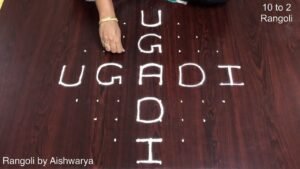
Ugadi is the lunar new year of the Telugu and Kannada calendars, falling on the first day of the bright fortnight of Chaitra (March–April), and a threshold-drawing occasion in the muggulu heartland: the year is opened with a fresh, festive design at a door cleaned for the purpose.
History
The muggulu ethnography documents the practice’s festival peaks around the winter season; Ugadi’s drawing belongs to the same household repertoire’s spring calendar, and this article keeps its historical claims within that documented frame. The day’s own observances are the new year’s: the ceremonial first tastes, new clothes, and the almanac reading — panchanga sravanam — that hears the year’s forecast read aloud; the fresh threshold design belongs to the same first-day preparations.
Description
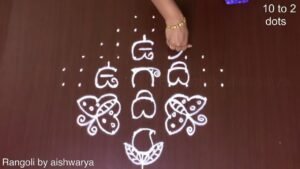
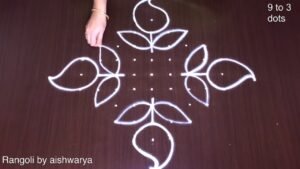
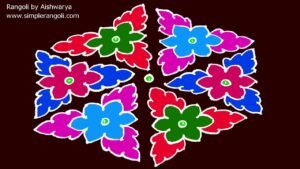
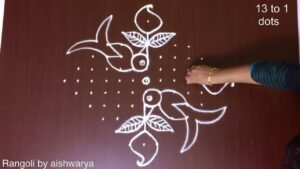
Ugadi designs are festival-grade but single-morning: coloured, moderately large, and drawn fresh for the day rather than built across a season. Mango leaf and flower motifs — the festival’s door-hanging translated into flour — are common choices, alongside the standard dotted repertoire; households keeping the fuller festival draw the design before the morning’s ritual bathing and first tastes, so the year’s first auspicious sight includes the threshold.
Cultural Context
New-year drawing is commonly described as beginning the year as one means to continue it — the threshold made auspicious on day one. The festival’s own emblem of mixed tastes — the six-flavoured ugadi pachadi, sweet to bitter in one dish — frames the day as acceptance of the year whole, and the drawn welcome is read in the same spirit: the door opened to whatever the almanac announces. These are attributed framings.
Regional Variations
The same lunar new year is kept as Gudi Padwa in Maharashtra — where rangoli likewise marks the door, within the tradition described in Rangoli at Home — and the Tamil solar new year, Puthandu, follows within weeks with kolam conventions of its own. Within the Telugu lands, urban practice compresses the day’s design; the older rural convention gives the new year the season’s full muggulu treatment.
Related Topics
The drawing tradition is Muggulu; the mango motif is described in Mango; the neighbouring new years are Puthandu and New Year.
Gallery
References
- Jyotsna Kilambi, “Toward an Understanding of the Muggu: Threshold Drawings in Hyderabad”, RES: Anthropology and Aesthetics 10, 1985.
Further Reading
- Vijaya Nagarajan, Feeding a Thousand Souls: Women, Ritual, and Ecology in India — An Exploration of the Kōlam, Oxford University Press, 2018.
This entry publishes at Evidence Level E1: common knowledge within the tradition, anchored to a verified standard reference.
Cite this entry: “Ugadi.” Rangoli Encyclopedia, Rangoli Designs, https://rangolidesigns.net/encyclopedia/ugadi/ — a permanent URL under the encyclopedia’s stable-identity policy. Entry last reviewed 2026-07-28.