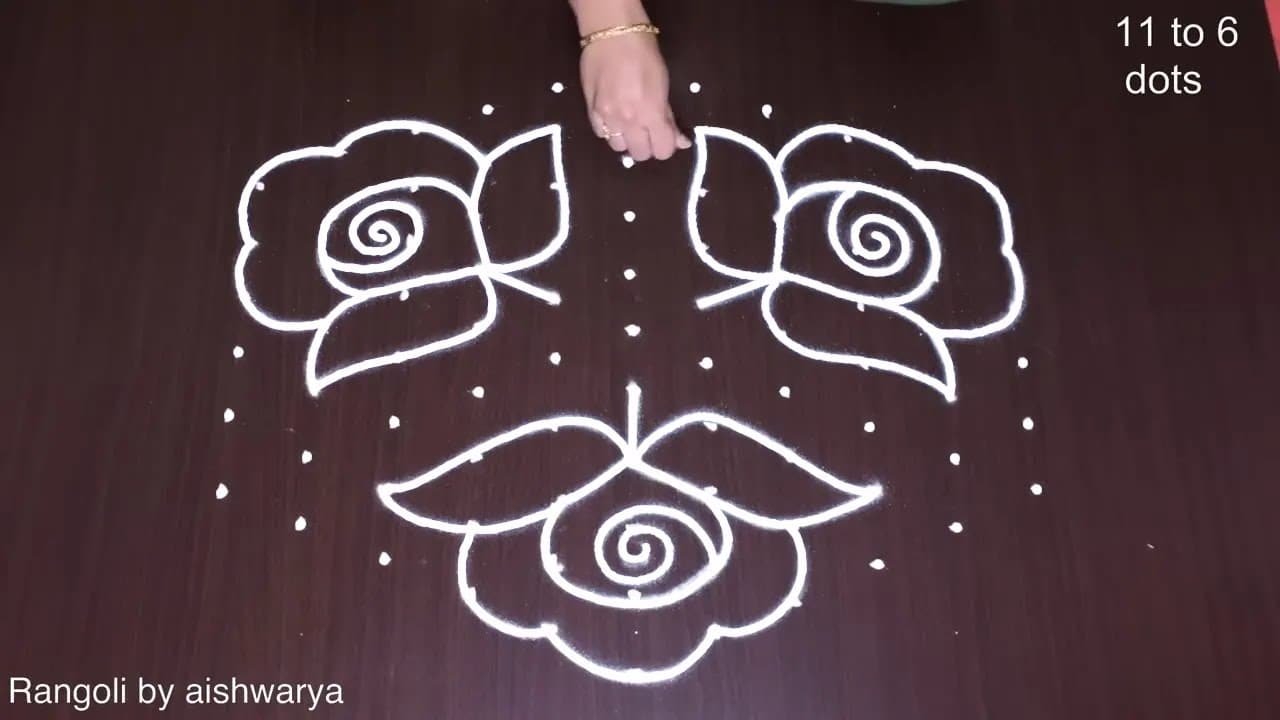
The most distinctive fact about a rangoli is that it is temporary by design. A drawing that took patient skill at dawn may be gone by evening — softened by wind, crossed by feet, dissolved by rain. To eyes trained on framed paintings and carved stone, the question is obvious: why invest such care in something built to disappear?
Beauty that does not need to last
The tradition’s answer reverses the premise. In the practice the ethnography documents, the act of creation carries as much meaning as the finished work: the drawing is preparation, attention, and generosity performed, not an object secured. Knowing the design will vanish concentrates the maker on the present morning — this day’s threshold, this festival, this welcome — and tomorrow offers the ground again. Impermanence is not the price of the art; it is one of its materials.
Every morning begins again
In households that keep the daily practice, yesterday’s design is not mourned; it has done its work. The sequence — sweep, sprinkle, draw, welcome the day — treats renewal as the natural state of things, and the drawing as its visible signature. Nagarajan’s study of the Tamil kolam places this daily re-creation at the tradition’s heart: a discipline practised not occasionally but continually, until precision becomes lived habit rather than technique.
The living canvas
The ground itself cooperates in the philosophy. Earth, stone, cement, and tile each take powder differently; humidity and wind change the line; no two mornings offer the same surface. The practitioner works with the environment rather than sealing the work against it — and when a corner blurs under a visitor’s careful step, many practitioners read it as the design entering the world, the way flowers enter a season.
What the discipline teaches
Modern vocabularies reach for the word “mindfulness”; the tradition needed no term for what the practice plainly develops — steady breath and posture, controlled movement, sustained attention to proportion and rhythm. Drawn daily, these become capacities of the person, not merely of the art: patience over speed, memory over measurement, structure as the ground of creativity rather than its enemy. A child who learns dots this year and curves the next is acquiring more than a repertoire.
The lesson
A design disappears; the knowledge does not. The skill remains, the tradition remains, and another hand will place the first dot tomorrow. In that plain fact lies the tradition’s quiet argument: creativity is measured not only by what survives, but by what enriches a moment and is willingly made again.
References
- Vijaya Nagarajan, Feeding a Thousand Souls: Women, Ritual, and Ecology in India — An Exploration of the Kōlam, Oxford University Press, 2018.
Further Reading
- Marcia Ascher, “The Kolam Tradition”, American Scientist 90(1), 2002.
This entry publishes at Evidence Level E1: common knowledge within the tradition, anchored to a verified standard reference.
Cite this entry: “The Philosophy of Impermanence.” Rangoli Encyclopedia, Rangoli Designs, https://rangolidesigns.net/encyclopedia/philosophy-of-impermanence/ — a permanent URL under the encyclopedia’s stable-identity policy. Entry last reviewed 2026-07-28.