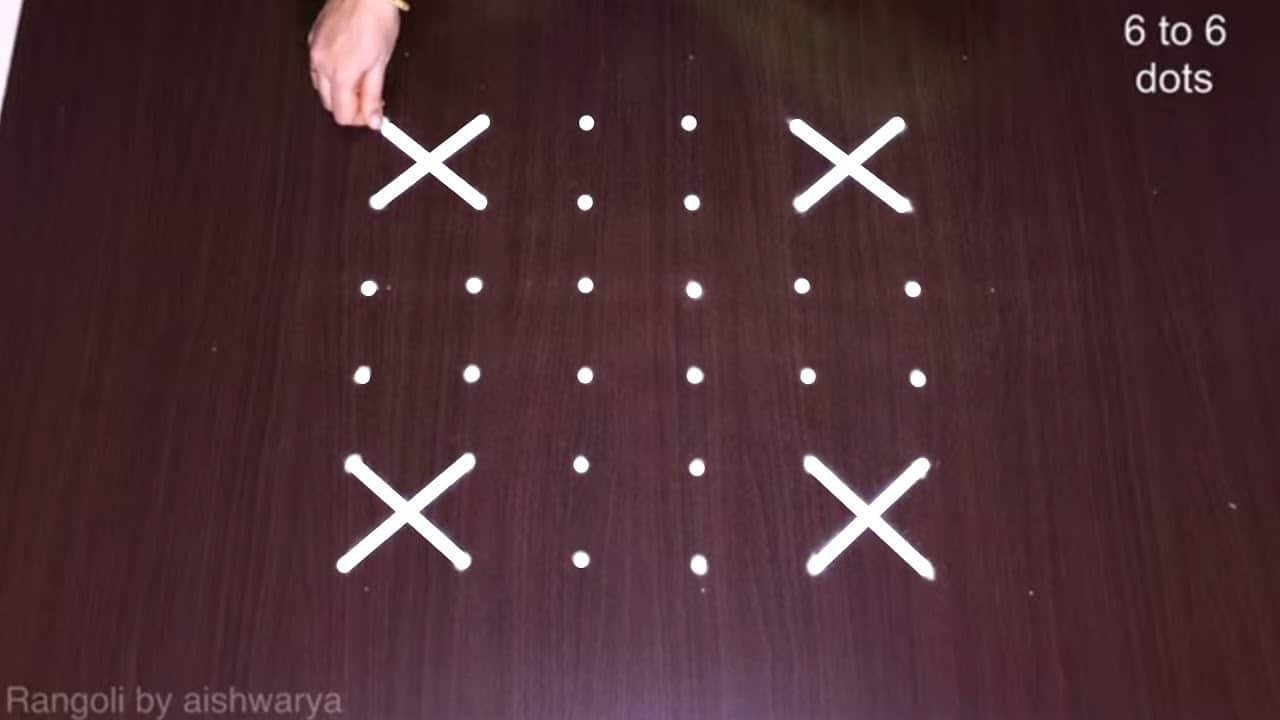
An art that erases itself daily has a complicated relationship with the technologies of keeping. For most of the tradition’s history, every design vanished unrecorded, and the only archive was the memory of the people who drew them. Photography, print, and the network each rewrote what “preserving” a rangoli can mean — and none of them has touched the fact that the tradition lives in hands, not files.
The camera changes the bargain
Photography was the first break in the old bargain with impermanence. A design could suddenly outlive its morning — in family records, in comparisons across regions, in research archives, in the images that inspire the next practitioner. What the photograph cannot hold is everything around the image: the making, the setting, the renewal. It preserves what a design looked like; the tradition is what a design is for.
Print and the pattern book
Printed collections widened the circle of learning. A practitioner could study unfamiliar regional styles at a distance, compare motifs, and work through patterns organised by difficulty; rare designs found a durable record. The books complemented the courtyard apprenticeship rather than replacing it — the page shows the pattern, and the hand still has to be taught by practice.
Design on screens
Digital tools brought planning into the tradition’s toolkit: colour combinations tried without powder, layouts refined, teaching diagrams prepared, grids printed for learners. The practice has been consistent about the boundary — screens assist the planning, and execution stays with the hand. A tradition whose principal instrument has always been a pinch of powder between finger and thumb has proven unsentimental about adopting tools and firm about which one is essential.
The network as a new oral tradition
The deepest change is the network. Tutorials, virtual workshops, and practitioner communities now move techniques between continents in hours; patterns once known to one district are studied everywhere; digital archives accumulate regional variation that no single household could hold. The archives that result are searchable in the practice’s own terms — designs indexed by the dot counts and families described in Counting the Grid — so a practitioner looking for a 15–8 frame can find a century of variations in moments. It is fair to call this a modern extension of oral transmission — knowledge still moves from practitioner to practitioner, demonstration first, now at network speed. The practitioners’ own caveat travels with it: watching is not drawing, and screen learning ends where practice begins.
The sustainability turn
Modern practice has also turned back toward its materials. The tradition was sustainable before the word existed — rice flour, petals, earths, everything returning to the ground — and the synthetic shelf that expanded the palette raised questions the older palette never did. The current movement toward biodegradable powders, plant colours, and natural pigments is less an innovation than a relearning, with the tradition’s own history as the guide. Public festivals increasingly specify biodegradable materials outright, and the requirement reads as a return rather than a restriction.
Keeping the record honest
A digital record is only worth what its integrity is worth, and three obligations follow. First, provenance: machine-generated imagery has to be distinguishable from documentation of actual practice — a plausible picture of a design nobody drew is not evidence, and mixing the two corrupts the archive it appears in. Second, fidelity: images can be adjusted, so a record’s value rests on knowing it has not been. Third, context: a photograph alone carries very little, and a documented design should arrive with its occasion, region, materials, construction method, local terminology, and the significance its community gives it — along with credit to the practitioner and community whose knowledge it is. And an archive is a commitment rather than a container. Files need active migration as formats age; storage neglected is storage lost. The difference is worth stating plainly: a design that washes off the threshold was always meant to go, while a record that quietly rots was meant to last.
What the tools cannot do
None of these technologies answers the practice’s real pressures: urban thresholds shrinking, the informal household apprenticeship thinning as lifestyles change, ready-made decorations substituting for drawn ones. What answers them is what always has — adaptation, the tradition’s oldest skill, now working through school programmes, festivals, online communities, and the households that simply continue. The recording technologies matter because they support that continuation. The essential act they exist to serve is unchanged: the first dot placed, the first line drawn, order made from simplicity on the ground where someone will cross.
References
- Vijaya Nagarajan, Feeding a Thousand Souls: Women, Ritual, and Ecology in India — An Exploration of the Kōlam, Oxford University Press, 2018.
- Kiwamu Yanagisawa & Shojiro Nagata, “Fundamental Study on Design System of Kolam Pattern”, Forma 22, 2007.
Further Reading
- Marcia Ascher, Mathematics Elsewhere: An Exploration of Ideas Across Cultures, Princeton University Press, 2002.
This entry publishes at Evidence Level E2: its claims rest on at least two independently verified sources.
Cite this entry: “The Digital Threshold.” Rangoli Encyclopedia, Rangoli Designs, https://rangolidesigns.net/encyclopedia/digital-threshold/ — a permanent URL under the encyclopedia’s stable-identity policy. Entry last reviewed 2026-07-30.