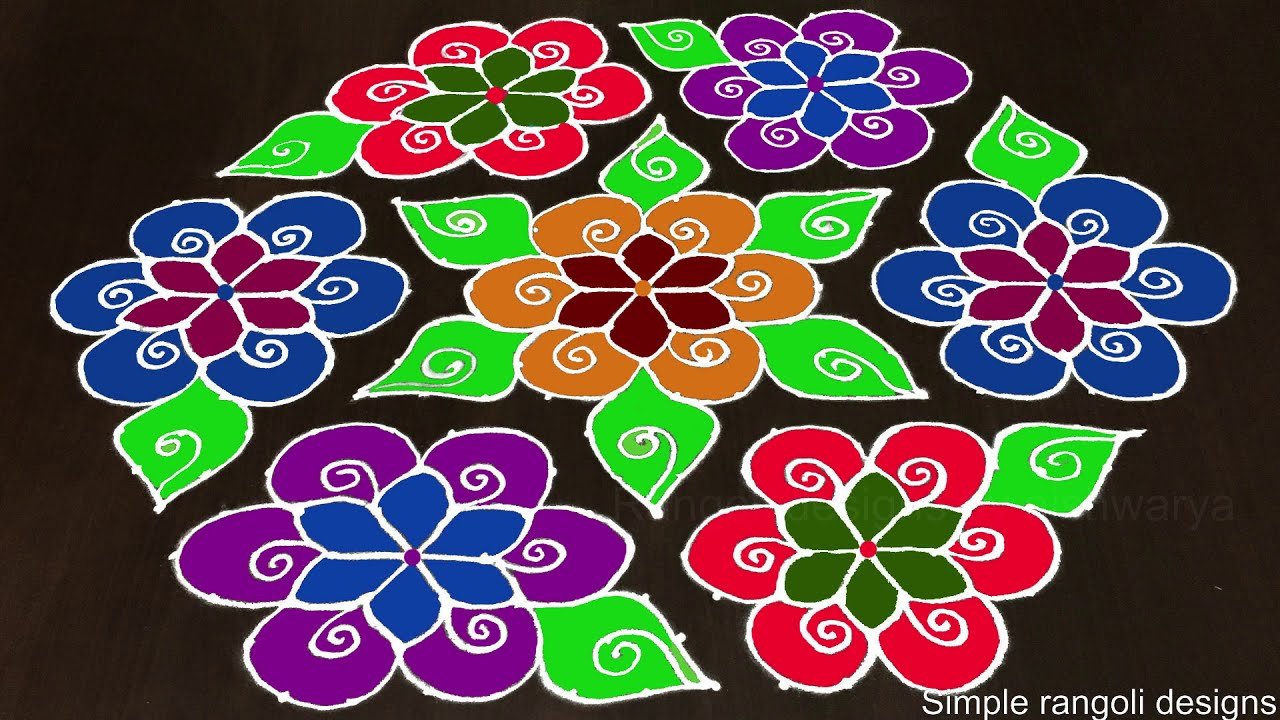
Every line in the repertoire belongs to one of two families. A straight line holds one direction; a curve changes direction continuously. The distinction sounds trivial and is not, because each family does compositional work the other cannot, and the tradition’s characteristic look comes from how deliberately the two are set against one another. The exercises that build both hands are described in Learning the Line; this essay is about the division of labour between them.
The framework that disappears
Most designs begin with straight lines the finished work never shows. Borders, central axes, diagonal alignments, the proportional divisions deciding how large each region will be — these are settled first, in the centre-outward order described in Composing the Whole, then buried under decoration. What makes the rangoli case unusual is that they are often never drawn at all. A draughtsman rules construction lines in pencil and erases them afterwards; a practitioner working in loose powder cannot erase, so the guides are carried in the eye instead — imagined alignments, checked against as the design grows, leaving nothing to remove. The symmetry that reads as effortless in a finished courtyard piece is the residue of geometry that was never on the ground.
The least forgiving element
The straight line is also the tradition’s hardest test, for a reason the craft knows from long experience: a drift in a straight line shows sooner than an equivalent wobble in a gentle curve. A curve that bends a little early or a little late still reads as a curve, while a straight line that wanders reads as an error. So the plainest element in the alphabet set out in The Elements of Design is the one learners practise longest, and a plain border remains a fair measure of a hand’s control.
Stillness that is drawn
Within a dense composition, straight passages do something curves cannot: they give the eye somewhere to stop. This is a different resource from the unmarked ground argued for in The Empty Space, where the resting place is an absence. Here the rest is a mark — a plain band, an unornamented division, a border kept deliberately austere — and its plainness is what allows the elaboration on either side to register. Complexity needs punctuation, and the straight line is where the tradition puts it.
What the curve is for
A curve’s continuous turning makes it the design’s guide. The eye follows a curve where it will not follow a corner, so curves are what carry attention across a composition, bind motifs that would otherwise sit as separate objects, and soften the junctions between regions. Built only from straight elements, a design reads as a diagram; the curves are what make it move while nothing moves.
The repertoire’s curves are also observed rather than invented. Petals, leaves, climbing stems, waves, the coiling forms that become a flower’s centre — the shapes the tradition curves into are shapes it found, which is why its motif entries read as a natural history as much as a vocabulary: the Lotus, the Creeper, the Spiral. That derivation explains the organic quality of work laid over a strictly counted grid. The geometry is exact; the forms drawn upon it come from things that grow.
Neither alone
The pairing is the point. Straight lines supply discipline and curves supply movement, and the balance this art is admired for is available from neither family by itself — a courtyard piece is typically straight at its frame and flowing at its heart, angular in its lattices and round in its blooms. How the curve behaves toward the counted dot, where the southern traditions concentrate their difficulty, is a subject of its own, treated as practice in Learning the Line and structurally in Interlaced Structure. What belongs here is the plainer observation: the tradition keeps both families on purpose, and its finest work is legible precisely because the two are doing different jobs.
References
- Vijaya Nagarajan, Feeding a Thousand Souls: Women, Ritual, and Ecology in India — An Exploration of the Kōlam, Oxford University Press, 2018.
- Jyotsna Kilambi, “Toward an Understanding of the Muggu: Threshold Drawings in Hyderabad”, RES: Anthropology and Aesthetics 10, 1985.
Further Reading
- Marcia Ascher, “The Kolam Tradition”, American Scientist 90(1), 2002.
This entry publishes at Evidence Level E2: its claims rest on at least two independently verified sources.
Cite this entry: “The Two Families of Line.” Rangoli Encyclopedia, Rangoli Designs, https://rangolidesigns.net/encyclopedia/two-families-of-line/ — a permanent URL under the encyclopedia’s stable-identity policy. Entry last reviewed 2026-07-30.