Definition
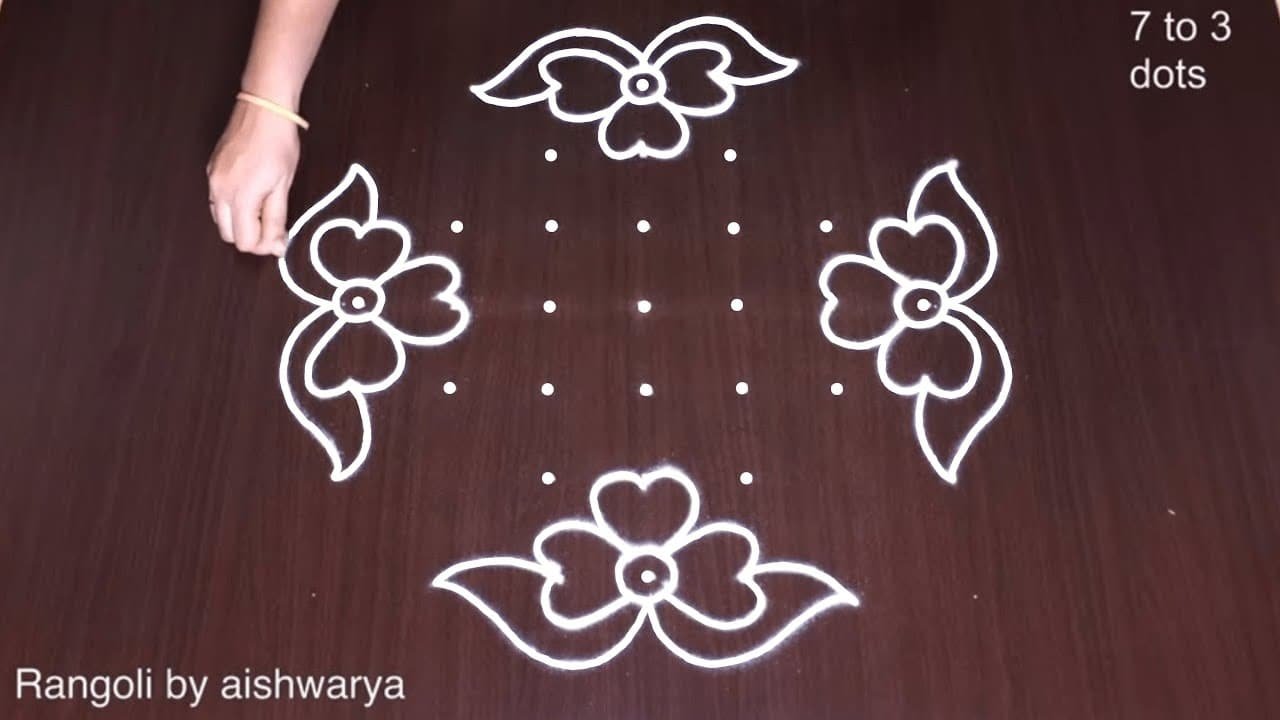
Pulli kolam is the dot-grid family of the Tamil tradition: designs that begin with a counted array of dots (pulli) and are completed by lines drawn to, between, or around them. It is the kolam’s daily workhorse — the register most morning designs belong to — and the construction system through which the practice teaches itself: learn to lay a grid and work it, and the repertoire opens from there.
The family divides by grid convention. Ner pulli arrangements set the dots in straight rows and columns — a square lattice; idukku pulli (also idai pulli) arrangements stagger each row into the gaps of the last — the offset lattice that hexagonal and star compositions favour. The choice is structural: it decides the symmetries available and the motifs the grid can carry.
History
The dot-grid method is the kolam’s teaching backbone, and its history is the tradition’s own: transmitted by demonstration at thresholds, held in memory by grid count, extended family by family across generations. The ethnographic record documents the system in detail — practitioners identify designs by their counts, exchange them by count, and grow their repertoires count by count, the grid functioning as the tradition’s shared notation without ever being written down.
The research literature made the grid its entry point. The 1974 array-grammar work of the Madras school formalised exactly this structure — the dot lattice as the scaffold on which pattern rules operate — and Ascher’s ethnomathematical analyses read the counted grids as coordinate systems built and used by hand. When the scholarly world discovered the kolam, it was the pulli system it discovered first.
Description
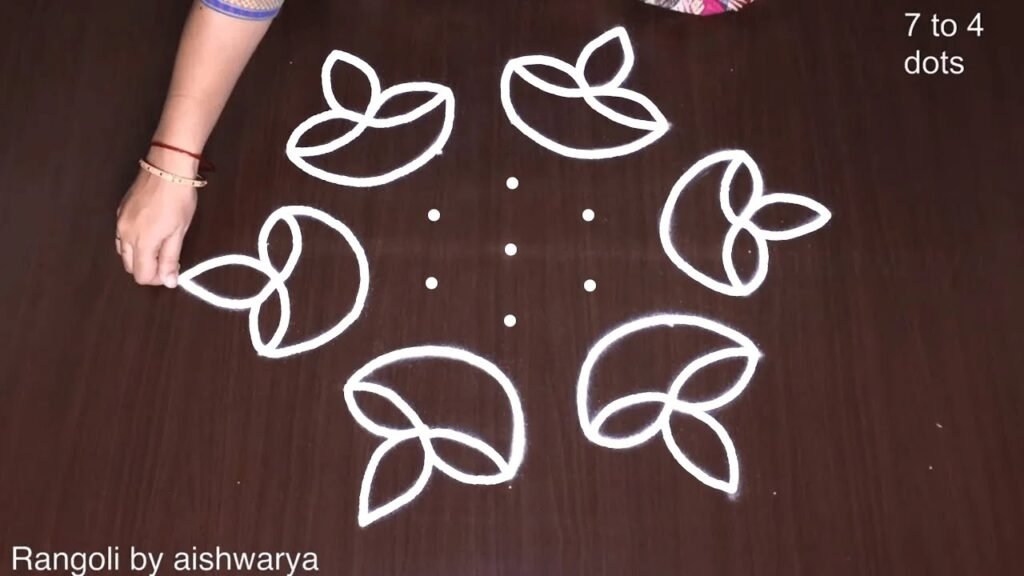
Construction begins before any line: the grid is laid dot by dot, spaced by eye and finger-gauge, its count chosen for the intended design — and the counts are the family’s names. Practitioners speak of grids by their dimensions, in the “N to M” convention the corpus records — seven-to-one, eleven-to-six, thirteen-to-seven — each count naming a diamond, square, or stepped lattice and, with it, a family of designs that fit it. The design library on this platform documents dozens of these counted families in living use.
Two line-to-dot relationships then divide the family. In the connecting style the drawn line joins the dots — petals, lattices, and figures built point to point. In the looping style the line surrounds the dots without touching them — the relationship that, taken to its full development, becomes the sikku knot. Daily designs may use either or both; the grid stays visible in the finished work, the framework showing through the ornament it carries, and the completed design erases with the day while the count survives in memory.
Cultural Context
The grid is the practice’s discipline made visible. Laying it accurately — even spacing, true rows, correct count — is the first skill a learner acquires and the foundation every subsequent skill rests on; the ethnography records children beginning with small counts and graduating upward, the grid functioning as a curriculum. Its meanings are attributed ones: the counted dots carry the senses of order, preparation, and readiness that the morning practice itself enacts.
The dot carries an older resonance the practice inherits lightly: in Indian thought the bindu — point, drop, seed — stands for origin and potential, the mark from which forms unfold. Whether or not a household intends the philosophy, the practice performs it daily: from a field of near-dimensionless points, a complete design emerges, and tomorrow another will. The pulli grid is that idea drawn on the ground.
The count system is also the family’s engine of growth. Because a count names a lattice and a lattice admits a family of designs, a practitioner who learns one new count inherits a whole territory — and because the same looping and joining rules apply at every scale, designs migrate upward as skill grows: the figure first learned at five dots reappears, elaborated, at eleven. The repertoire is therefore not a list of designs but a grammar of counts and rules, which is why it can live entirely in memory and still keep growing for a lifetime.
Regional Variations
The pulli system is Tamil in name and pan-southern in fact: the Telugu chukkala muggulu build on the same counted grids with their own aesthetic, and Karnataka’s rangavalli keeps the method among its modes. Within Tamil practice the family runs from three-dot children’s exercises to festival grids of a hundred dots and more, with Margazhi carrying the largest counts of the year. The grid conventions travel unchanged; only the ornament above them changes accent.
Related Topics
The parent tradition is Kolam; the structural article for the scaffold itself is Dot Grid; the looping development of the family is Sikku Kolam; the Telugu counterpart is Muggulu; the umbrella practice is Rangoli.
Gallery
References
- Gift Siromoney, Rani Siromoney & Kamala Krithivasan, “Array grammars and kolam”, Computer Graphics and Image Processing 3(1), 1974.
- Marcia Ascher, “The Kolam Tradition”, American Scientist 90(1), 2002.
Further Reading
- Vijaya Nagarajan, Feeding a Thousand Souls: Women, Ritual, and Ecology in India — An Exploration of the Kōlam, Oxford University Press, 2018 — for the practice surrounding the grids.
This entry publishes at Evidence Level E2: its claims rest on at least two independently verified sources.
Cite this entry: “Pulli Kolam.” Rangoli Encyclopedia, Rangoli Designs, https://rangolidesigns.net/encyclopedia/pulli-kolam/ — a permanent URL under the encyclopedia’s stable-identity policy. Entry last reviewed 2026-07-28.