Definition
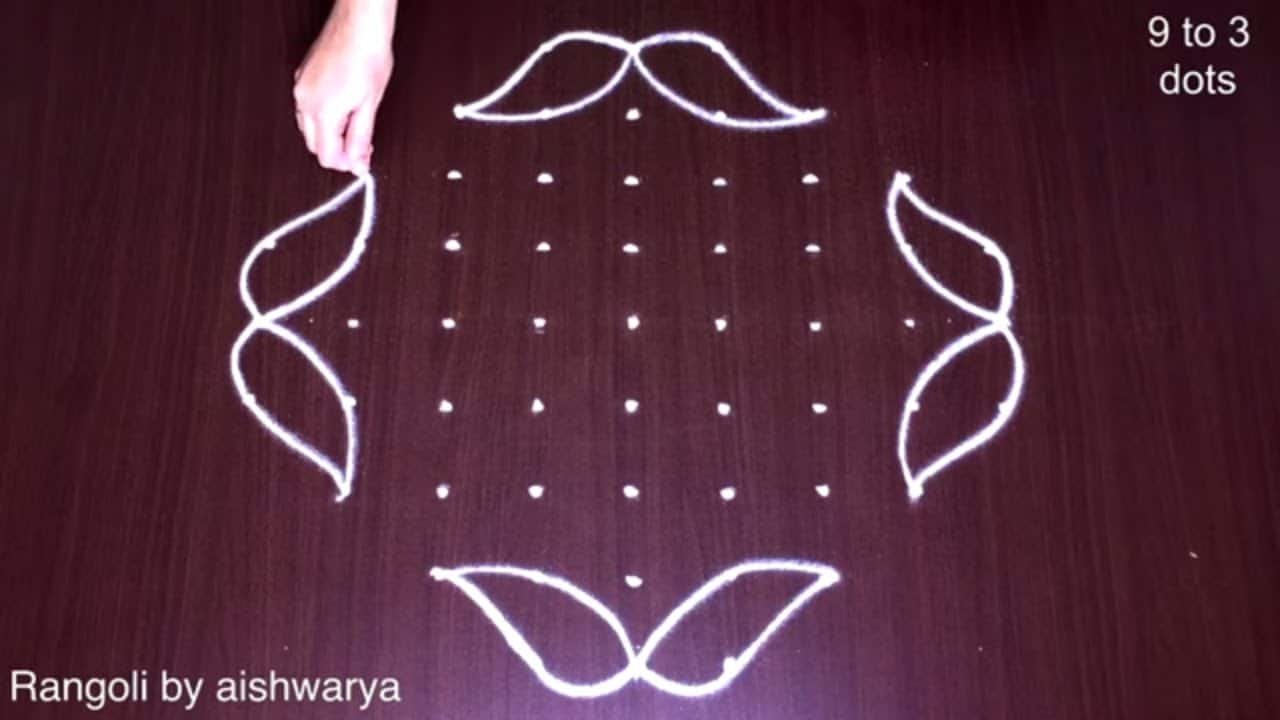
The creeper motif — lata — draws the climbing vine: a flowing stem that curls, branches, and carries leaves, buds, and blossoms along its length. Alone in the rangoli vocabulary, the creeper’s job is connective — it is the motif that joins other motifs, framing compositions as a living border, linking flowers to lamps to geometry, and softening angular structure with organic line.
Where other motifs occupy a place, the vine moves through the design. Its drawn character matches its botanical one: a plant that grows by reaching, attaching, and continuing — ornament with momentum.
History
Vine ornament is among the oldest and most universal elements of Indian decoration: temple friezes and carved pillars, manuscript illumination, woven silk borders, painted ceilings, wooden doorways, metalwork — the flowing stem appears in all of them, usually carrying lotus blossoms, mango leaves, birds, or bells along its curl. The forms the floor art uses descend directly from this shared ornamental stock; a kolam’s vine border and a temple frieze’s scroll are the same idea in different materials.
The real plants behind the motif — jasmine, betel, grapevine, morning glory, the flowering climbers of every Indian garden — supplied both the forms and the observations: flexible stems that survive by bending, new shoots always continuous with old growth, abundance carried on connection. The ornament kept the botany’s lessons.
Description
The creeper’s construction is rhythm made visible: a base curve — usually a running S-line — with leaves, tendrils, and blossoms placed at regular stations along it. Experienced practitioners draw the stem in a single continuous motion and add the attachments after, and the discipline is in the spacing: curve length, leaf interval, blossom placement, and branching angle all repeat within tolerances, so the apparent freedom rests on hidden proportion. Ornament theory calls the principle controlled variation — no two leaves identical, every leaf in system.
The standard roles: border, framing a composition with movement; connector, joining separate motifs so the design reads as one growth; garland chains; curved fill, softening angular fields; and expansion, the vine continuing outward as far as the occasion wants — a creeper border can, in principle, go on forever, which is part of what it means.
Cultural Context
The creeper’s attributed meanings are relational: growth, continuity, prosperity, interdependence, family and friendship — flourishing understood as connection. The observations underneath are botanical: vines rarely stand alone; every blossom depends on an earlier stem; flexibility, not rigidity, is their strength. A flourishing drawn vine wishes the household exactly that kind of prosperity — continuous, connected, still growing. Attributed senses, every one — what the ground actually carries is a curve with leaves.
Ecology, as it happens, agrees with the ornament. Climbing plants link trees, shrubs, and undergrowth into the connective tissue of forest ecosystems, their reaching growth building the networks that biodiversity lives on. The symbolism belongs to culture, not science — but few motifs have their meaning so neatly confirmed by their referent’s actual job: the plant that connects, drawn as the line that connects.
The motif also carries a design philosophy the whole practice shares: that beauty lies in relationships as much as in objects. The vine is the visible statement of that principle — the line that makes many motifs one composition — and its open-endedness adds the quiet promise of continuity: the border could continue; the growth has not finished; the design, like the household, is still extending.
Regional Variations
Vine and creeper work appears in every tradition, with its richest development where freehand curvilinear drawing dominates: the flowing borders of festival rangoli, the painted stems of the eastern rice-paste arts, and the floral chains of rangavalli practice. The southern grid traditions carry the same idea in disciplined form — running-border kolams whose repeating units are stylised leaf-and-stem cells. Everywhere the vine keeps its role: the ornament that connects.
Related Topics
The creeper’s usual passengers are the Lotus and Mango leaf; its garden companions are the Parrot and Butterfly; its structural method belongs to Freehand practice; the umbrella practice is Rangoli.
Gallery
References
- Vijaya Nagarajan, Feeding a Thousand Souls: Women, Ritual, and Ecology in India — An Exploration of the Kōlam, Oxford University Press, 2018.
Further Reading
- Marcia Ascher, “The Kolam Tradition”, American Scientist 90(1), 2002.
This entry publishes at Evidence Level E1: common knowledge within the tradition, anchored to a verified standard reference.
Cite this entry: “Creeper.” Rangoli Encyclopedia, Rangoli Designs, https://rangolidesigns.net/encyclopedia/creeper/ — a permanent URL under the encyclopedia’s stable-identity policy. Entry last reviewed 2026-07-28.