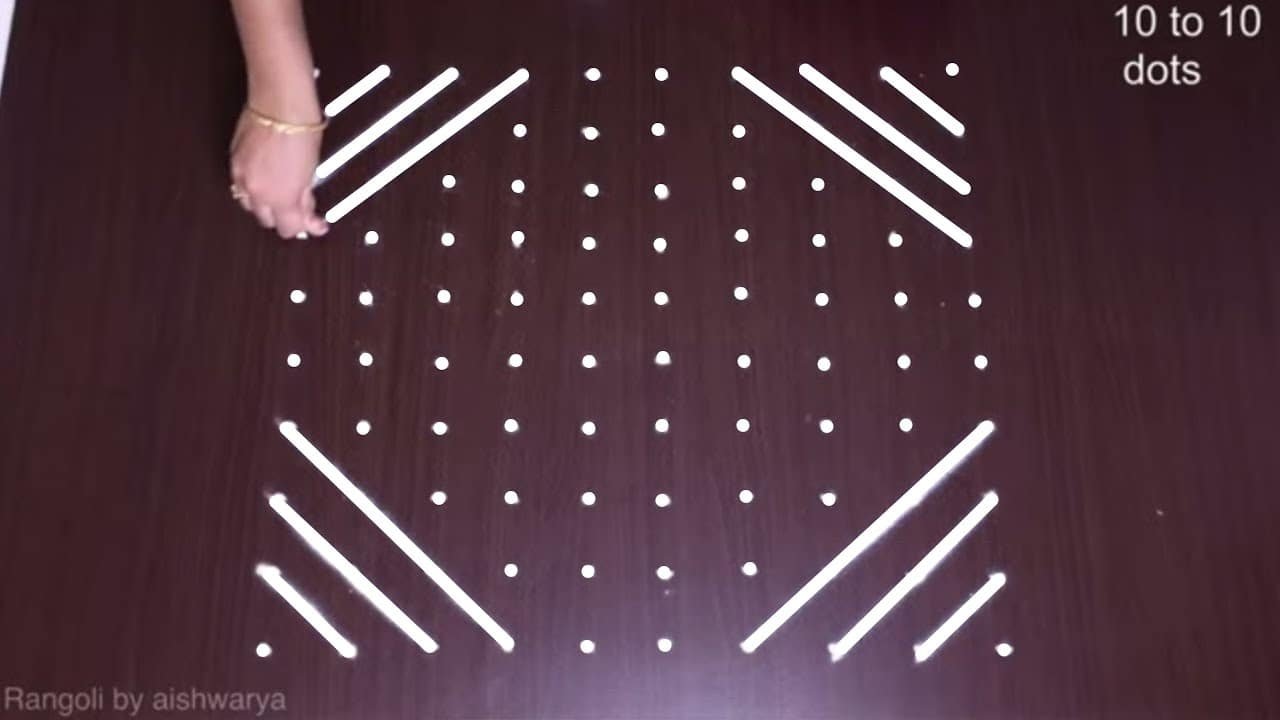
“Kolam” is one word for many systems. Tamil practice does not treat its threshold art as a single technique with variations; it names families of construction, and the names say how a design is built before they say anything about how it looks. Learning the tradition means learning which family a design belongs to — and the families together form a grammar that has carried the art across generations without a single written manual.
Two ways to lay a grid
Most kolam work begins with pulli — dots — set down before any line is drawn, and the first family distinction is in the grid itself. In ner pulli arrangements the dots sit in straight rows and columns, a square lattice; in idukku pulli (also called idai pulli, or woda pulli in the recorded fieldwork) arrangements each row is staggered into the gaps of the row before, producing the offset lattice that hexagonal and star compositions favour. The choice is structural, not cosmetic: it decides which symmetries the finished design can have and which motifs the grid can carry. Practitioners count both by their dimensions — a design is remembered as, say, a “seven-to-one” or an “eleven-dot” pattern — and the count is the first thing one artist asks another about an unfamiliar design.
Lines around, lines between
The second distinction is the relationship between line and dot. In one register the drawn line connects the dots, joining them into petals, lattices, and figures. In the other — the sikku or “knot” kolam — the line never touches a dot at all: it loops around each one, crossing and recrossing itself until it closes back on its starting point, ideally as a single unbroken curve. The sikku family is the one that has drawn the most sustained mathematical attention, and it has its own article in this encyclopedia. The names themselves overlap in practice: fieldwork records kambi (line), sikku (knot), and nelevu (curving) as practitioners’ names for this same loop family — one family, several names — and the research literature has used “kambi kolam” for the square-grid loop form since the 1980s.
The ceremonial straight-line register
Alongside the curvilinear families stands a plainer, older-feeling register the practice calls padi kolam: compositions of parallel straight lines and stepped square frames, often drawn without any dot grid, associated with ceremonial occasions and ritual settings rather than the ordinary morning. Where the sikku line dazzles, the padi line is deliberately measured — thick, doubled strokes building rectilinear order. The practice literature describes it as a register reserved for weightier moments; a fuller account, like the kambi entry, is source-gated for now, and this encyclopedia says so rather than padding the record.
Freehand and the festival register
Not all kolam work is grid-bound. Freehand designs — vines, lotuses, birds, lamps, conches — are drawn directly, and they dominate the festival register, when designs grow beyond the doorstep and colour joins the white. Through Margazhi, the Tamil month of December–January, the practice reaches its annual peak: larger grids, more ambitious knots, competition designs, and thresholds redrawn daily at their most elaborate. The festival register does not replace the families above; it enlarges them.
Held in memory
What makes the family system remarkable is where it is stored. There is no pattern book at the threshold. Designs are held in memory — learned in childhood by watching, copying, and correcting, and extended across a lifetime as an artist’s repertoire grows. The ethnography of the Tamil practice documents this transmission in detail: the grid counts, the family grammar, and the designs themselves passing from hand to hand, mother to daughter, neighbour to neighbour, with the drawing itself as the only notation.
Creativity within convention
The families are a grammar, not a cage. A practised artist moves between them — a staggered grid carrying a knot line, a freehand border around a pulli centre — and invents within them, because a shared system is precisely what makes an individual hand visible. That balance, between convention strong enough to transmit and freedom wide enough to matter, is the kolam style system’s quiet achievement, and the rest of this chapter describes the families it names.
References
- Vijaya Nagarajan, Feeding a Thousand Souls: Women, Ritual, and Ecology in India — An Exploration of the Kōlam, Oxford University Press, 2018.
- Marcia Ascher, “The Kolam Tradition”, American Scientist 90(1), 2002.
- Timothy M. Waring, “Sequential Encoding of Tamil Kolam Patterns”, Forma 27, 2012.
Further Reading
- Gift Siromoney, Rani Siromoney & Kamala Krithivasan, “Array grammars and kolam”, Computer Graphics and Image Processing 3(1), 1974.
This entry publishes at Evidence Level E2: its claims rest on at least two independently verified sources.
Cite this entry: “The Kolam Style Families.” Rangoli Encyclopedia, Rangoli Designs, https://rangolidesigns.net/encyclopedia/kolam-style-families/ — a permanent URL under the encyclopedia’s stable-identity policy. Entry last reviewed 2026-07-28.