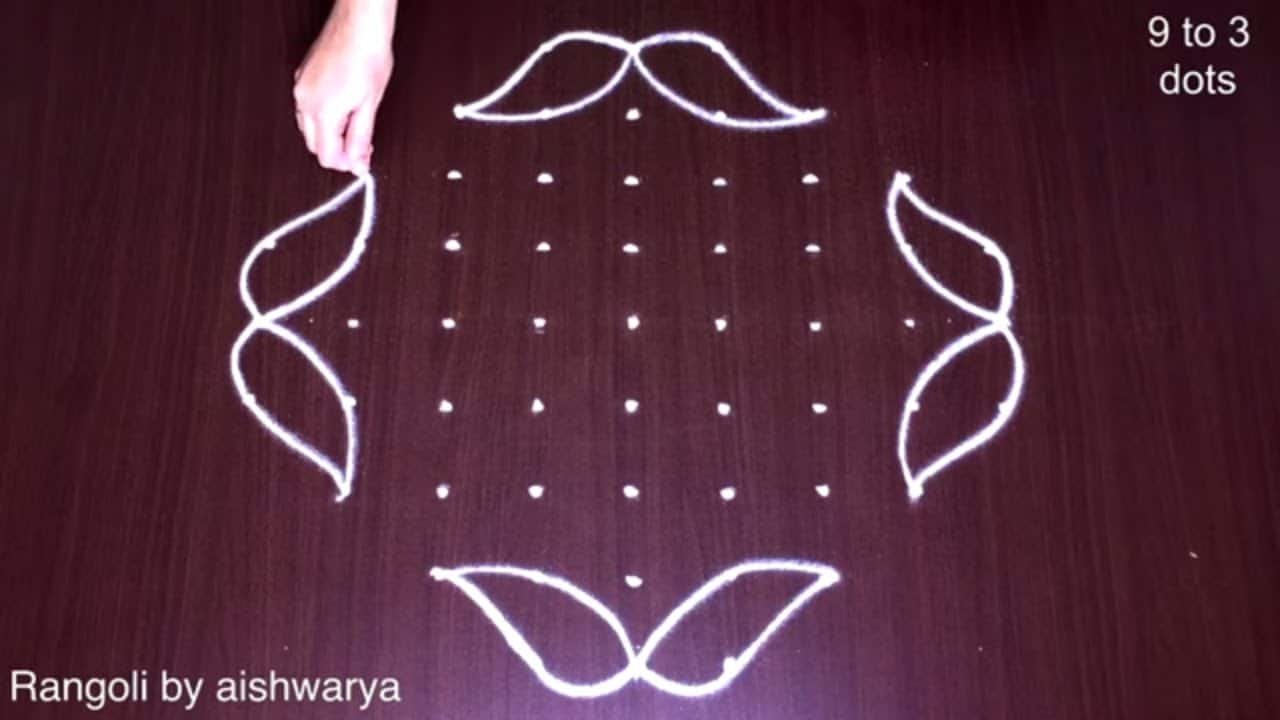
For most of the year the muggu is a daily discipline — a modest white grid drawn at dawn, walked over by noon, redrawn the next morning. For one month it becomes a public art. The Sankranti season is the Telugu tradition’s annual summit, and following it is the best single way to understand what distinguishes the muggu within India’s threshold arts.
The month of Dhanurmasam
The season begins a month before the festival. Through Dhanurmasam — the winter month that Tamil practice knows as Margazhi — households that draw modestly the rest of the year draw seriously: earlier, larger, more elaborate, the daily chukkala (dot) grids growing in ambition as Makara Sankranti approaches. The month is a crescendo, not a switch; by its final days the morning drawing has become the morning’s principal work, and the festival itself arrives on thresholds already at full scale.
Scale, borders, colour
Festival muggulu enlarge in every dimension at once. Compositions spread across entrances and out onto the street; border work — repeated geometric bands, floral chains, scalloped frames — becomes a showpiece in its own right, one of the tradition’s most recognisable signatures; and colour enters over the white. The sequence matters: the white framework is drawn first and establishes the design, and coloured powders then fill and heighten it. The Hyderabad ethnography documents both the everyday register and this festival elaboration — the same practice at two intensities, not two practices.
The harvest vocabulary
Sankranti is a harvest festival, and the season’s designs carry a harvest iconography: overflowing pots, sugarcane, the sun, kites, cattle honoured in the festival’s cycle, mango leaves, lotuses, parrots and peacocks. These motifs have their own entries in this encyclopedia’s Motifs chapter; what the Telugu season shows is the vocabulary deployed together, at scale, as a single festive statement. District by district the selection shifts — the tradition has always been locally inflected, and the variation is part of the record rather than a deviation from it.
Gobbemmalu
In parts of the Telugu country the festival muggu is not drawn alone. Gobbemmalu — small mounds of cow dung, dressed with turmeric, vermilion, and flowers — are set within or beside the design during the Sankranti observances, and in many places girls circle them with songs and games. The convention matters to the historian of the art for what it shows structurally: floor drawing interacting with other ceremonial forms rather than standing apart as decoration. The muggu is the prepared ground on which the season’s other customs stand.
Streets as galleries
Because every household draws at once, the festival turns residential streets into open-air exhibitions. Neighbours’ designs answer one another; informal competition sharpens the work; walking a street becomes a way of viewing it. For the month’s duration the line between private and public art thins almost to nothing — the threshold drawing, made for one doorway, is read by the whole neighbourhood.
After the festival
Then the season ends, and the daily register returns: smaller grids, white lines, the ordinary morning. Nothing about that return is a decline. The festival is the tradition’s summit, but the daily habit is its foundation — the practice that keeps the hands trained, the repertoire alive, and the threshold marked every morning of the year until Dhanurmasam comes around again.
References
- Jyotsna Kilambi, “Toward an Understanding of the Muggu: Threshold Drawings in Hyderabad”, RES: Anthropology and Aesthetics 10, 1985.
- Vijaya Nagarajan, Feeding a Thousand Souls: Women, Ritual, and Ecology in India — An Exploration of the Kōlam, Oxford University Press, 2018.
Further Reading
- Marcia Ascher, “The Kolam Tradition”, American Scientist 90(1), 2002.
This entry publishes at Evidence Level E2: its claims rest on at least two independently verified sources.
Cite this entry: “Muggulu at Sankranti: When Streets Become Galleries.” Rangoli Encyclopedia, Rangoli Designs, https://rangolidesigns.net/encyclopedia/muggulu-at-sankranti/ — a permanent URL under the encyclopedia’s stable-identity policy. Entry last reviewed 2026-07-28.