Definition
The Tree of Life motif draws a complete tree as a symmetrical composition: central trunk, mirrored branching, a canopy of repeated leaves and blossoms, and often roots shown spreading below — the one motif in the vocabulary that depicts an entire living system rather than a single form. It serves as a centrepiece for large ceremonial designs, where its vertical axis organises the whole composition.
Unlike the leaf, flower, and fruit motifs that surround it in this chapter, the tree is drawn for its wholeness: roots, trunk, branches, leaves, flowers, and fruit in one figure, each part depending on the rest.
History
Tree imagery runs through the whole depth of Indian art — ancient stone reliefs, temple sculpture, cave painting, manuscripts, textiles, and folk painting — and behind the imagery stands a lived relationship: communities gathered, taught, traded, and rested beneath large trees, villages grew around them, and particular species accumulated reverence. The banyan, with its aerial roots and vast canopy, carries longevity and shelter; the peepal, contemplation and learning; the neem, healing; the mango, abundance — a botanical vocabulary the decorative arts drew on freely.
Philosophy made the tree an image of existence itself: roots as foundations, trunk as stability, branches as diversity, leaves as individual lives, fruit as the results of growth, seed as the future. The drawn Tree of Life inherits that whole reading in a single symmetrical figure.
Description
Construction is axial: the trunk establishes a centre line, branches mirror left and right, and the canopy fills as a circular or arched field of repeating leaf and flower units. Roots, where shown, mirror the crown below the ground line — a symmetry nature only suggests and the motif makes literal. The repertoire includes the flowering tree, the fruit-bearing tree, trees with birds or animals among the branches, and the fully stylised Tree of Life with geometric ornament through the canopy.
The design challenge is the balance of organic and ordered: too rigid and the tree becomes a diagram, too loose and the symmetry collapses. Practised artists hold the two together — mirrored structure carrying free-drawn foliage — which is why the motif is regarded as one of the more demanding centrepieces in the repertoire.
Cultural Context
The tree’s meanings are the meanings of the living system it depicts: growth, continuity, stability, fertility, interconnection, the cycle of life. What endures in a tree is the whole, not the parts — leaves fall, branches age, the tree persists — and the motif carries exactly that sense of renewal within continuity. These are senses communities bring to the drawn form; the figure itself is a trunk with mirrored branches.
A modern reading has joined the old ones without displacing them: as environmental awareness has grown, the Tree of Life increasingly appears in designs made for conservation programmes and community campaigns — the ancient symbol of interconnection serving the contemporary argument for it. Few motifs cross from ritual decoration to civic message so naturally.
The living referents keep the drawn form honest. A mature tree shelters an entire community of organisms — birds, insects, and more — and the banyan, India’s national tree, extends itself on aerial roots until one tree stands like a grove. Artists drawing the Tree of Life are abbreviating something genuinely vast, and the motif’s dignity comes from that: it is the portrait of the largest living things most households will ever stand beside.
Regional Variations
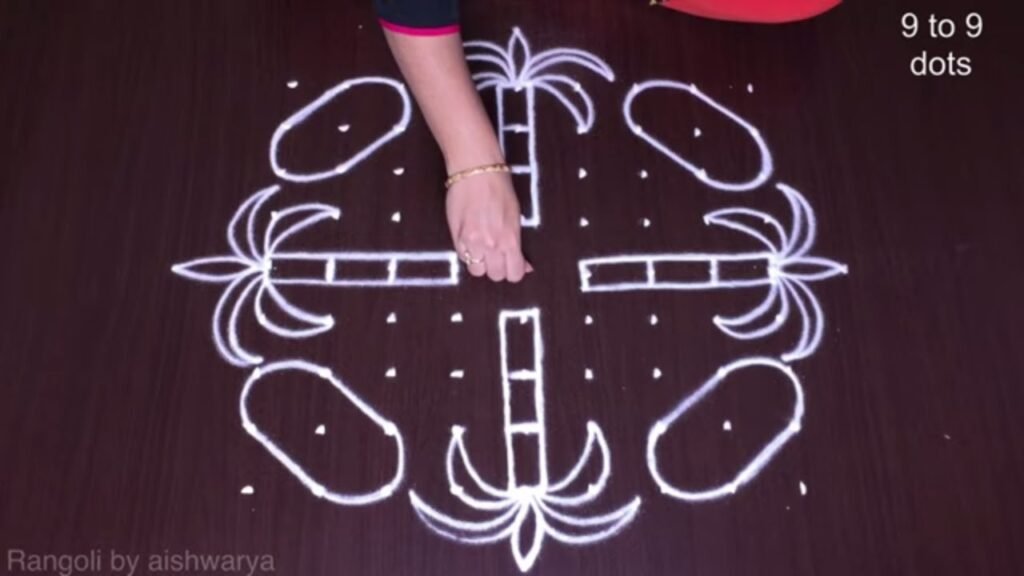
Tree compositions appear across the regional traditions — in the freehand festival styles of the north and west, the painted arts of the east, and the grid traditions of the south, where the tree is built symmetrically across a counted lattice. The sacred-tree associations shift by region and species; the drawn form keeps its axial grammar everywhere.
Related Topics
The tree’s parts have their own entries: the Mango and Creeper among its botanical kin, the Parrot and Peacock among its inhabitants; its compositional family is the axial symmetry described under Freehand practice.
Gallery

References
- Vijaya Nagarajan, Feeding a Thousand Souls: Women, Ritual, and Ecology in India — An Exploration of the Kōlam, Oxford University Press, 2018.
Further Reading
- Marcia Ascher, Mathematics Elsewhere: An Exploration of Ideas Across Cultures, Princeton University Press, 2002.
This entry publishes at Evidence Level E1: common knowledge within the tradition, anchored to a verified standard reference.
Cite this entry: “Tree of Life.” Rangoli Encyclopedia, Rangoli Designs, https://rangolidesigns.net/encyclopedia/tree-of-life/ — a permanent URL under the encyclopedia’s stable-identity policy. Entry last reviewed 2026-07-28.