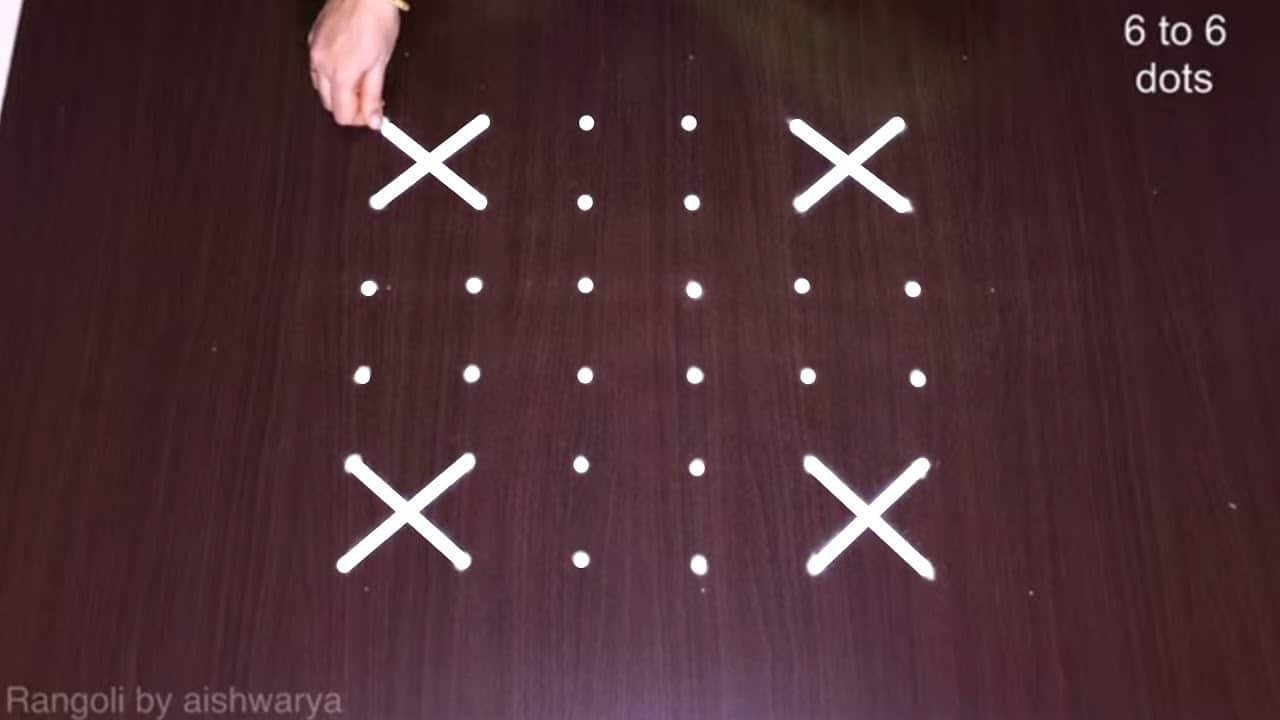
Watch a practised artist begin and rangoli looks improvised: no sketch, no blueprint, powder simply starts falling and pattern appears. The improvisation is an illusion. The composition exists before the first line — held in the head, worked out in the seconds or years before the hand moves — and the drawing is its performance. This essay is about that invisible stage: how a design is planned, sequenced, and balanced as one whole.
The invisible sketch
Planning starts with seeing the design entire before any part of it: where the centre will sit, how large the whole can grow in the available ground, whether the border will be plain or rich, how the design should meet its architectural setting. The mental image is a framework, not a finished picture — detailed enough to govern proportions, loose enough to leave room for the day’s decisions. And it is rarely invented from nothing: practitioners carry libraries in memory — motifs, borders, whole arrangements accumulated over years — so planning is mostly recall and adaptation, familiar forms recombined for a new space and occasion. How that library is built is the story of How the Hand Learns; composition is where it pays out.
Centre first, large to small
The construction order is remarkably consistent: establish the centre and axes, then the major divisions, then the principal motifs, then the supporting elements, and only at the end the fine decoration. The logic is structural — detail added early makes the large relationships impossible to adjust, while a settled framework lets every small decision inherit its proportions from the whole. It is the same whole-before-detail discipline the colour method applies to the palette in Colour Harmony, operating here on the entire design.
Planning the hand, not just the picture
A rangoli plan is also choreography, because the artist is inside the work as it grows. The sequence must be drawable: begin where later work will not force a reach across finished lines, move around the composition rather than over it, leave the border for last so the frame can answer the finished centre — the final act described in Borders and Frames. The plan anticipates the body’s route as deliberately as the design’s appearance, which is one reason large festival pieces read as effortless: the walking was composed along with the drawing.
What the planner is balancing
The material being arranged is visual weight. Elements pull on attention unequally — by size, colour intensity, line thickness, decorative density, position, contrast — and composition is the distribution of that pull until the design rests. Symmetry is the familiar solution: mirror and rotation equalise weight automatically, which is why the structures described in The Four Symmetries carry so much of the tradition. But equilibrium has a subtler form. Asymmetrical balance sets a large motif against several small ones, a bold colour against generous open ground, a dense passage against a plain one — no duplication, yet the whole still rests, with more movement in it than a mirror can give. Spacing is a weight in its own right: a modest motif inside open ground can balance a rich region elsewhere, the working face of the principle argued in The Empty Space. And the distribution is expressive — even balance reads calm, managed imbalance reads energetic — so where the weight sits is part of what the design says.
Rhythms to deploy
Repetition, the composition’s connective tissue, comes in three usable kinds. Regular rhythm repeats one unit at one interval — the border’s default, stability itself. Alternating rhythm cycles two or more forms — large petal, small petal; curve, triangle — variety that stays orderly. Progressive rhythm changes the unit as it travels — motifs growing, shrinking, or densifying outward from the centre — the expanding bloom that radial work is built on. The fourth tool is the break: one deliberate interruption in an established rhythm is the strongest accent available, and it works only because the rhythm exists to be broken.
Flexible to the end
The plan is living. Surfaces disappoint, powder behaves, a motif wants enlarging — and the practitioner adjusts while preserving the framework, because every added line changes the balance of everything already drawn. Evaluation is continuous: the eye compares the growing design against the imagined whole, and small corrections keep the two converging until they meet at the final stroke. That meeting is the goal the entire process serves — the state where every element belongs and nothing is missing or spare. The tradition’s most composed designs look effortless for exactly one reason: the composition was finished, in the head, before it began on the ground.
References
- Vijaya Nagarajan, Feeding a Thousand Souls: Women, Ritual, and Ecology in India — An Exploration of the Kōlam, Oxford University Press, 2018.
- Marcia Ascher, “The Kolam Tradition”, American Scientist 90(1), 2002.
Further Reading
- Marcia Ascher, Mathematics Elsewhere: An Exploration of Ideas Across Cultures, Princeton University Press, 2002.
This entry publishes at Evidence Level E2: its claims rest on at least two independently verified sources.
Cite this entry: “Composing the Whole.” Rangoli Encyclopedia, Rangoli Designs, https://rangolidesigns.net/encyclopedia/composing-the-whole/ — a permanent URL under the encyclopedia’s stable-identity policy. Entry last reviewed 2026-07-29.