For most of its history, rangoli lived entirely in practice and memory. The last two centuries changed not the practice but its record: an art that had never been written down became documented, photographed, studied, broadcast, and finally shared globally within hours of being drawn.
The first systematic records (c. 1750–1947)
The colonial era brought surveys, ethnography, photography, and print to Indian cultural life. Floor art entered the written record obliquely at first — noted among festival customs and household practices — and the camera became its first true archive: a design drawn at sunrise and gone by dusk could now survive as an image. The scholarly record has a datable early landmark: in 1937 the journal Folklore carried John Layard’s long study of the threshold designs, with a first-hand account of the continuous-line technique, the pre-dawn hour, and the names practitioners gave their never-ending-line designs — and its footnotes already cite a 1929 description of powder taken “between the thumb and first finger”. The documentation is decades older than the disciplines that now study it. Printed pattern collections made designs portable beyond family lines for the first time, though oral transmission remained the tradition’s real school. By the early twentieth century, Indian scholars and the cultural revival around the freedom movement were documenting regional traditions under their own names — rangoli, kolam, muggu, alpana, mandana, aipan — a habit of respecting local identity that modern scholarship, and this encyclopedia, inherit.
Independent India: new stages for an old practice
After 1947, urbanisation moved the threshold: village courtyards gave way to apartment entrances, school corridors, and office foyers, and the practice moved with them. Schools adopted rangoli for festivals and competitions; television carried regional styles across the country; commercial colours widened the palette while rice flour kept its place in worship. Competition — originality, symmetry, execution, theme — was a genuinely new social form for the art, and the scholarship that now anchors this encyclopedia belongs to the same era: Kilambi’s Hyderabad ethnography (1985), the Siromoneys’ mathematical analyses (from 1974), Ascher’s ethnomathematics, Nagarajan’s decades of Tamil fieldwork — the documented tradition studying itself.
The digital present
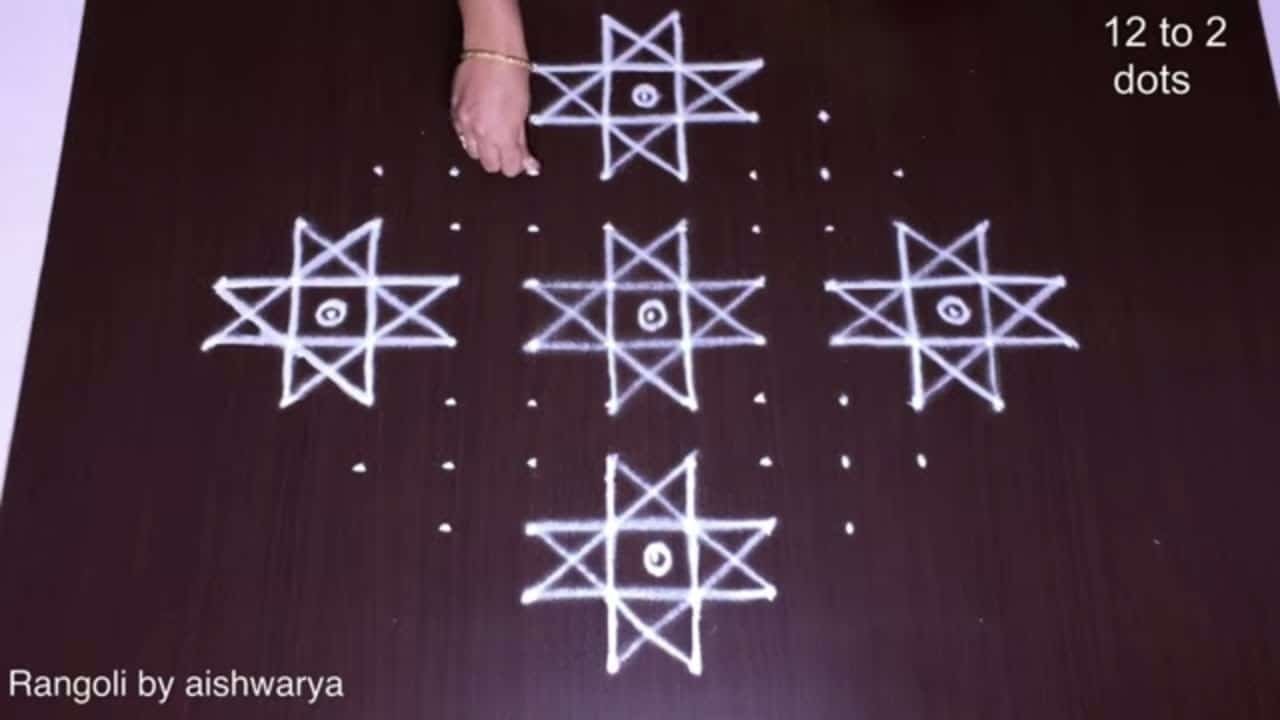
The internet did for rangoli what no earlier medium could: a design drawn in one courtyard can now be seen worldwide before it fades. Tutorials, time-lapse videos, digital archives, and diaspora practice from Singapore to Toronto have made the tradition globally visible while its daily foundation continues unchanged. Scholars now study it as intangible cultural heritage — preserved not by collecting objects but by sustaining knowledge, skills, and participation — and as computational geometry, with researchers analysing kolam families that practitioners generate by hand. Sustainability has returned the oldest materials to favour; the newest tools catalogue what the oldest habits create.
What the era establishes
Documentation preserved the images; practice preserved the art. The archive grows daily now — but the tradition’s greatest gallery remains the one it always had: millions of thresholds, redrawn every morning.
References
- Jyotsna Kilambi, “Toward an Understanding of the Muggu: Threshold Drawings in Hyderabad”, RES: Anthropology and Aesthetics 10, 1985.
- Gift Siromoney, Rani Siromoney & Kamala Krithivasan, “Array grammars and kolam”, Computer Graphics and Image Processing 3(1), 1974.
- Vijaya Nagarajan, Feeding a Thousand Souls: Women, Ritual, and Ecology in India — An Exploration of the Kōlam, Oxford University Press, 2018.
- John Layard, “Labyrinth Ritual in South India: Threshold and Tattoo Designs”, Folklore 48(2), 1937.
Further Reading
- Kiwamu Yanagisawa & Shojiro Nagata, “Fundamental Study on Design System of Kolam Pattern”, Forma 22, 2007.
This entry publishes at Evidence Level E2: its claims rest on at least two independently verified sources.
Cite this entry: “From Documentation to the Digital Age.” Rangoli Encyclopedia, Rangoli Designs, https://rangolidesigns.net/encyclopedia/documentation-to-digital/ — a permanent URL under the encyclopedia’s stable-identity policy. Entry last reviewed 2026-07-28.