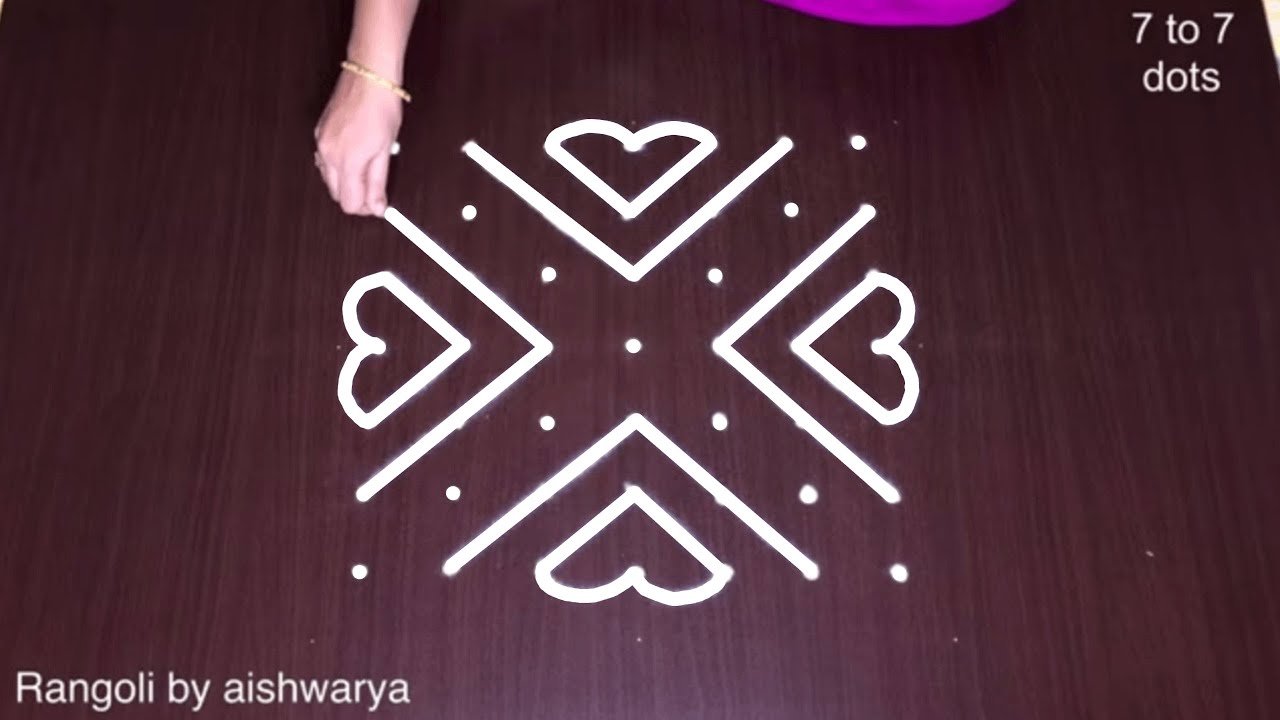
Before any line is drawn, the southern traditions lay dots — and in that quiet preliminary act sits a genuinely mathematical object. A counted, evenly spaced array of points is what mathematics calls a lattice, and the pulli grid is a lattice built by hand: the coordinate system of an art that never wrote a coordinate.
The grid as coordinate system
Modern geometry locates points by numbered pairs; the practice locates them by relationship — this dot beside that one, this curve passing between these two. No numbers are assigned, yet every position is exact, because each dot’s place is fixed by its neighbours. The function is the same as graph paper’s: a reliable frame that makes construction repeatable and error visible. The grid is why a design can be transmitted precisely across generations without a single written measure — the count carries the geometry.
The lattice families
Four arrangements do most of the work. The square lattice — rows and columns at right angles, four neighbours per interior dot — favours reflection and fourfold rotation: the natural home of rectangular borders and square motifs. The triangular lattice, whose neighbouring dots form equilateral triangles, gives each point six neighbours and opens threefold and sixfold symmetry — stars and hexagonal blooms. The hexagonal relationship, nature’s packing of honeycombs, emerges within it. And the staggered lattice — alternate rows offset into the gaps — is the great enabler of flowing work: its diagonals run naturally, which is why the interlaced families favour it. The lattice chosen quietly decides which symmetries the finished design can have before the first curve exists.
Precision without instruments
What makes the practice remarkable to formal eyes is that all of this precision is manual. Spacing is judged by eye and finger-gauge; circles divide into equal sectors without a protractor; symmetry holds across a courtyard without a ruler ever touching the ground. The accuracy is trained, not measured — years of repetition teach the hand what equal looks like — and the research literature treats these grids as exactly what they behave as: coordinate systems and lattice structures, arrived at through practice rather than notation.
Thinking in space
Behind the grid stands a cognitive achievement the tradition rarely names. Practitioners hold whole designs in the mind before drawing — the centre, the axes, the repeating units — and navigate the lattice from memory, judging distance, orientation, and proportion continuously as the work develops. Experienced artists read the grid in chunks, the way fluent readers see words rather than letters: a loop, a petal-module, a border unit recognised whole. This spatial fluency is the practice’s real instrument, and it is what the formal descriptions — coordinates, lattices, adjacency — are descriptions of.
One framework, endless designs
A fixed grid sounds restrictive; it is the opposite. From one counted lattice, different artists produce entirely different designs — looping, angular, floral, minimal — because the framework settles only position, never choice. The same property makes the grid the gateway to everything the later essays in this chapter describe: the graph theory of the one-line families, the algorithms of construction, and the tiling mathematics of repeats all operate on the lattice the morning’s dots lay down. In the largest sense the pulli grid is the practice’s founding theorem: order first, and freedom follows from it. The chessboard is the right comparison: the board never changes, and no two games are alike. Ten artists beginning from one identical lattice will finish with ten different designs — the framework fixes positions, the practitioner chooses relationships, and the same handful of dots yields looping, angular, floral, or austere results depending entirely on the choices made above it.
References
- Gift Siromoney, Rani Siromoney & Kamala Krithivasan, “Array grammars and kolam”, Computer Graphics and Image Processing 3(1), 1974.
- Marcia Ascher, “The Kolam Tradition”, American Scientist 90(1), 2002.
Further Reading
- Vijaya Nagarajan, Feeding a Thousand Souls: Women, Ritual, and Ecology in India — An Exploration of the Kōlam, Oxford University Press, 2018.
This entry publishes at Evidence Level E2: its claims rest on at least two independently verified sources.
Cite this entry: “Grids, Lattices, and Thinking in Space.” Rangoli Encyclopedia, Rangoli Designs, https://rangolidesigns.net/encyclopedia/grids-and-lattices/ — a permanent URL under the encyclopedia’s stable-identity policy. Entry last reviewed 2026-07-28.