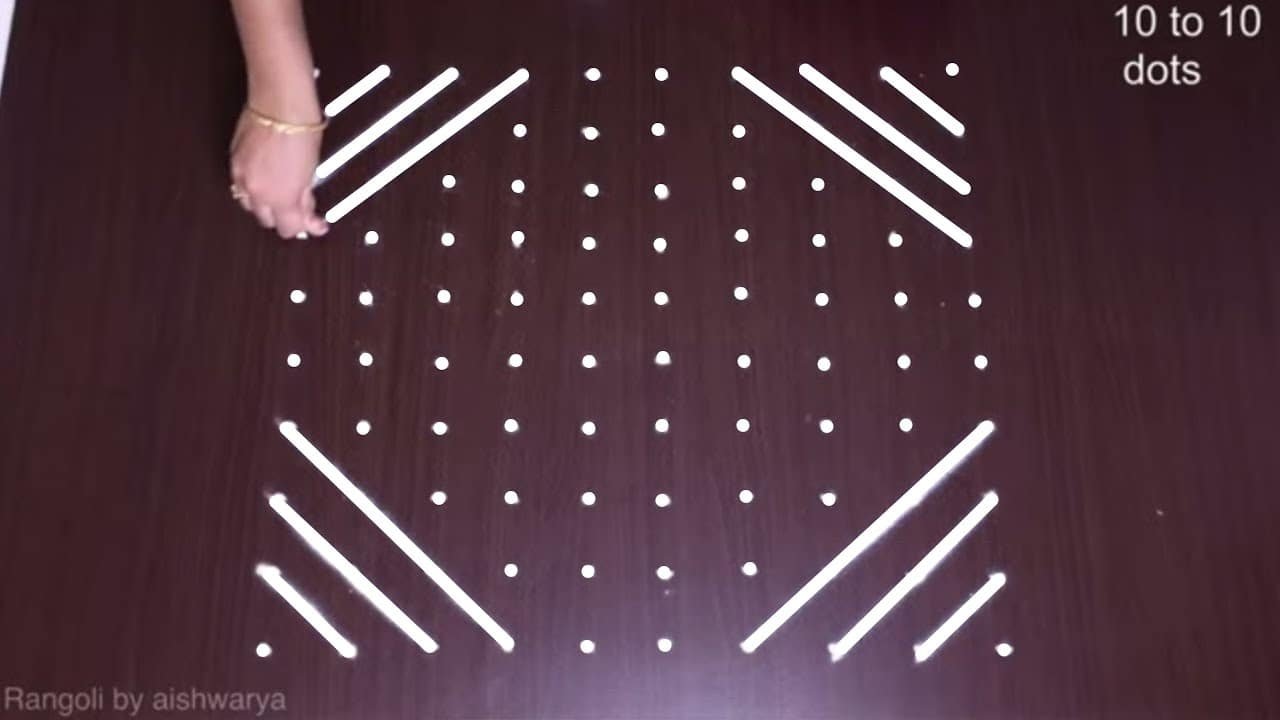
Ask a practitioner how many designs they know and the honest answer is not a number — because the repertoire is not a list. It is a small set of rules whose applications never run out: curve around every dot, keep the line unbroken, preserve the symmetry, repeat the unit, hold the spacing. Five instructions, endless designs. Mathematics has a name for this kind of thing: an algorithm.
The algorithm at the threshold
An algorithm is a finite sequence of steps that accomplishes a task, and every practised kolam follows one: lay the grid, fix the centre, establish the symmetry, begin the principal curve, extend the pathways, close the loops, finish the border. The order matters — change it and the design changes — and the process even branches the way programs do: if a neighbouring dot remains, curve around it; if the symmetry has drifted, correct the matching side. None of this is spoken as logic at the threshold; it is simply how the hands have learned to proceed. But the structure is unmistakable, and the research literature has treated kolam construction as rule-based procedure since the array-grammar work of the 1970s formalised pattern families as grammars — rules that generate designs, including designs no one has drawn yet.
Recursion: the rule applied to its own result
The most powerful rule in the set is the one that feeds on its own output. Recursion applies an operation to the result of the same operation: a flower ringed by flowers, each ringed again; a border whose units contain smaller versions of the whole; loops nested in loops. Each stage inherits the structure of the last, so growth never loses order — the large design stays coherent because it is the small design, repeated at scale. This is how modest daily motifs and courtyard masterpieces can be the same knowledge at different magnifications, and it is the same mechanism computer science uses to build complexity from compact code.
Fractal-like, honestly stated
Twentieth-century mathematics named the extreme of this idea: fractals, forms whose structure recurs at every scale of magnification, coined by Mandelbrot for the geometry of coastlines, ferns, and branching things. Threshold designs are not fractals in the strict sense — their recursion stops after a few levels, and their self-similarity is approximate — and this encyclopedia says so plainly. What they genuinely share with fractal geometry is the generative principle: repetition across scales, with variation, producing richness that rewards both the distant glance and the close look. The resemblance to natural growth is no accident; the practice learned its patterns watching the same ferns and branches the mathematicians later measured.
Emergence: the whole from the steps
A last idea completes the picture. In a large design no single curve matters much; hundreds of small, locally sensible decisions accumulate into a global order none of them contains alone. Mathematics calls that emergence, and its favourite examples — flocks, colonies, traffic — arise without any designer at all. The kolam is emergence with a designer: the artist supplies the rules and the patience, and the complexity assembles itself from their repetition. Finite rules, infinite possibility — the oldest lesson in the practice, and one of the newest in mathematics. The pedagogy follows the mathematics: learners master one operation at a time — a single loop, one enclosure done correctly — then combine operations into compounds, exactly the progression by which programming is taught. The tradition discovered algorithmic instruction the same way it discovered the algorithms: by finding what transmits.
References
- Gift Siromoney, Rani Siromoney & Kamala Krithivasan, “Array grammars and kolam”, Computer Graphics and Image Processing 3(1), 1974.
- Kiwamu Yanagisawa & Shojiro Nagata, “Fundamental Study on Design System of Kolam Pattern”, Forma 22, 2007.
Further Reading
- Marcia Ascher, “The Kolam Tradition”, American Scientist 90(1), 2002.
This entry publishes at Evidence Level E2: its claims rest on at least two independently verified sources.
Cite this entry: “Simple Rules, Infinite Patterns.” Rangoli Encyclopedia, Rangoli Designs, https://rangolidesigns.net/encyclopedia/simple-rules-infinite-patterns/ — a permanent URL under the encyclopedia’s stable-identity policy. Entry last reviewed 2026-07-28.