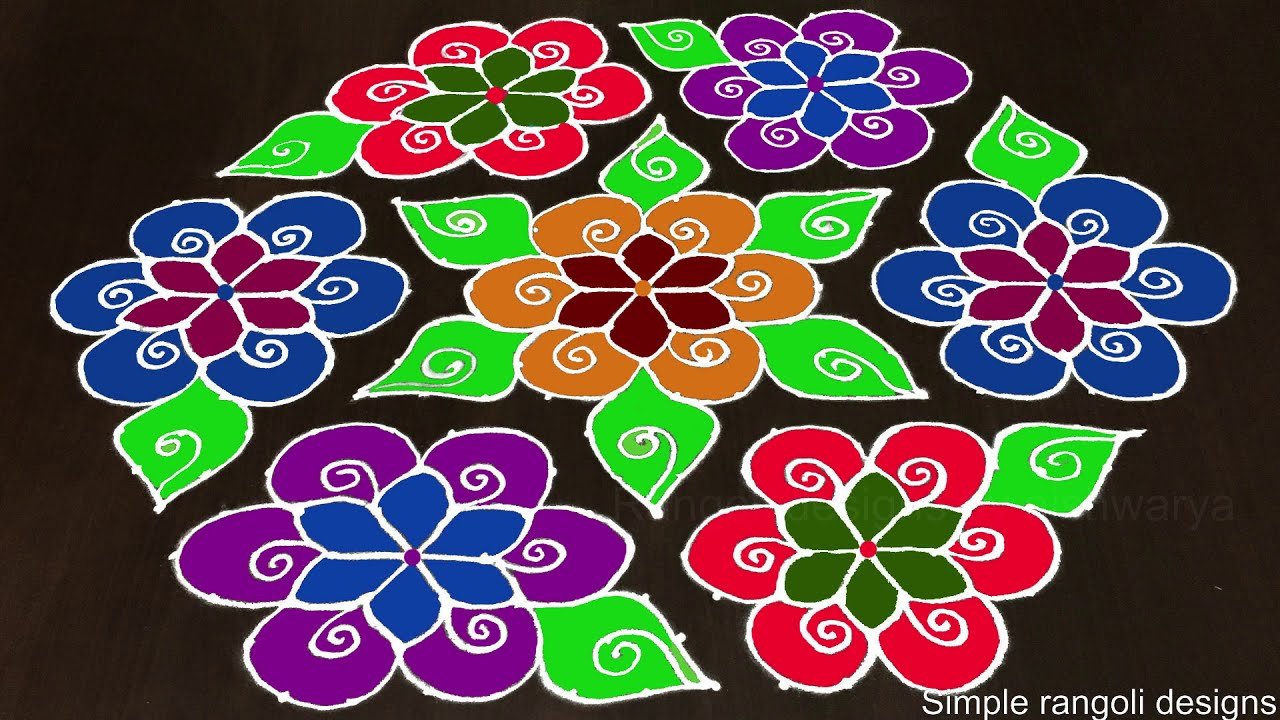
To much of the world, rangoli means Diwali — lamplit designs photographed once a year. The image is true and radically incomplete. The tradition’s real home is the ordinary day: the doorstep at dawn, the courtyard before a ceremony, the shared spaces where household life happens.
The day begins at the threshold
In regions where the daily practice continues, the sequence runs ahead of sunrise: the entrance swept, water sprinkled to settle the dust, and a fresh design drawn before the household’s day begins. The routine is practical and more than practical — the prepared threshold marks the boundary between home and world as cared-for, and communicates welcome before a word is spoken. Its absence, in the Tamil practice Nagarajan documents, traditionally signals a house in mourning: the drawing is legible precisely because it is expected.
A calendar drawn on the ground
The practice keeps time. Ordinary mornings take modest white designs; Fridays and goddess-days raise the care; the great festivals — Pongal, Sankranti, Diwali — bring colour, scale, and neighbourly competition. Beyond the festival calendar, the art accompanies the family’s own milestones: weddings, housewarmings, naming ceremonies, harvest thanksgivings — occasions where the decorated ground becomes part of the event itself rather than its backdrop.
Made together, learned together
Large designs are rarely one person’s work. Festival compositions divide naturally — outlines, borders, colour-filling, finishing — and the finished piece belongs to the group that made it. Transmission works the same way: a child watches a grandmother’s border, is invited to fill a colour, later places dots alone, and eventually carries the family repertoire. Each generation is learner and teacher at once, and the skills that pass — steadiness, proportion, patience — outlast any single design.
Village ground, city pavement
The practice adapts to its surfaces. Packed earth and stone courtyards take rice flour differently from urban concrete and tile; city practice leans on coloured powders, flower petals, and competition formats, while agricultural communities draw their seasons — crops, birds, harvest imagery — directly into the designs. School and civic competitions have added a public, intergenerational stage. Under all the variation, the constants hold: the threshold, the hand, the welcome.
References
- Vijaya Nagarajan, Feeding a Thousand Souls: Women, Ritual, and Ecology in India — An Exploration of the Kōlam, Oxford University Press, 2018.
- Jyotsna Kilambi, “Toward an Understanding of the Muggu: Threshold Drawings in Hyderabad”, RES: Anthropology and Aesthetics 10, 1985.
Further Reading
- Marcia Ascher, “The Kolam Tradition”, American Scientist 90(1), 2002.
This entry publishes at Evidence Level E2: its claims rest on at least two independently verified sources.
Cite this entry: “Rangoli in Everyday Life.” Rangoli Encyclopedia, Rangoli Designs, https://rangolidesigns.net/encyclopedia/rangoli-in-everyday-life/ — a permanent URL under the encyclopedia’s stable-identity policy. Entry last reviewed 2026-07-28.