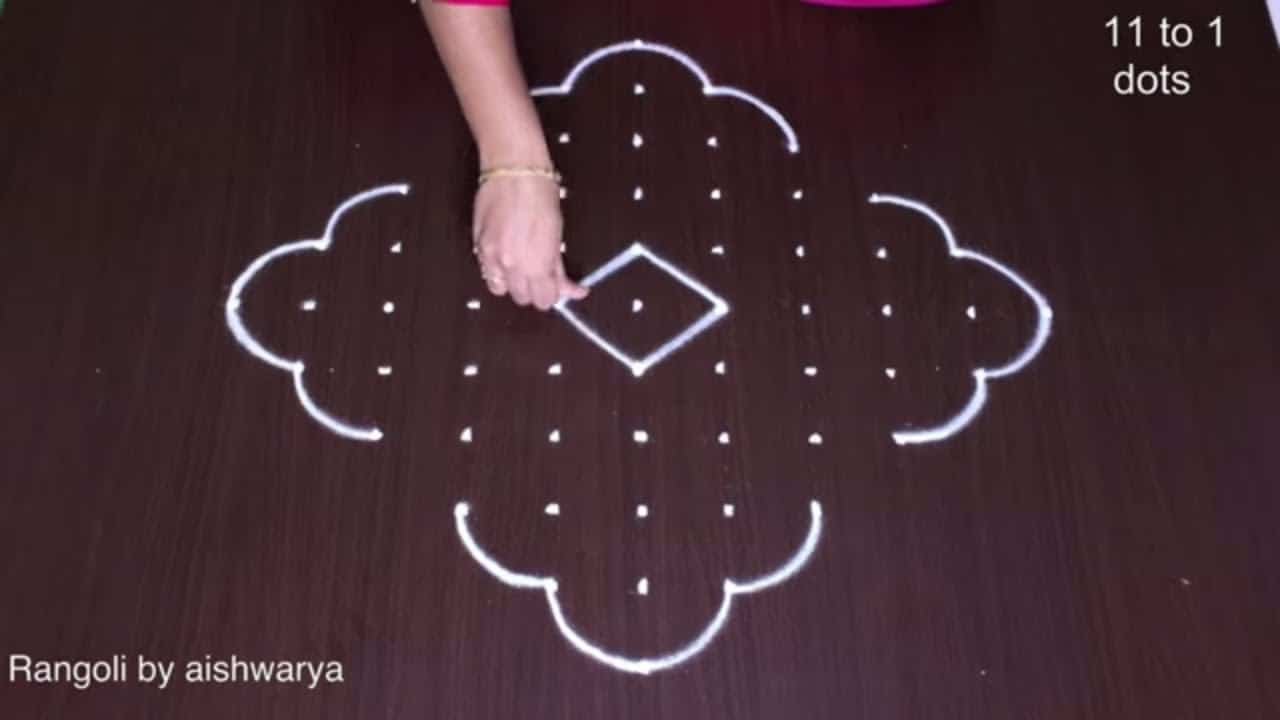
Definition
The gopuram is the temple tower drawn in flour: the stepped, tapering gateway of southern temple architecture rendered as a symmetrical pyramid of tiers, the repertoire’s most architectural standing figure.
History
The motif borrows the skyline of the southern temple town — the towering gateway that marks sacred ground — and the drawing repertoires deploy it on temple festival days and worship occasions, when the household threshold borrows the temple’s own sign; the ethnography treats it within that festival repertoire.
Description
The drawn gopuram is a broad base narrowing through three, five, or seven stepped tiers to a finial, each tier articulated with small arcs or dots for its sculptured niches. Grid versions build the steps from descending dot rows; the figure’s strict bilateral symmetry makes it, like the butterfly, a mirroring exercise — at monumental scale.
Cultural Context
Drawing the gateway is commonly read as drawing the threshold’s own archetype — the door before the god, set before the door of the house. On temple festival days the motif aligns the household with the procession outside; these readings are attributed and occasion-bound.
Regional Variations
The gopuram is a southern motif above all, strongest where the towers themselves stand — Tamil Nadu foremost — with Telugu practice drawing it in the same festival spirit; northern styles use temple-arch forms of their own architecture instead.
Related Topics
Its processional companion is the Chariot; its lamp-crowned festival nights include Karthigai Deepam; stepped construction on descending rows is dot-grid work — see Dot Grid.
Gallery
References
- Vijaya Nagarajan, Feeding a Thousand Souls: Women, Ritual, and Ecology in India — An Exploration of the Kōlam, Oxford University Press, 2018.
Further Reading
- Jyotsna Kilambi, “Toward an Understanding of the Muggu: Threshold Drawings in Hyderabad”, RES: Anthropology and Aesthetics 10, 1985.
This entry publishes at Evidence Level E1: common knowledge within the tradition, anchored to a verified standard reference.
Cite this entry: “Gopuram.” Rangoli Encyclopedia, Rangoli Designs, https://rangolidesigns.net/encyclopedia/gopuram/ — a permanent URL under the encyclopedia’s stable-identity policy. Entry last reviewed 2026-07-28.