Ask what a rangoli is made of and the answers come easily: lines, dots, colours, motifs. The complete answer includes something else — the ground deliberately left bare. Every accomplished design is composed as much from its open spaces as from its marks, and the tradition’s handling of emptiness is one of its quietest and deepest skills.
Absence with a job
The unmarked areas of a design are not leftovers; they are working parts. Open ground defines the shapes beside it, separates motifs that would otherwise merge, makes symmetry legible, and gives the eye places to rest. Design practice calls these areas negative space — an active component of the composition, never leftover background. Fill every gap and a composition does not become richer — it becomes noise. The practice knows this from experience: beginners tend to add, and accomplished artists are recognisable by what they decline to draw. Knowing when to stop is treated, within the tradition, as a mark of mastery rather than a shortcut.
Shunya
Indian thought has a name for meaningful emptiness: shunya — void, openness, zero. The word runs through Indian philosophy, where emptiness is a serious metaphysical topic; through mathematics, where the concept of zero — a nothing that changes everything around it — became one of India’s most consequential intellectual exports; and through the arts, where unfilled space is understood as an active element of composition. These are distinct traditions of thought, not one doctrine, and the philosophical literature on shunya is specialist territory this encyclopedia will cite only when verified sources pass its gate. What can be said plainly is the shared insight: absence can carry significance, and what is not present still shapes the whole.
The dot and the gap
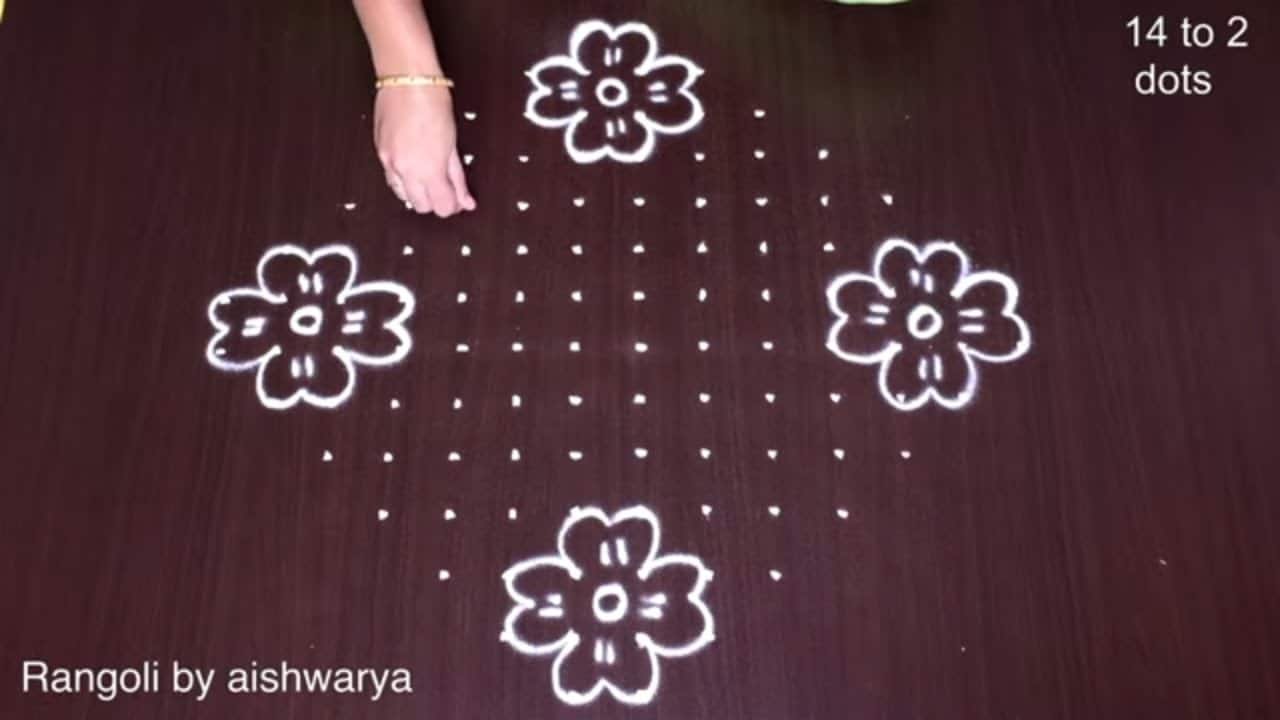
In the southern grid traditions the role of space is structural, not just aesthetic. A kolam or muggu begins with counted dots whose spacing sets the entire design’s proportions; the drawn line then loops around the dots without touching them, and the untouched ground between the line’s passes is precisely what keeps an interlaced design readable. The research literature on kolam geometry describes designs whose beauty lies in this disciplined alternation of mark and gap — the grid is as much a system of spacing as a system of points.
A shared principle
Rangoli keeps company here with the other arts. Music depends on rests, poetry on the line break, architecture on the courtyard, the manuscript page on its margins. In each, what is withheld gives structure to what is offered. The threshold arts belong to this family: their compositions breathe because the artist has composed the silence along with the sound.
Restraint as skill
The tradition’s plainest demonstration of the principle is the white-only design. Many of the most admired kolams use no colour at all — line, proportion, and open ground doing all the work — and their refinement is not a lesser register of the art but one of its summits. A practice that renews itself every morning learned long ago that elegance is a relationship between presence and absence. The empty space is the partner that never signs the work.
References
- Marcia Ascher, “The Kolam Tradition”, American Scientist 90(1), 2002.
- Vijaya Nagarajan, Feeding a Thousand Souls: Women, Ritual, and Ecology in India — An Exploration of the Kōlam, Oxford University Press, 2018.
Further Reading
- Kiwamu Yanagisawa & Shojiro Nagata, “Fundamental Study on Design System of Kolam Pattern”, Forma 22, 2007.
This entry publishes at Evidence Level E2: its claims rest on at least two independently verified sources.
Cite this entry: “The Empty Space: What Is Not Drawn.” Rangoli Encyclopedia, Rangoli Designs, https://rangolidesigns.net/encyclopedia/empty-space/ — a permanent URL under the encyclopedia’s stable-identity policy. Entry last reviewed 2026-07-28.