
Definition
Sankranti — Makara Sankranti, the sun’s mid-January transition — is the harvest festival of the Telugu lands and the peak of the muggulu year: the month before it, Dhanurmasam, is drawn morning by morning toward the festival’s largest compositions.
History
Kilambi’s study of Hyderabad threshold drawing documents the Sankranti season as the practice’s annual high point, and the month-long escalation of designs is a fixture of Telugu household practice recorded throughout the regional ethnography.
Description
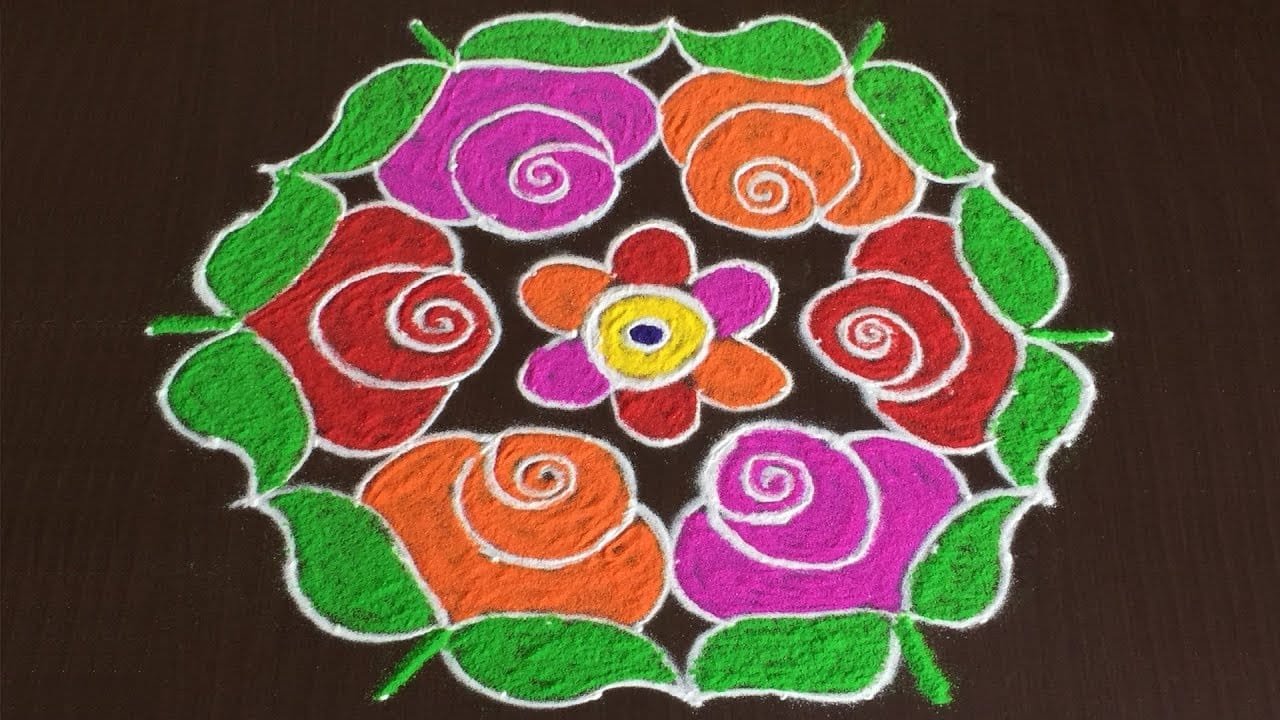
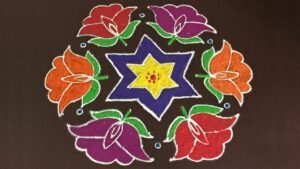
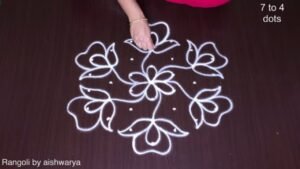
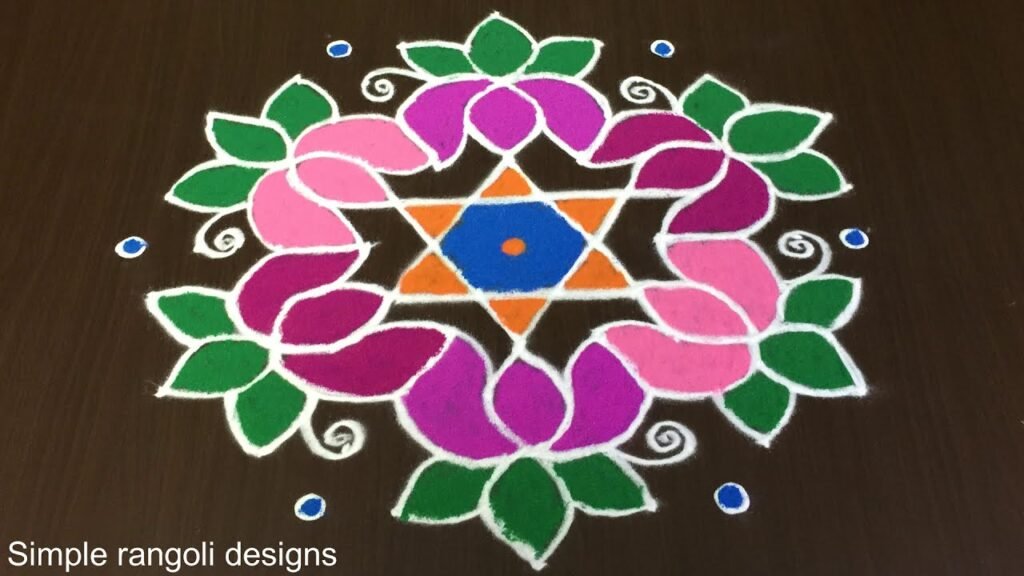
Through Dhanurmasam the daily white muggu grows daily in size and ambition; by Sankranti the designs are large, colour-filled, and often ornamented with gobbemmalu — balls of cow dung set with flowers and turmeric — placed at the composition’s centre. Chariot (ratham) designs mark the festival sequence’s final days in many households. The festival runs across several days, and the days set the subjects: Bhogi opens it as the day of renewal, when the entrance is cleaned and the season’s first festival muggu is drawn; Makara Sankranti proper carries the largest and most elaborate design; Kanuma honours cattle and the farm, its muggulu taking up bulls, cows, and harvest imagery accordingly; and where Mukkanuma follows, it belongs to community gathering and the competitions. This platform’s design library indexes the Bhogi designs as a family of their own.
Cultural Context
The escalating month is commonly understood as invitation — prosperity welcomed stepwise to a threshold made daily more splendid — and the neighbourly competition it produces is part of the festival’s texture, documented plainly in the ethnography. These are attributed meanings, variously held.
Regional Variations
Sankranti is the Telugu counterpart of the same solar festival kept in Tamil practice as Pongal; the drawing traditions differ in vocabulary — muggulu rather than kolam — while sharing the counted dot grid.
Related Topics
The drawing tradition is Muggulu; the scaffold is the Dot Grid; the parallel Tamil festival is Pongal.
Gallery
References
- Jyotsna Kilambi, “Toward an Understanding of the Muggu: Threshold Drawings in Hyderabad”, RES: Anthropology and Aesthetics 10, 1985.
- Vijaya Nagarajan, Feeding a Thousand Souls: Women, Ritual, and Ecology in India — An Exploration of the Kōlam, Oxford University Press, 2018.
Further Reading
- Marcia Ascher, Mathematics Elsewhere: An Exploration of Ideas Across Cultures, Princeton University Press, 2002.
This entry publishes at Evidence Level E2: its claims rest on at least two independently verified sources.
Cite this entry: “Sankranti.” Rangoli Encyclopedia, Rangoli Designs, https://rangolidesigns.net/encyclopedia/sankranti/ — a permanent URL under the encyclopedia’s stable-identity policy. Entry last reviewed 2026-07-30.