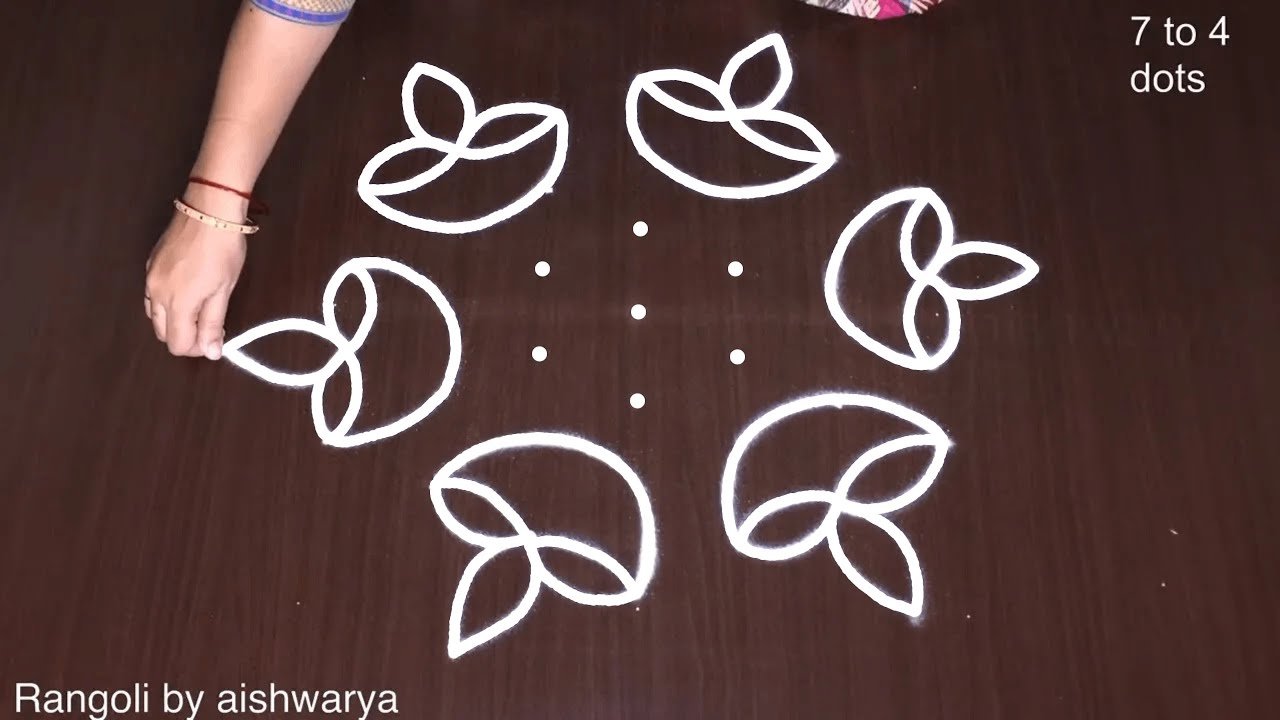
Collect repeating patterns from every tradition on earth — mosaics, textiles, lattice screens, threshold borders — and mathematics makes a claim that sounds impossible: beneath all of it lie exactly seventeen fundamentally different symmetry systems. Not sixteen, not eighteen. Every flat pattern that repeats belongs to one of the seventeen wallpaper groups, and the proof of that count is one of geometry’s landmark results.
Tiling first: covering without gaps
The story starts with tessellation — covering a surface completely, no gaps, no overlaps. Among regular polygons, only three can do it alone: triangles (six around each corner), squares (four), and hexagons (three). The pentagon famously fails — its angles cannot close around a point — and that failure teaches the chapter’s recurring lesson: geometry constrains design before taste ever enters. Mixing shapes opens the semi-regular tilings, and nature votes with the bees: the hexagonal honeycomb is provably the most efficient equal-area division of the plane — a result finally proved in 1999, millennia after the bees settled it. Threshold practice lives mostly in finite compositions, but its borders, repeated grounds, and courtyard fields are tessellation thinking at work: one unit, a rule of placement, a surface filled.
The seventeen
Wallpaper groups classify what happens when repetition is analysed completely. Take the four symmetries this chapter began with — translation, reflection, rotation, glide reflection — and ask how they can consistently combine across an endlessly repeating plane. The answer is exactly seventeen distinct combinations. Translation is mandatory (nothing repeats without it); rotations can only be of order two, three, four, or six — five-fold rotation cannot coexist with periodic repetition, which is why no repeating border on earth turns on a pentagon; mirrors and glides may be present or absent in specific arrangements. Every possibility is one of the seventeen, and two patterns that look nothing alike may share a group, while near-twins may not. Appearance is culture; symmetry structure is mathematics.
The algebra underneath
Why exactly seventeen? Because symmetry operations form an algebra. Combine two valid symmetries of a pattern and the result is another valid symmetry; every operation can be undone; doing nothing counts as an operation. A system with those properties is what mathematics calls a group, and group theory — the general study of such systems — is what turns the classification into a proof: enumerate the possible groups and the possibilities end at seventeen. The same algebra classifies crystals, whose atomic lattices repeat in three dimensions the way borders repeat in two — the reason crystallography and ornament share their mathematics, and the reason a drawn lattice at a threshold has a real, if distant, kinship with the structure of a mineral.
The traditions in the catalogue
The comparative literature on cultural pattern applies this classification directly: border and field designs from the world’s decorative arts, analysed by their symmetry groups and compared across cultures. India’s threshold traditions supply rich entries — mirrored doorway pairs, glide-reflected chains, four- and six-fold fields, translated running borders — spanning a wide sweep of the catalogue. The point of such analysis is never to reduce the art to a taxonomy; it is the opposite: to show that within seventeen rigid mathematical frames, human traditions have produced unbounded variety. The constraint is universal. The voices are not.
What the count teaches
Seventeen is a strange and wonderful number to find at the bottom of the world’s ornament. It says that repetition — the most open-ended of artistic instincts — answers to laws as strict as arithmetic, and that every culture that ever repeated a motif was exploring the same finite mathematical territory, each in its own dialect. A practitioner laying a glide-reflected border at dawn is working inside one of the seventeen, whether or not anyone ever says so. The mathematics was always there; the art is what it looks like when it is loved.
References
- Marcia Ascher, Mathematics Elsewhere: An Exploration of Ideas Across Cultures, Princeton University Press, 2002.
- Marcia Ascher, “The Kolam Tradition”, American Scientist 90(1), 2002.
Further Reading
- Gift Siromoney, Rani Siromoney & Kamala Krithivasan, “Array grammars and kolam”, Computer Graphics and Image Processing 3(1), 1974.
This entry publishes at Evidence Level E2: its claims rest on at least two independently verified sources.
Cite this entry: “Seventeen Ways to Repeat.” Rangoli Encyclopedia, Rangoli Designs, https://rangolidesigns.net/encyclopedia/seventeen-ways-to-repeat/ — a permanent URL under the encyclopedia’s stable-identity policy. Entry last reviewed 2026-07-28.