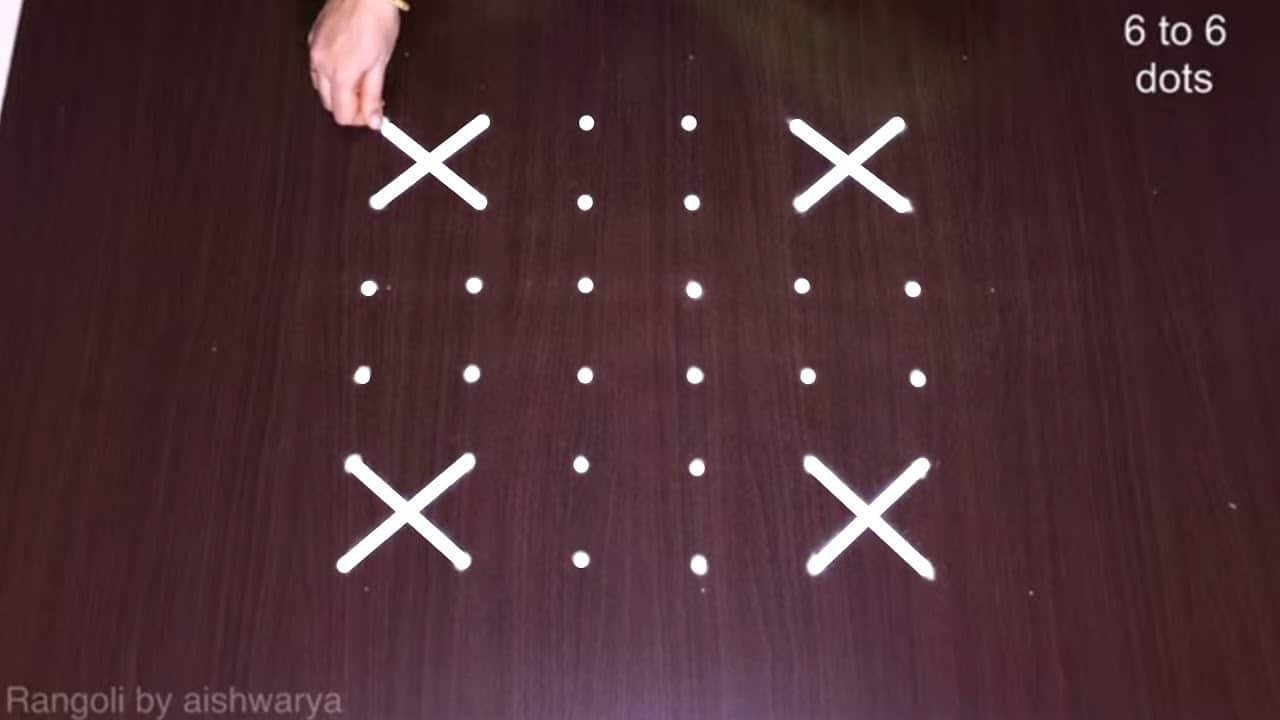
For an art this old, the tradition has produced remarkably little writing about itself. No manuals, no academies, no diagrams passed down in books — and yet thousands of designs and the skill to draw them have crossed generations intact. The transmission system is the practice itself: the classroom is the courtyard, the textbook is the finished design, and the lesson is an experienced hand moving while a learner watches. This essay describes that system.
Watching before drawing
Learning begins as observation. Before a child ever holds powder, they have watched it held — how the pinch sits between thumb and forefinger, how a curve begins and commits, how a mistake is absorbed without fuss. Watching carries what words cannot: timing, posture, the rhythm of release, the calm. No lecture accompanies the morning kolam; the demonstration is the instruction, and by the time a learner first crouches to try, much of the knowledge is already lodged in the eye waiting for the hand to catch up.
The ladder
Traditional instruction follows a progression whose shape repeats everywhere even though its first rungs do not: simple before complex, the elaborate ceremonial work last. In the dot-grid traditions the ladder opens with the grid itself — dots first, then straight lines, then curves, then small patterns, then larger compositions. Each rung earns the next, and teachers do not skip stages — a learner frustrated into attempting festival designs in their first season is being set up to fail, which is why the classic remedy for discouragement is a step back down the ladder, not a harder climb. Where the entry point differs, it differs with the tradition: Tamil learners begin on pulli grids and work toward sikku looping; Telugu learners move from chukkala grids to the freehand geethala register and on to festival scale; Maharashtra’s freehand practice starts instead with strokes, floral forms and borders, and introduces colour earlier than the southern grid traditions; and Kerala’s pookalam learning begins with no drawn line at all, but with petal arrangement, colour harmony and circular composition. The content of those rungs — the four foundational exercises and what each trains — is described in Learning the Line; what matters here is the ladder itself, the tradition’s insistence that complexity is grown, not attempted.
Repetition until the hand knows
No explanation replaces repetition, because the knowledge being transmitted is not propositional — it is coordination. A movement practised across seasons stops requiring thought: the hand learns turning angles, release rates, and spacing the way the tongue learns a language, and what once demanded full attention becomes fluent background. Practitioners describe this as the hands knowing, and it is the real credential of the craft — visible in the difference between a drawn line and a deliberated one.
Correction as curriculum
Errors are teaching material, not failures. A teacher uses a wandering curve to talk about spacing; a learner gradually acquires the more valuable skill of noticing their own deviations while drawing and adjusting before small problems compound. And instruction outlives the instructor: completed designs teach proportion to anyone who studies them, mistakes teach judgement, daily practice teaches patience. The tradition’s teachers are not only people — which is part of why learning in it never ends.
Slow first, fast later
Beginners are told to draw slowly, and the instruction is not caution but method: slow drawing is what makes observation possible — of spacing, flow, and symmetry — while speed hides everything. The fluency of practised artists is routinely misread as hurry. It is the opposite: experience removes hesitation, not care, and the expert is fast because nothing is wasted, every gesture already decided by ten thousand earlier ones. Forcing speed early delays it; patience is the shortest route.
Imitation, then a voice
Every practitioner begins by copying, and the tradition sees no shame in it — imitation is the foundation, not the ceiling. Style arrives on its own: with mastery, each hand’s line acquires a character as recognisable as handwriting, and practised observers can name the maker of a design from the quality of its curves alone. The individuality grows out of the inherited technique, never against it. And then the chain continues — the learner becomes the demonstrating hand, parents teach children, every generation is student and teacher at once. That unbroken relay, running on nothing but attention and practice, is how an art with no textbooks became one of the most durably transmitted in the world.
References
- Vijaya Nagarajan, Feeding a Thousand Souls: Women, Ritual, and Ecology in India — An Exploration of the Kōlam, Oxford University Press, 2018.
- Marcia Ascher, “The Kolam Tradition”, American Scientist 90(1), 2002.
Further Reading
- Jyotsna Kilambi, “Toward an Understanding of the Muggu: Threshold Drawings in Hyderabad”, RES: Anthropology and Aesthetics 10, 1985.
This entry publishes at Evidence Level E2: its claims rest on at least two independently verified sources.
Cite this entry: “How the Hand Learns.” Rangoli Encyclopedia, Rangoli Designs, https://rangolidesigns.net/encyclopedia/how-the-hand-learns/ — a permanent URL under the encyclopedia’s stable-identity policy. Entry last reviewed 2026-07-30.